

 Governance and Policy Management
ISO/IEC 27001:2022: The Blueprint for Information Security Management

ISO/IEC 27001 is one of the most widely adopted security standards in the world. Organizations of every size rely on it to build predictable security programs that protect confidential information, reduce operational risk, and support regulatory compliance. Its strength lies in the discipline it introduces. Instead of relying on scattered controls or informal practices, ISO/IEC 27001 provides a structured way to manage information security across people, processes, and technology.
Understanding ISO/IEC 27001
ISO/IEC 27001 is an international standard that specifies requirements for establishing, implementing, maintaining, and improving an Information Security Management System (ISMS). Published jointly by the International Organization for Standardization and the International Electrotechnical Commission, this standard applies to organizations regardless of size, industry, or location.
The standard takes a risk-based approach to security. Instead of mandating specific technologies or controls, it requires organizations to identify their unique risks and implement appropriate safeguards. This flexibility makes ISO/IEC 27001 relevant to a startup handling customer data or a multinational corporation managing complex IT infrastructure.
Core Principles
ISO/IEC 27001 is built on three fundamental security principles:
Confidentiality restricts information access to authorized parties only. Organizations must prevent unauthorized disclosure through technical controls, physical security measures, and clear policies governing data handling.
Integrity ensures information remains accurate and unaltered except through authorized changes. Organizations need mechanisms to detect tampering and maintain data reliability throughout its lifecycle.
Availability guarantees that authorized users can access systems and information when needed. This requires redundancy planning, backup strategies, and business continuity measures to maintain operations during disruptions.
What is an Information Security Management System?
An ISMS is your organization’s systematic approach to managing information security. It encompasses the policies, procedures, controls, and resources you dedicate to protecting sensitive data. Think of it as the engine that drives your security program forward.
The ISMS operates on a Plan-Do-Check-Act cycle:
- Plan: Define your scope, assess risks, and establish security objectives
- Do: Implement the controls and processes you’ve identified
- Check: Monitor performance through audits, metrics, and reviews
- Act: Correct issues and improve your security posture based on findings
This continuous cycle ensures your security measures evolve alongside changing threats and business conditions.
Risk Assessment: The Foundation
Risk assessment drives everything in ISO/IEC 27001. You must systematically identify your information assets, evaluate threats and vulnerabilities, and determine the potential impact of security incidents.
The process involves cataloging what you’re protecting – customer databases, intellectual property, financial records, employee information. Then you assess what could go wrong: unauthorized access, data corruption, system failures, insider threats.
After identifying risks, you evaluate their likelihood and potential impact. This helps prioritize where to invest your security resources. A high-probability, high-impact risk demands immediate attention, while low-likelihood, low-impact scenarios might be acceptable to tolerate.
Risk Treatment Strategies
Once you understand your risks, ISO/IEC 27001 requires you to treat them through one of four approaches:
Mitigate the risk by implementing security controls that reduce likelihood or impact. This is the most common approach – adding firewalls, encrypting data, training employees.
Transfer the risk to another party through insurance policies or contractual agreements. Cyber insurance is a popular transfer mechanism for financial risk.
Accept the risk after determining that the cost of controls exceeds the potential impact. Leadership must formally acknowledge and document accepted risks.
Avoid the risk entirely by eliminating the activity or asset that creates exposure. Sometimes the best security decision is not to do something.
Annex A Controls
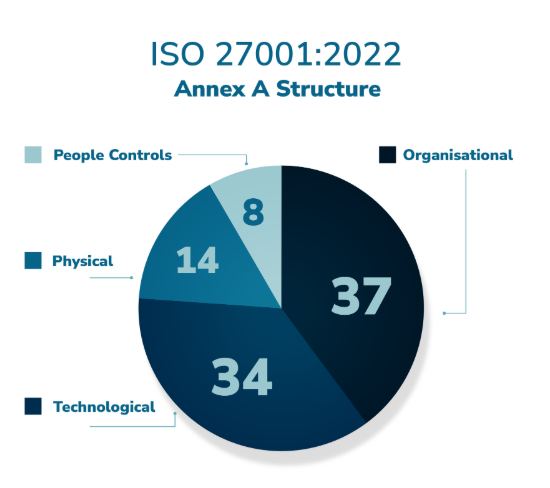
Annex A of ISO/IEC 27001 contains 93 security controls organized into four categories. These controls represent best practices for addressing common information security risks.
Organizational controls (37 controls) establish governance structures, policies, roles, incident response procedures, and business continuity planning. These create the management foundation for your security program.
People controls (8 controls) address human factors in security – employee screening, training programs, awareness initiatives, confidentiality agreements, and handling employment changes.
Physical controls (14 controls) protect your facilities and physical assets. These include perimeter security, access controls, equipment protection, secure disposal procedures, and environmental safeguards.
Technological controls (34 controls) form the technical backbone of your security program. Access management, encryption, network segmentation, malware protection, backup procedures, logging, monitoring, and secure development practices all fall here.
You don’t need to implement every control. The Statement of Applicability documents which controls you’ve chosen and justifies why any controls are excluded. Your risk assessment should drive these decisions.
The Certification Journey
Achieving ISO/IEC 27001 certification typically requires three to twelve months, depending on your organization’s size, current security maturity, and available resources.
Define your scope carefully. Identify which business units, locations, systems, and data types your ISMS will cover. A well-defined scope prevents ambiguity during audits and ensures critical assets receive protection.
Perform a gap analysis comparing your current practices against ISO/IEC 27001 requirements. This reveals what you need to build, improve, or document before pursuing certification.
Develop documentation that reflects actual operations. Required documents include information security policies, risk assessment methodology, risk treatment plans, the Statement of Applicability, and procedures for key processes like incident response and access control.
Implement your controls based on your risk treatment decisions. This phase involves deploying technology, updating procedures, assigning responsibilities, and training staff.
Run internal audits to verify that controls work as designed and comply with standard requirements. Internal audits identify problems before external auditors arrive.
Engage a certification body for a two-stage external audit. Stage one examines your documentation and ISMS design. Stage two evaluates implementation through staff interviews, evidence sampling, and control testing.
Organizations seeking expert guidance through this process can work with Complyan to accelerate implementation and ensure audit readiness.
Building Security Awareness
Beyond implementing technical controls and documenting procedures, successful organizations cultivate security awareness across all staff levels. This involves regular training, awareness campaigns, and channels for reporting security concerns without fear of consequences.
Effective security training connects to employees’ daily work. Phishing simulations, incident response exercises, and real-world breach case studies reinforce key concepts and prepare staff to respond appropriately when threats emerge.
Integration with Other Standards
ISO/IEC 27001 works smoothly alongside other management system standards. Combine it with ISO 9001 (quality management), ISO 14001 (environmental management), ISO 22301 (business continuity), or ISO 27701 (privacy management).
Integration creates efficiency through aligned processes, consolidated documentation, combined audits, and unified management reviews.
Conclusion
ISO/IEC 27001 provides a structured approach to managing information security risks. Success requires thorough risk assessment, practical documentation, and commitment to continuous improvement. At Complyan, we develop implementation strategies that protect organizational assets while positioning businesses for sustainable growth.