


 Governance and Policy Management
Cybersecurity Risk Management in 2026: Moving Beyond Heat Maps and Static Registers

Cybersecurity risk management in 2026 looks less like a technical checklist and more like a business discipline sitting next to financial planning and legal risk. Boards no longer ask whether a firewall is configured correctly. They ask how much a specific cyber risk could cost the business and what happens if it materializes next quarter. Complyan’s cyber risk management platform was built around exactly this shift, tracking risk through a centralized register rather than scattered spreadsheets and one-off assessments.
Why the Old Reporting Model Stopped Working
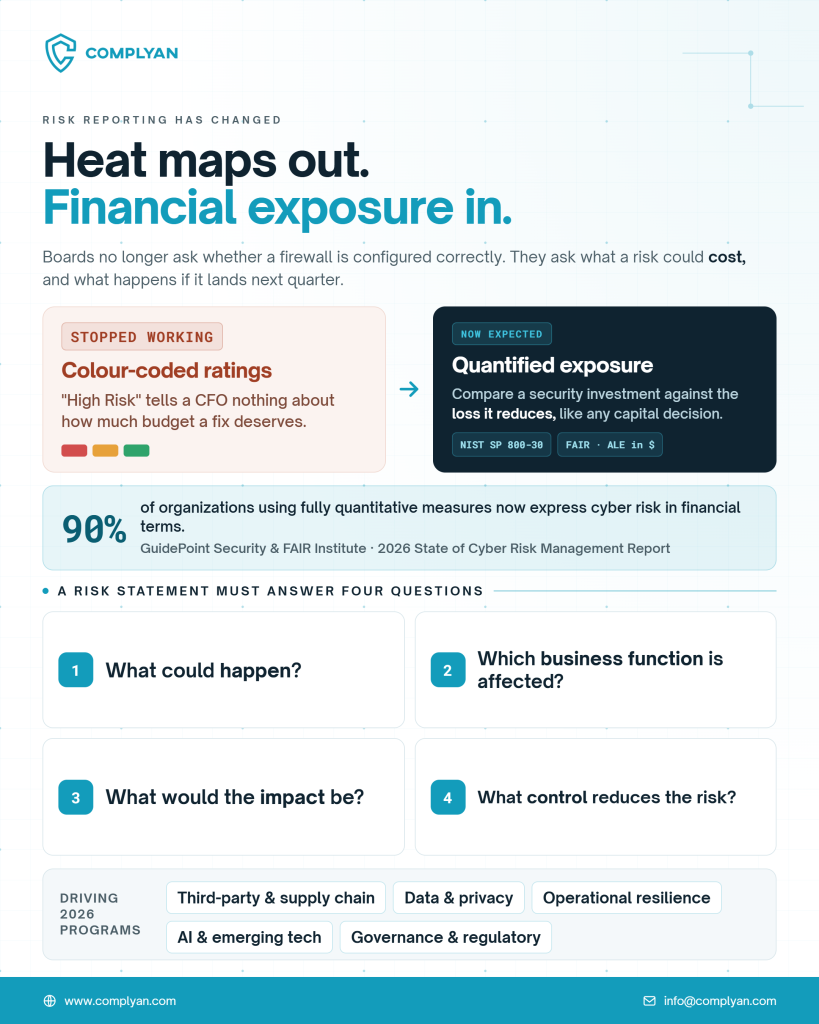
For years, security teams communicated risk through color-coded heat maps: red, amber, green. These charts look clear on a slide, but they rarely answer the question a board actually cares about. A label of “High Risk” tells a CFO nothing about how much budget a fix deserves, and “Medium Likelihood” gives a board no real basis for an informed risk acceptance decision.
This gap is pushing organizations toward financial risk quantification instead of subjective ratings. Two methodologies dominate this shift. NIST SP 800-30 offers a structured process: identify assets and threats, assess likelihood and impact, then prioritize and select a treatment path. FAIR, or Factor Analysis of Information Risk, goes further by estimating Annualized Loss Expectancy in actual dollar terms, letting a board compare a proposed security investment against the financial exposure it would reduce, the same way it evaluates any other capital decision.
Why "One Cloud Region" Is a Compliance Trap
A common and costly assumption is that a single Middle East cloud deployment can serve all three markets at once. In practice, Saudi customer data processed through UAE-based infrastructure, or the reverse, can trigger cross-border transfer obligations even within the same general region, since each country’s law looks at where data actually sits and moves, not just where a business is headquartered.
The safer architecture separates workloads by jurisdiction: Saudi customer data processed in Saudi-approved infrastructure, UAE data kept within UAE-compliant environments, and Bahrain-related data handled according to its own Adequacy List. This adds real operational complexity, but it avoids the audit exposure that comes from a shared database quietly moving regulated data across a border nobody tracked.
Move Away From Static Risk Registers
A risk register is useful only when it reflects the business as it operates today. In many organizations, the register is updated during audits, risk workshops, or quarterly reviews, then left untouched while systems, vendors, users, cloud services, and business priorities keep changing.
That model does not work in 2026.
Security teams should treat the risk register as a live decision tool. Each risk should have an owner, affected assets, business impact, likelihood, current controls, treatment plan, due date, residual risk, and executive reporting status.
A risk entry such as “phishing risk is high” is too vague. A stronger entry would say: “Credential theft could expose finance systems because MFA exceptions still exist for three privileged user groups.” That gives teams something to fix, track, and explain.
Complyan Cyber Risk Management helps organizations centralize cyber risks, assign owners, monitor treatment plans, track KRIs, and report risk in a structured way.
The Governance Function Changes Everything
NIST CSF 2.0 added a sixth function, GOVERN, sitting alongside Identify, Protect, Detect, Respond, and Recover. This single addition reflects the biggest structural shift in risk management this decade: cybersecurity governance, accountability, and strategy now sit at the center of the framework rather than as an afterthought layered on top of technical controls.
GOVERN covers defining risk management policy, integrating cybersecurity into enterprise risk management, managing supply chain risk, and reporting cyber exposure to leadership directly. Organizations that treat this as a documentation exercise miss the point. The function exists because risk management consistently breaks down without clear ownership, and no framework can fix that gap through technical controls alone.
The Risk Categories Driving 2026 Programs
Third-party and supply chain risk: now sits at board level in most industries. A single vendor breach can ripple through hundreds of downstream organizations at once, and Complyan’s third-party risk management tools exist specifically to replace the static, once-a-year vendor questionnaire with continuous monitoring that catches posture changes as they happen.
Data security and privacy risk: carries growing regulatory weight, with frameworks such as GDPR, HIPAA, and various regional data protection laws attaching real financial consequences to a mishandled breach, beyond the operational disruption alone.
Operational resilience risk: has grown as ransomware and destructive attacks increasingly target the systems that keep physical operations running, not just data stores. A shutdown at a manufacturing plant or a hospital carries consequences well beyond a typical data breach.
AI and emerging technology risk: cuts both directions. Attackers use AI to scale phishing and reconnaissance faster than defenders can respond, while organizations simultaneously need governance over their own AI tools to prevent data leakage and shadow AI usage from creating new exposure.
Cyber governance and regulatory risk: closes the list, reflecting growing expectations from regulators, investors, and customers that organizations demonstrate real oversight, not just a policy binder nobody has opened since it was written.
Board members do not always need technical severity scores. They need to know what a risk could cost, which business service is affected, how likely the scenario is, and what remediation would reduce exposure.
GuidePoint Security and FAIR Institute’s 2026 State of Cyber Risk Management Report states that among organizations using fully quantitative measures, 90% now express cyber risk in financial terms. The same report also notes that cyber risk management is being integrated into IT asset management, enterprise risk management, and finance functions.
Quantification does not mean every risk needs a complex financial model. Start with the risks that matter most: ransomware affecting operations, breach of regulated data, payment system compromise, cloud outage, supplier failure, privileged account abuse, or business email compromise.
A practical risk statement should answer four questions:
What could happen?
Which business function would be affected?
What would the impact be?
What investment or control would reduce the risk?
This gives leadership a clearer reason to approve budget and prioritize remediation.
Connect Risk to Assets and Critical Services
Cyber risk management fails when teams cannot connect risks to assets. A vulnerability on an unknown server is easy to ignore. A vulnerability on a payment platform, core banking system, customer portal, or production application becomes harder to dismiss.
Security teams should classify assets by criticality, data sensitivity, business owner, exposure, regulatory relevance, and dependency level. Cloud workloads, SaaS platforms, APIs, identity systems, OT assets, and third-party systems should be included.
This asset context makes prioritization more accurate. A medium-rated issue on a critical identity system may deserve more attention than a high-rated issue on an isolated test asset.
Cybersecurity risk management in 2026 should be continuous, evidence-based, and tied to business decisions. The strongest programs connect assets, vendors, controls, incidents, privacy obligations, resilience, and executive reporting in one operating model.
The goal is not to create a longer risk register. The goal is to help the organization decide what matters, fix what matters, prove progress, and explain residual risk with confidence.
Building a Program That Holds Up
Adopt a recognized framework as the foundation: NIST CSF 2.0, ISO 27001, or CIS Controls give a program consistent structure for assessments, governance, and reporting, rather than an ad hoc process built one department at a time.
Define ownership and risk appetite explicitly: A cybersecurity risk policy should state clearly how risks get scored, who owns each one, and what the organization’s tolerance actually is, so risk decisions do not depend on whoever happens to be in the room.
Build a centralized risk register, not a shared spreadsheet: Each entry needs a clear owner, business impact, likelihood, existing controls, and a defined treatment path: accept, avoid, mitigate, or transfer. A register scattered across departments defeats its own purpose.
Translate risk into language a board actually uses: Reporting should cover the organization’s top risks, how exposure has changed since the last review, mitigation progress, and key risk indicators, framed in terms of cost and likelihood rather than technical severity alone.
Treat the program as continuous, not annual: New vulnerabilities, threat intelligence, incidents, and regulatory changes should all feed back into the risk register in real time. A risk assessment performed once a year is stale within months.
Common Mistakes Organizations Still Make
Confusing activity with risk reduction: Running more scans or generating more reports does not automatically lower risk exposure if findings never translate into prioritized remediation.
Reporting technical severity instead of business impact: A board cannot weigh a vulnerability’s CVSS score against a budget decision. Framing risk in financial and operational terms closes that gap directly.
Treating third-party risk as a one-time onboarding step: Vendor security postures shift constantly, and a questionnaire completed at signing tells an organization nothing about where that vendor stands a year later.
Skipping the governance layer entirely: Programs built purely around technical controls, without clear ownership and board reporting, tend to stall exactly when a real incident demands fast, accountable decision-making.
The Bottom Line
Cybersecurity risk management in 2026 rewards organizations that treat risk as a business metric, not a technical scorecard. The programs holding up best combine a recognized framework, a centralized risk register, quantified financial exposure, and reporting that speaks the same language as the rest of the business. Getting that structure right turns cyber risk from a recurring surprise into a number leadership can actually plan around.