 Governance and Policy Management
SOC 2 Type I and Type II: Which Report Does Your Business Need First?

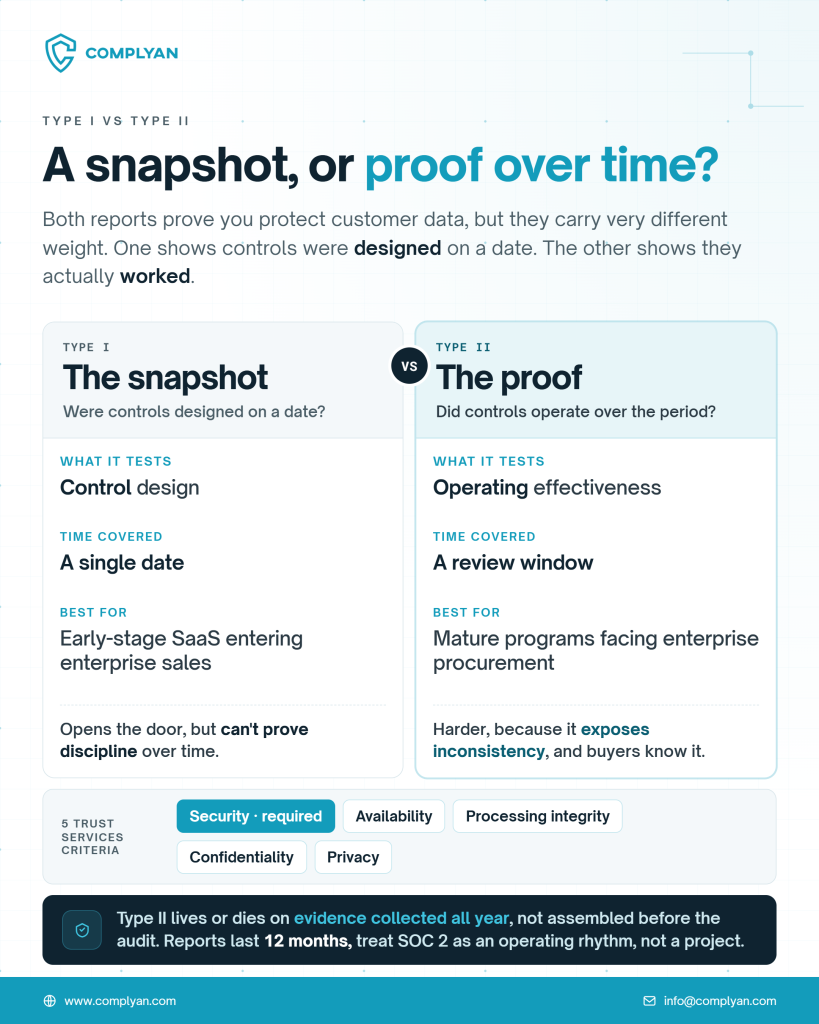
SOC 2 Type I and Type II reports both help service organizations prove that customer data is protected, but they do not give the same level of assurance. A Type I report shows whether controls are suitably designed at a specific point in time. A Type II report goes further by testing whether those controls operated effectively over a defined review period. For SaaS providers, managed service firms, fintech platforms, cloud service providers, and data processors, the real question is not only which report to pursue. It is whether the business can prove that its controls work beyond audit day.
SOC 2 is based on the AICPA Trust Services Criteria, which cover security, availability, processing integrity, confidentiality, and privacy. AICPA describes the criteria as control criteria used to evaluate and report on controls over information and systems used to provide products or services.
Type I Gives Buyers a Snapshot
A SOC 2 Type I report is useful when a company needs to show that its control design is ready. It answers a narrow but important question: were the controls suitably designed and implemented on a specific date?
This can help early-stage SaaS companies, new service providers, or organizations entering enterprise sales for the first time. A Type I report can give prospects some comfort that the company has formal controls around access, change management, security monitoring, vendor oversight, incident response, and data protection.
The limitation is clear. A snapshot cannot prove discipline over time. A company may have a policy, configured control, or access review process in place on the report date, but that does not prove the process was followed consistently across several months. Secureframe describes Type I as a point-in-time control design review, while Type II evaluates whether controls functioned as intended over a specified period.
Type II Carries More Weight
A SOC 2 Type II report usually matters more to serious buyers because it tests operating effectiveness. Instead of asking whether the control exists on one date, the auditor checks whether it worked during the review period.
That difference changes the evidence burden. Teams need to show access reviews, security training, vulnerability remediation, change approvals, incident records, backup tests, risk reviews, vendor assessments, and monitoring activities across the audit window.
A Type II report is harder because it exposes inconsistency. Missed reviews, late tickets, undocumented changes, stale vendor evidence, weak offboarding records, or incomplete logs can become audit issues.
This is why mature customers often ask for Type II. They want proof that security is part of the operating rhythm, not a control set assembled for one audit date.
A common and costly assumption is that a single Middle East cloud deployment can serve all three markets at once. In practice, Saudi customer data processed through UAE-based infrastructure, or the reverse, can trigger cross-border transfer obligations even within the same general region, since each country’s law looks at where data actually sits and moves, not just where a business is headquartered.
The safer architecture separates workloads by jurisdiction: Saudi customer data processed in Saudi-approved infrastructure, UAE data kept within UAE-compliant environments, and Bahrain-related data handled according to its own Adequacy List. This adds real operational complexity, but it avoids the audit exposure that comes from a shared database quietly moving regulated data across a border nobody tracked.
The Five Trust Services Criteria
SOC 2 reports are built around the Trust Services Criteria selected for the engagement. Security is the common baseline, while the other categories depend on the service and customer expectations.
Security covers protection against unauthorized access, misuse, and system compromise.
Availability applies when customers depend on the service being accessible under agreed terms.
Processing integrity is relevant when complete, valid, accurate, timely, and authorized processing matters.
Confidentiality focuses on protecting confidential information according to commitments.
Privacy applies when personal information is collected, used, retained, disclosed, and disposed of according to privacy commitments.
Choosing too many criteria too early can create unnecessary work. Choosing too few can weaken buyer confidence. The right scope should match the product, data handled, contractual promises, and customer risk expectations.
SOC 2 Readiness Starts Before the Auditor
Many organizations make the mistake of calling an auditor before the control program is stable. That creates pressure because audit evidence has to come from real operations.
A better path starts with readiness. Map the systems in scope. Confirm the Trust Services Criteria. Identify control owners. Review policies. Fix missing controls. Test evidence collection. Close known gaps before the formal review starts.
For companies managing SOC 2 alongside ISO 27001, GDPR, PCI DSS, NIST CSF, or regional compliance frameworks, Complyan Audit and Compliance Management helps connect requirements, controls, owners, evidence, gaps, and remediation tasks in one place.
Evidence Makes or Breaks Type II
Type II readiness depends on consistency. Every recurring control needs a frequency, owner, evidence source, and exception process.
If access reviews are monthly, the team must prove they happened monthly. If vulnerability remediation has a target timeline, the evidence must show that findings were handled within that timeline. If employees complete security awareness training, completion records should be current and traceable.
Common evidence gaps include:
Missing approval records for production changes
No proof of quarterly access reviews
Late remediation for critical vulnerabilities
No documented vendor review
Incomplete incident response testing
Policy documents with no approval history
Weak offboarding evidence
These issues do not always mean the company has no security program. They often mean the program is not producing reliable proof.
Vendor Risk Belongs in the SOC 2 Program
SOC 2 is not limited to internal systems. Third-party vendors can affect the service organization’s control posture. Cloud platforms, development tools, support platforms, payment processors, analytics tools, outsourced IT providers, and managed service partners may all touch customer data or support critical service delivery.
Vendor files should include risk tiering, due diligence evidence, contract terms, security reports, subprocessors, access reviews, and incident notification expectations.
Complyan Third-Party Risk Management helps teams manage vendor assessments, evidence requests, risk scoring, remediation workflows, and supplier review cycles. This supports SOC 2 because vendor assurance needs structure, ownership, and current evidence.
Type I or Type II First?
A Type I report may be the right starting point if the company is early in its compliance program, needs quick buyer assurance, or wants an auditor-reviewed baseline before a longer review period.
A Type II report is the stronger option when the company already has mature controls, recurring evidence, enterprise customers, or procurement teams asking for proof of operating effectiveness.
Some organizations start with Type I, then move into Type II after stabilizing controls. Others go straight to Type II if the control program is already mature enough. The right choice depends on customer pressure, control maturity, sales timeline, audit readiness, and available evidence.
Common Mistakes Companies Make
Assuming Type I satisfies every customer. Increasingly, enterprise procurement teams treat Type I as insufficient on its own, since it says nothing about whether controls hold up under real operating conditions.
Starting evidence collection right before the audit window closes. Type II requires evidence gathered throughout the entire observation period. Evidence assembled retroactively, or missing from earlier months, weakens the report and can trigger exceptions noted by the auditor.
Choosing every Trust Services Criterion by default. Only Security is required. Adding criteria that do not reflect actual customer commitments creates unnecessary audit scope and cost without adding real value to the report.
Treating the report as a one-time achievement. SOC 2 reports are valid for twelve months. Maintaining certification requires continuous control operation and evidence collection year over year, not a project that ends once the first report is issued.
Common Mistakes Companies Make
SOC 2 Type I and Type II reports serve different business needs. Type I proves control design at a point in time. Type II proves that controls operated over time.
For most growing service organizations, Type I can open the door, but Type II builds stronger trust. The companies that do well are the ones that prepare early, scope carefully, assign control owners, collect evidence continuously, and treat SOC 2 as part of the way the business runs.
The strongest SOC 2 programs do not rush to look compliant. They build controls that work, then keep the proof ready.