

 Governance and Policy Management
Cybersecurity GRC Implementation Does Not Have to Slow You Down: How Complyan Helps Saudi SMEs Stay Agile

For mid-size companies operating in Saudi Arabia, GRC pressure rarely arrives gradually. It shows up during audits, regulatory reviews, customer due diligence, or when a regulator asks for evidence that should already exist. By that point, gaps are no longer theoretical. They are visible, measurable, and difficult to explain away.
Saudi regulators now expect organizations to demonstrate how controls are applied, who owns them, and how risks are tracked over time. This applies whether the organization employs five hundred people or five thousand. Frameworks issued by bodies such as Saudi Arabian Monetary Authority (SAMA) and the National Cybersecurity Authority (NCA) have moved beyond policy intent and into operational proof.
For many mid-size firms, this is where friction begins. Governance is spread across departments, risk registers sit in disconnected files, and compliance activity accelerates only when deadlines approach. The challenge is not awareness. It is the absence of a structure that can sustain compliance without overwhelming already stretched teams.
Managing Compliance Across Multiple Saudi Authorities
Saudi Arabia’s regulatory environment has transformed dramatically over the past five years. Organizations now face overlapping requirements from multiple authorities, each with distinct mandates and expectations.
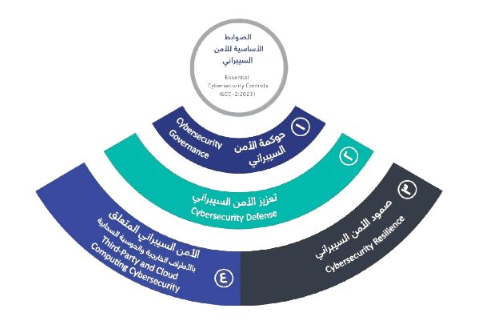
The National Cybersecurity Authority (NCA) enforces the Essential Cybersecurity Controls (ECC 2:2024), a comprehensive framework with 110 controls across four domains that applies to government entities and critical infrastructure operators. The updated framework addresses modern threats while demanding rigorous implementation and continuous monitoring.
The Saudi Central Bank (SAMA) maintains its Cybersecurity Framework, which financial institutions must satisfy. This framework extends beyond basic security controls to include detailed governance requirements, risk management procedures, and incident response capabilities. Banks, payment processors, and fintech companies face particularly stringent scrutiny under SAMA’s oversight.
The Saudi Data and AI Authority (SDAIA) enforces the Personal Data Protection Law (PDPL), Saudi Arabia’s comprehensive data privacy regulation. Organizations handling personal data must implement technical safeguards, establish data processing records, and demonstrate accountability for cross-border data transfers.
Each authority operates independently, publishes updates on different schedules, and conducts separate audits. For mid-size companies, tracking these requirements while maintaining daily operations creates substantial strain.
Common GRC Struggles Across Mid-Size Saudi Companies
Fragmented ownership of controls
In many organizations, compliance responsibilities are spread across IT, risk, legal, internal audit, and operations. Control ownership is often informal. Evidence lives in email threads, spreadsheets, shared drives, or ticketing tools. When audits arrive, teams lose time reconciling who owns what and where proof resides.
Manual compliance processes that do not scale
Spreadsheets remain the default GRC system for many mid-market firms. While workable at small scale, they break down when mapped against SAMA or NCA requirements. Version control issues, inconsistent scoring, and manual updates introduce risk rather than reduce it.
Audit-driven compliance culture
Compliance activity spikes only when audits are approaching. Outside those windows, controls drift, evidence becomes outdated, and risk registers lose relevance. This creates a cycle where compliance is viewed as disruption rather than operational support.
Difficulty mapping multiple frameworks
Saudi organizations rarely operate under a single framework. SAMA, NCA ECC, ISO 27001, and internal risk standards often overlap. Without a centralized control library, teams duplicate work and miss opportunities for reuse across frameworks.
Limited visibility for leadership
Executives need a clear view of risk posture, compliance gaps, and remediation progress. What they often receive are static reports built manually. These snapshots lack context and rarely reflect real operational status.
Why Traditional GRC Approaches Fall Short
Without dedicated GRC platforms, mid-size companies often resort to spreadsheets, shared documents, and email chains to manage compliance activities. This approach creates multiple problems that worsen as regulatory requirements expand.
A typical mid-size organization might maintain separate spreadsheets for NCA controls, SAMA requirements, PDPL obligations, and internal policy tracking. Each spreadsheet requires manual updates when regulations change. Staff members struggle to identify control overlaps between frameworks, resulting in duplicated effort and inconsistent implementation.
Evidence collection for audits becomes a major undertaking. Security teams scramble to gather screenshots, log files, and configuration data when auditors request proof of compliance. The process takes weeks, disrupts normal operations, and often reveals gaps that require immediate remediation.
Policy management suffers from version control issues. Different departments maintain their own copies of security policies, leading to conflicting guidance and implementation inconsistencies. When regulations change, updating all relevant documents requires coordination across multiple teams.
Risk assessments conducted annually or quarterly fail to capture the rapid changes in threat environments and business operations. By the time assessment results reach decision-makers, the information has often become outdated.
Compliance Challenges in Saudi Arabia’s Vision 2030
Saudi Arabia’s Vision 2030 initiative accelerates digital transformation across all economic sectors. Government entities push for cloud adoption, digital services, and data-driven operations. While these changes create opportunities, they also introduce new compliance challenges for mid-size companies attempting to participate in this transformation.
Digital transformation projects often proceed faster than GRC programs can accommodate. Companies migrate data to cloud platforms before establishing proper governance frameworks. New applications go live without adequate security controls. The rush to innovate creates compliance debt that becomes harder to address over time.
Organizations pursuing government contracts face particularly strict requirements. Procurement guidelines increasingly reference NCA, SAMA, and SDAIA standards, effectively making compliance a prerequisite for business opportunities. Mid-size companies that cannot demonstrate regulatory adherence find themselves excluded from lucrative contracts.
How Complyan Addresses These Challenges
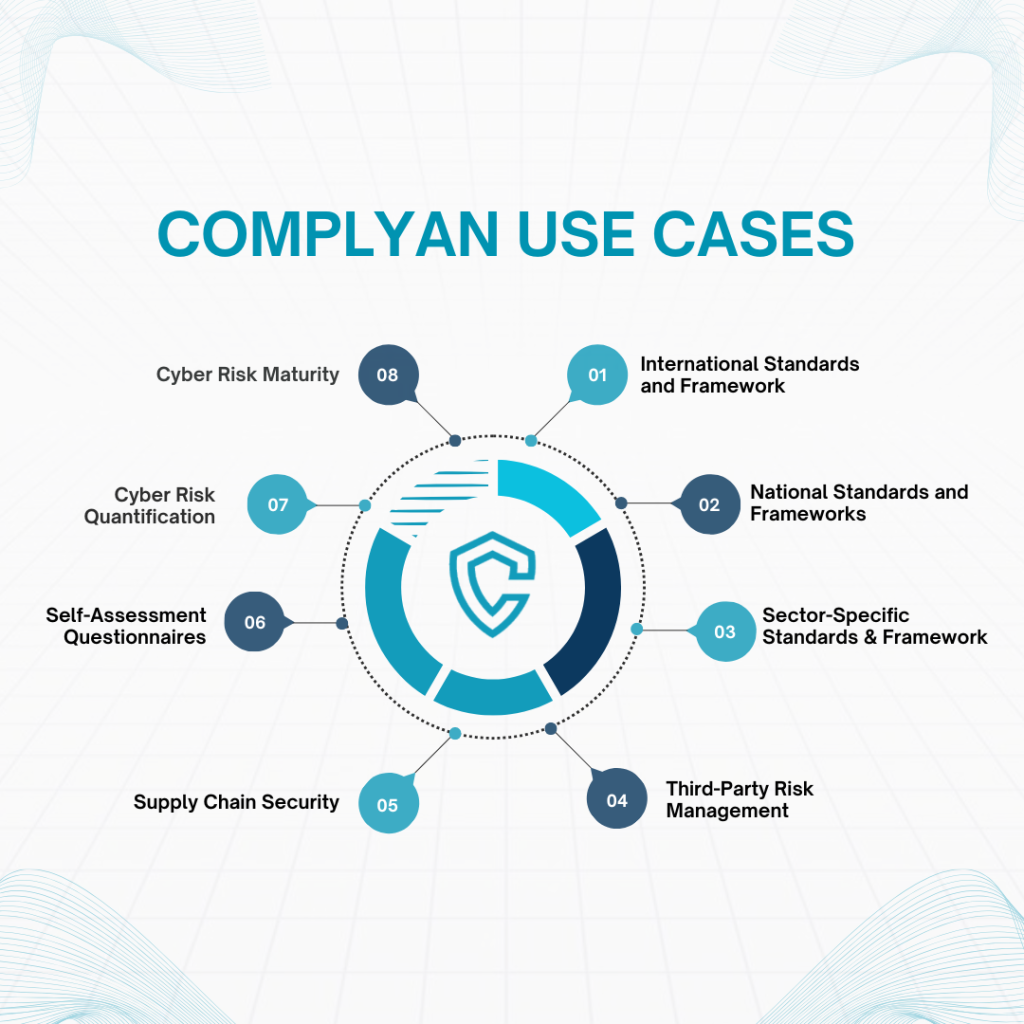
Complyan comes pre-configured with NCA ECC, SAMA Cybersecurity Framework, PDPL, and other regional frameworks. Instead of building compliance programs from scratch, organizations can start with established control mappings that regulatory authorities expect. This approach reduces implementation time from months to weeks while ensuring comprehensive coverage of all requirements.
Control mapping capabilities allow companies to identify overlaps between different frameworks. A single security control might satisfy requirements in NCA, SAMA, and ISO 27001 simultaneously. Complyan automatically identifies these relationships, eliminating duplicate work and streamlining implementation efforts.
Automated evidence collection addresses one of the most time-consuming aspects of compliance management. The platform connects to existing security tools, gathers relevant data automatically, and organizes evidence according to framework requirements. When auditors request proof of weekly vulnerability scanning or access control reviews, the documentation is already prepared.
Continuous monitoring replaces periodic assessments with real-time visibility into compliance status. Organizations can identify gaps as they emerge rather than discovering them during annual audits. This proactive approach reduces the risk of enforcement actions and allows for more effective resource allocation.
Complyan’s risk management module helps organizations conduct vendor assessments, track third-party risk, and maintain evidence of due diligence. Automated workflows guide staff through assessment processes, ensuring consistent evaluation across all vendors. Built-in questionnaires based on SAMA and NCA requirements save time while maintaining thoroughness.
Moving Forward
Mid-size companies cannot ignore GRC requirements, but they can implement them more efficiently with the right approach and tools. Organizations should begin by conducting a comprehensive gap analysis against applicable frameworks. This assessment identifies current compliance levels and highlights areas requiring immediate attention.
Prioritization based on regulatory risk helps allocate limited resources effectively. Not all controls carry equal weight in terms of enforcement likelihood and potential penalties. Organizations should focus first on high-priority requirements while developing longer-term plans for comprehensive compliance.
Platform selection requires careful evaluation of features, pricing, and support. The ideal GRC solution for a mid-size company combines robust functionality with intuitive interfaces that minimize training requirements. Integration capabilities with existing security tools ensure that automation delivers its full value.
Implementation should proceed incrementally rather than attempting to address all requirements simultaneously. Organizations might start with a single framework like NCA ECC, establish solid processes, then expand to additional regulations. This phased approach prevents overwhelming staff and allows for learning from early experiences.
Conclusion
When GRC is treated purely as an obligation, it consumes time and delivers little strategic value. When implemented correctly, it improves decision-making, reduces operational risk, and strengthens trust with regulators and customers.
Mid-size Saudi companies are at a critical point. Regulatory scrutiny is increasing, but the opportunity to mature governance practices has never been clearer. The organizations that succeed will be those that replace fragmented processes with structured automation and clear ownership.
Complyan enables this transition without unnecessary complexity.
For organizations evaluating how to operationalize GRC across Saudi frameworks while maintaining agility, Complyan provides a practical, scalable path forward. Learn more about how Complyan supports compliance, risk management, and security automation here