

 Governance and Policy Management
Kuwait’s Data Privacy Protection Regulations: What Telecom and IT Licensees Must Do Within 24 Hours of a Breach

Kuwait’s Data Privacy Protection Regulations place strict breach-response duties on telecom and IT licensees. For Communications and Information Technology service providers licensed by CITRA, a serious personal data incident can trigger a 24-hour notification obligation where personal information is incorrectly disclosed or accessed by a third party, and that disclosure or access causes harm to a large number of users. The regulation states that the licensee must notify CITRA, end users, and law enforcement agencies as soon as possible, and no later than 24 hours after the licensee reasonably determines that a violation has occurred.
For compliance leaders, this 24-hour window is the part that creates operational pressure. A breach response plan cannot begin after the breach has already happened. Telecom operators, ISPs, cloud-related providers, managed service providers, and licensed IT service providers need a process that can confirm facts, classify the incident, notify the right parties, and preserve evidence quickly.
What the regulation expects from licensees
CITRA’s Data Privacy Protection Regulation applies to Communications and Information Technology service providers. It sets obligations around consent, transparency, data processing, privacy notices, security measures, staff training, third-party handling, records of processing, breach reporting, and data owner rights.
The regulation also requires service providers to protect personal data against unauthorized or illegal processing, accidental loss, impairment, damage, disclosure, breach by an unauthorized third party, replacement, or addition of incorrect data. Security measures must be appropriate to the nature and scope of the provider’s activities and the sensitivity of the personal information collected and stored.
This means licensees need more than a policy. They need working controls across systems, people, vendors, and incident response.
The 24-Hour Rule
Under the updated regulation, licensees must notify CITRA within 24 hours of becoming aware of a personal data breach. This is a sharp reduction from the previous framework, and it leaves almost no room for the kind of internal deliberation that used to happen before a regulator was informed.
The notification has to include specifics, not a placeholder message. CITRA expects details on the nature of the breach, its scope, the data owners affected, and which security measures were compromised. It also wants contact information for the organization’s data protection officer and a description of what steps have been taken or are planned to contain the incident.
If the breach creates real risk to a data owner’s rights, the affected individuals must be told as well, unless the organization can show it already had adequate technical safeguards in place that limit the impact.
What must happen in the first 24 hours?
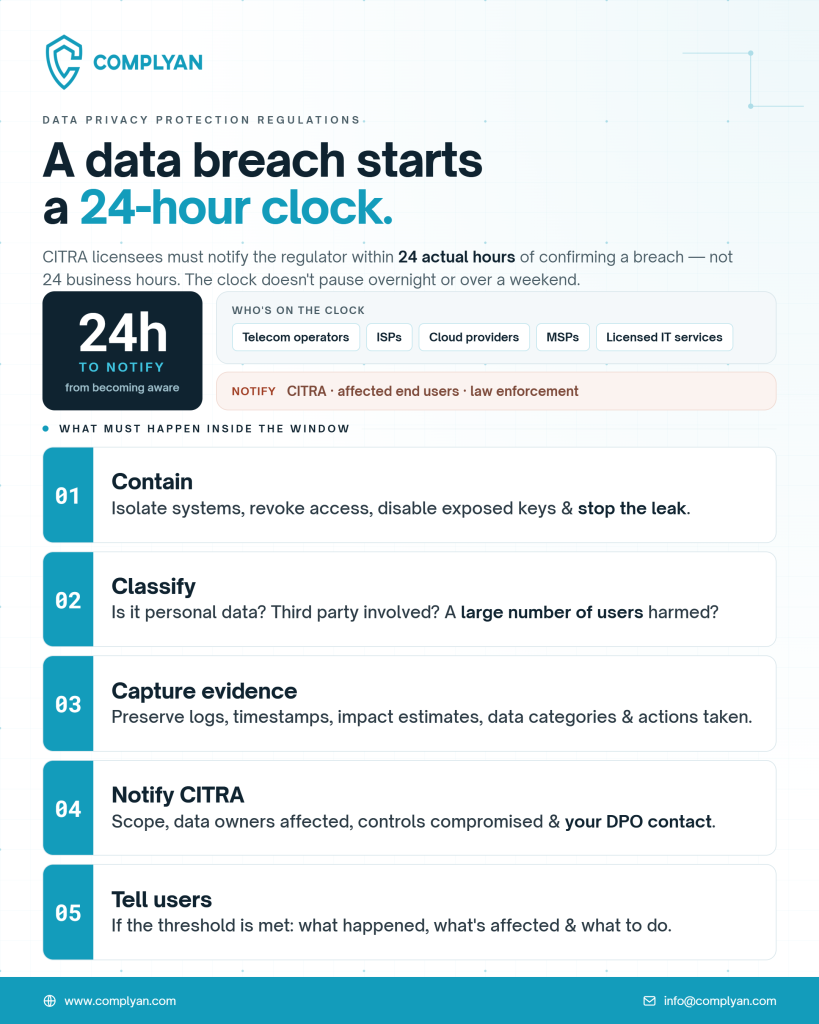
The first action is containment. Security teams should isolate affected systems, revoke compromised access, disable exposed keys, preserve logs, and stop any ongoing data leakage. At the same time, legal, compliance, privacy, security, and executive stakeholders should join a defined incident bridge.
The second action is classification. The team must decide whether the incident involves personal data, whether it was incorrectly disclosed or accessed, whether a third party was involved, and whether a large number of users may be harmed.
The third action is evidence capture. Teams should preserve timestamps, affected systems, access logs, user impact estimates, data categories, screenshots, tickets, communications, containment actions, and forensic notes.
The fourth action is notification readiness. Even when all facts are not final, the organization should prepare a clear initial notification that explains what is known, what is being investigated, what actions have been taken, and who CITRA can contact.
The fifth action is user communication. If the threshold is met, affected end users must be notified. The notice should be clear, factual, and practical. Users need to know what happened, what data may be affected, what the provider has done, and what actions they may need to take.
Who Is Actually Covered
The DPPR applies to entities licensed by CITRA, primarily telecom operators and IT service providers, along with businesses that collect and process personal data through websites, applications, or similar digital channels. Coverage extends to processing that happens inside or outside Kuwait, so a licensee using an overseas data center or cloud provider does not step outside the regulation’s reach.
A small number of exceptions exist, mainly for individuals handling purely personal or family data and for security authorities carrying out defined law enforcement functions. Beyond those narrow carve-outs, if your organization holds a CITRA license and touches personal data, the 24-hour clock applies to you
Building an Incident Response Process That Can Actually Hit the Deadline
Predefine who has authority to notify CITRA. Waiting for sign-off from multiple stakeholders during an active incident wastes hours the organization does not have. One person or a small designated group should be able to trigger the notification without waiting on a full committee.
Draft your notification template in advance. CITRA expects specific details on breach scope, affected data, and remediation steps. Building that template before an incident happens means filling in facts rather than drafting language under pressure.
Automate detection and alerting wherever possible. The clock starts at the moment of awareness, so faster detection directly buys back response time. Manual log reviews conducted once a week are not compatible with a 24-hour reporting requirement.
Map your data flows now, not during the incident. Knowing which systems hold personal data, and where that data physically sits, saves critical time when trying to determine what was actually exposed.
Keep the data protection officer’s contact details current in every internal escalation document. CITRA specifically wants this contact listed in the notification, so it needs to be accurate and immediately accessible when the clock is running.
Rehearse the process, not just the policy. A written incident response plan sitting in a shared drive is not the same as a team that has actually walked through a simulated breach and knows exactly who does what within the first hour.
The Cost of Missing the Window
Failing to notify CITRA within the required timeframe is not a minor administrative slip. The regulation gives CITRA authority to impose administrative sanctions, and repeated or serious violations can put an operating license at risk. For a telecom operator or IT licensee, a suspended or revoked license is far more damaging than the original breach itself.
Beyond the regulatory consequence, a missed or incomplete notification tends to surface during any follow-up investigation. If CITRA later determines that a licensee knew about a breach and delayed reporting it, that gap becomes its own compliance failure, layered on top of whatever caused the original incident.
Common Mistakes Licensees Make
A few patterns show up repeatedly among organizations struggling to meet the 24-hour requirement.
Treating the deadline as 24 business hours instead of 24 actual hours. The clock does not pause overnight or over a weekend, so response plans built around a standard workday will fall short.
Assuming legal review must finish before notification. CITRA does not require a complete forensic conclusion within the window. A timely notification with the facts known so far, followed by updates as the investigation progresses, is far safer than waiting for full certainty.
Underestimating third-party involvement. If a breach originates with a vendor or cloud provider, contractual clarity on who notifies whom needs to be settled before an incident occurs, not during one.
Where Compliance Tooling Helps
Meeting a 24-hour deadline consistently is difficult when incident evidence, contact lists, and reporting templates live in scattered documents across different teams. A centralized platform built for data protection and cybersecurity compliance, such as Complyan’s CITRA-focused guidance, helps organizations keep this information current and accessible instead of reconstructing it during an active incident. The same applies to organizations managing DPPR obligations alongside other Kuwait requirements, where a structured GRC platform reduces the coordination overhead that eats into an already narrow response window.
The Bottom Line
The DPPR’s 24-hour notification requirement is not just a paperwork obligation. It is a test of whether an organization’s incident response process actually works under time pressure. Licensees that predefine ownership, prepare their notification templates, and invest in faster detection are the ones who meet the deadline without a last-minute scramble. Waiting until a real breach happens to figure out the process is the most expensive way to learn it.