


 Governance and Policy Management
GDPR in 2026: What Has Changed Since Enforcement Began and What Organizations Are Still Getting Wrong

GDPR in 2026 is very different from the last-minute compliance rush organizations faced when enforcement began on 25 May 2018. The core regulation still rests on lawful processing, transparency, accountability, security, data subject rights, and controlled international transfers, but regulators now expect mature operating evidence, not policy documents written years ago and left untouched. The European Commission confirms that GDPR has applied since 25 May 2018 and continues to sit at the center of EU data protection law.
For CISOs, privacy leaders, legal teams, and compliance managers, the question is no longer “Do we have GDPR documents?” The better question is “Can we prove how personal data is collected, used, shared, retained, deleted, secured, and transferred today?”
The Regulation Has Not Disappeared
Some organizations treat GDPR like an old compliance project. That is the first mistake.
GDPR did not fade after the first wave of privacy notices and cookie banners. It became the baseline for privacy operations across the EU and European Economic Area. It also influenced privacy laws in other regions, making it a reference point for organizations that operate globally.
A useful external reference for teams reviewing the law is the European Commission’s GDPR and EU data protection page, which outlines EU data protection rules, international transfer safeguards, and the GDPR timeline. The Commission notes that transfers to third countries rely on mechanisms such as adequacy decisions, standard contractual clauses, and binding corporate rules.
Enforcement Has Become More Process-Driven
A major change since 2018 is the push for faster and more consistent cross-border enforcement. In May 2025, the Council and European Parliament agreed on new procedural rules for GDPR enforcement in large cross-border cases. The Commission states that these rules are designed to improve cooperation between data protection authorities, streamline dispute resolution, and improve transparency without changing the core rights, obligations, or lawful grounds in GDPR.
For organizations, this means complaints, investigations, and regulatory engagement may become more structured. Slow evidence gathering will create pressure. Privacy teams need records, decisions, contracts, risk assessments, and remediation history ready before a regulator asks.
The Fines Getting Regulators' Attention
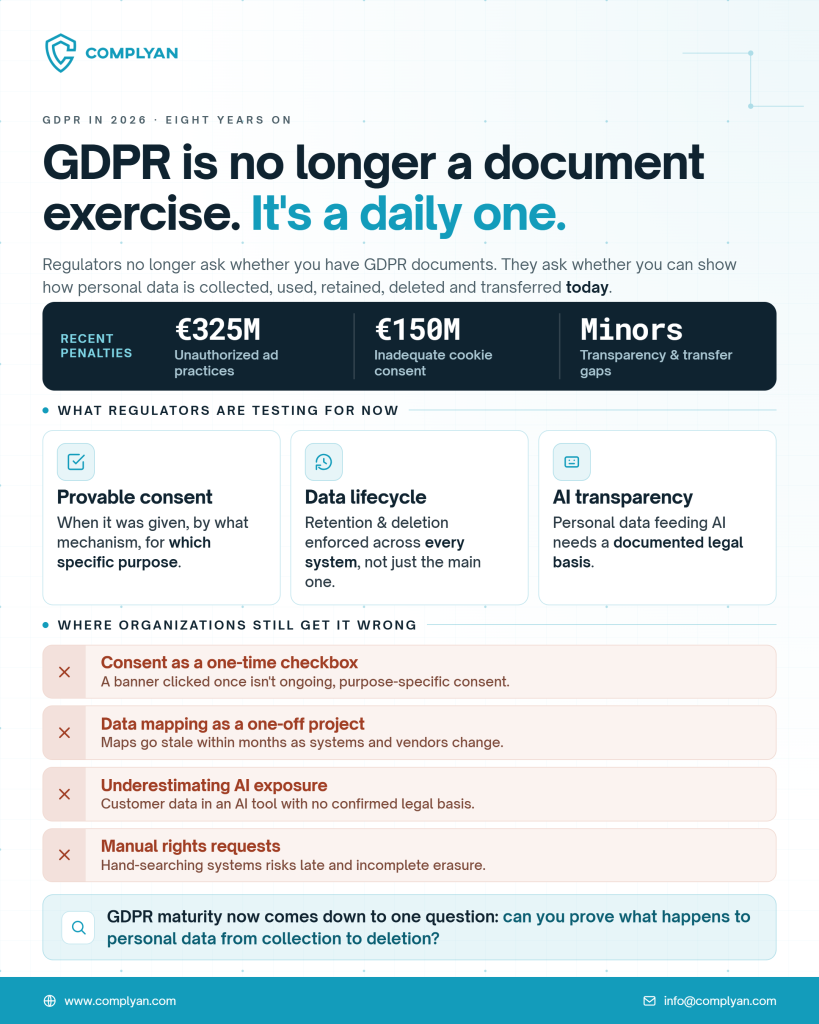
Recent enforcement actions illustrate exactly where the pressure is landing. A French insurer faced a fine of up to 150 million euros for inadequate cookie consent tracking. A major technology company was fined 325 million euros for unauthorized advertising practices. A social media platform was sanctioned for failing to protect minors’ data and for gaps in transparency around international data transfers. Even established financial institutions have drawn penalties for weak data traceability, proving that size and reputation offer no real protection once an audit finds a genuine gap.
The pattern across these cases is not a string of unrelated incidents. Each one exposes the same underlying weakness: an organization that cannot show, with evidence, where personal data lives, how it moves, and who is accountable for it.
What Regulators Are Testing For Now
Three areas draw the sharpest scrutiny in current enforcement activity.
Granular, provable consent. Collecting consent is no longer sufficient on its own. Regulators expect organizations to demonstrate exactly when consent was given, through what mechanism, and for which specific purpose, with records that hold up under direct examination rather than a general privacy policy statement.
Controlled data lifecycle management. Personal data cannot sit indefinitely in a system because deleting it felt inconvenient. Retention, archiving, and deletion rules need to be enforced consistently across every system that touches personal data, not just the primary customer database.
AI and data usage transparency. As AI adoption accelerates, regulators expect clear traceability showing that personal data feeding into AI systems has a documented legal basis and has not been exposed beyond its intended purpose.
AI Has Made Privacy Governance Harder
AI adoption has created a new privacy control problem. Employees may paste personal data into tools for summaries, research, code review, customer replies, or document drafting. Business teams may buy AI-enabled SaaS platforms without checking where prompts are stored, whether inputs are used for training, or which subprocessors receive data.
GDPR already has the tools to address this: lawful basis, transparency, purpose limitation, minimization, DPIAs, security controls, processor due diligence, and transfer safeguards. The weak point is implementation.
Organizations should treat AI tools like any other data processor or high-risk processing activity. Each tool needs an owner, approved use cases, data restrictions, vendor evidence, transfer review, access control, and audit trail.
Where Organizations Are Still Getting It Wrong
Treating consent as a one-time checkbox. A cookie banner clicked once does not satisfy the ongoing, purpose-specific consent standard regulators now expect. Consent records need to be maintained and retrievable, not just collected.
Assuming a local entity limits exposure. The 2025 CJEU ruling closed this strategy directly. Structuring operations to shield global revenue from a local violation no longer works as a risk mitigation tactic.
Managing data mapping as a one-time project. A data flow diagram built once during initial GDPR implementation goes stale within months as systems, vendors, and integrations change. Complyan’s data flow and mapping tools address this by keeping data flow records current rather than treating the map as a static artifact filed away after the initial audit.
Underestimating AI-related exposure. Feeding customer data into an AI tool without confirming a documented legal basis creates exactly the kind of transparency gap regulators are actively testing for in 2026.
Responding to rights requests manually. A right-to-erasure request that requires manually searching multiple systems takes too long and risks incomplete deletion. Organizations without centralized visibility into where personal data lives struggle to respond within required timeframes.
Building for Continuous Compliance, Not a Point-in-Time Audit
The organizations avoiding these penalties share a common trait: they treat GDPR as an operating discipline rather than a project completed once and revisited only before an audit. This means centralized visibility into where data lives, documented consent that can be produced on demand, enforced retention rules, and clear accountability for every category of personal data an organization holds.
Building for Continuous Compliance, Not a Point-in-Time Audit
GDPR in 2026 is no longer about proving that an organization reacted to enforcement in 2018. Regulators, customers, partners, and boards now expect evidence that privacy controls work every day.
The organizations still getting it wrong are usually not missing a privacy policy. They are missing live data maps, clean vendor records, tested response workflows, enforceable retention rules, and governance over new tools such as AI.
GDPR in 2026 is no longer about proving that an organization reacted to enforcement in 2018. Regulators, customers, partners, and boards now expect evidence that privacy controls work every day.
The organizations still getting it wrong are usually not missing a privacy policy. They are missing live data maps, clean vendor records, tested response workflows, enforceable retention rules, and governance over new tools such as AI.