

 Governance and Policy Management
Security Compliance Automation for Organizations: How Cutting Manual GRC Work Directly Reduces Risk and Increases Audit Confidence

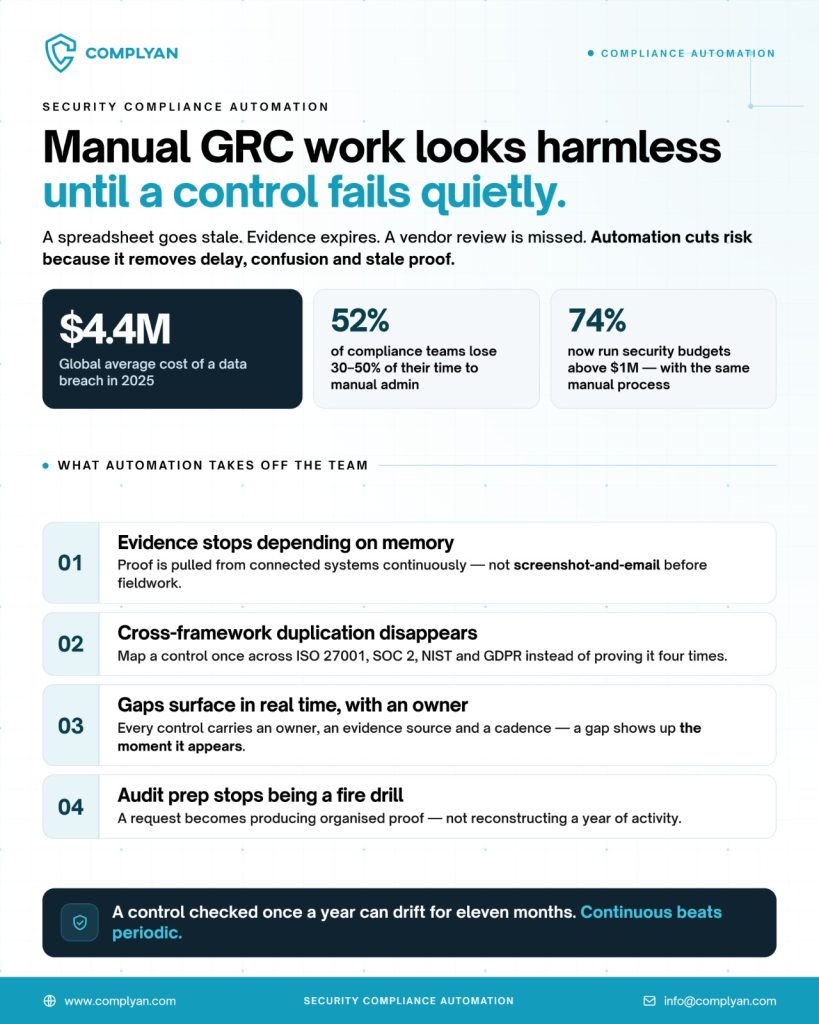
Manual GRC work looks harmless until a control fails quietly. A spreadsheet is not updated. Evidence expires. A vendor review is missed. A risk owner leaves the business. An auditor asks for proof and the team spends days searching through emails, screenshots, shared folders and old tickets.
That is where security compliance automation becomes more than an efficiency play. It reduces risk by making compliance work timely, traceable and owned. When controls are mapped properly, evidence is collected from source systems, findings are assigned, and gaps are visible before the audit, the organization gains more than speed. It gains confidence that the program is working when nobody is chasing it manually.
Compliance automation is commonly described as the use of software to reduce manual work across the compliance lifecycle, including evidence collection, risk assessment, reporting, vendor due diligence and control testing. For security teams, the business case is clear: less manual chasing means fewer blind spots.
Why Manual GRC Work Became Unsustainable
Compliance programs were traditionally built around the audit calendar: a scramble to collect evidence in the weeks before a review, followed by months of relative quiet until the next cycle. That model assumed regulatory requirements stayed relatively fixed and a handful of frameworks covered most of what a business needed to prove. Neither assumption holds anymore.
Recent industry benchmarking found that 74 percent of organizations now report annual security budgets exceeding a million dollars, yet 52 percent of compliance teams still spend between 30 and 50 percent of their time on manual administrative work: data entry, evidence chasing, and reconciling the same control across multiple frameworks by hand. Budgets are growing, but the labor behind compliance has not gotten proportionally lighter, because the underlying process never changed.
The Direct Cost of Staying Manual
The financial stakes attached to this gap are not abstract. The global average cost of a data breach reached nearly 4.4 million dollars in 2025, and organizations relying on manual, reactive risk processes are considerably more likely to experience one. Manual compliance work introduces specific, avoidable risks: evidence that goes stale between collection cycles, control failures that go unnoticed because nobody reviewed the log in time, and duplicated effort across frameworks that eats time without reducing exposure anywhere.
Every one of these gaps traces back to the same root cause: a process built around periodic snapshots rather than continuous operation. A control that gets checked once a year can drift out of compliance for eleven months before anyone notices.
Automation Makes Control Ownership Clear
A control without an owner is a future finding. Manual GRC programs often hide this problem because ownership sits in old trackers or depends on someone remembering who handled the last audit.
Security compliance automation makes ownership visible. Every control should have a business owner, technical owner, evidence source, review frequency, status, linked risks and remediation workflow. When something fails, the platform should show who owns the fix, when it is due and what proof is needed to close it.
This changes the compliance team’s role. Instead of chasing every file, the team manages the system of accountability. That is a stronger use of compliance expertise because the team can focus on risk, exceptions, control design and management reporting
What Automation Removes From the Equation
Evidence collection stops depending on memory: Automated evidence gathering pulls directly from connected systems on an ongoing basis, replacing the screenshot-and-email routine that leaves gaps whenever someone forgets a step or leaves the organization mid-cycle.
Cross-framework duplication disappears: A control satisfied under ISO 27001 should not require separate proof under SOC 2 or a regional framework if the underlying safeguard is identical. Complyan’s cybersecurity compliance tools map controls once across every applicable standard, removing the redundant collection work that consumes so much of a compliance team’s calendar.
Control health becomes visible in real time: Dashboards showing current compliance status replace static reports that are already outdated by the time they reach a board. A gap surfaces the moment it appears, not months later during the next scheduled review.
Audit preparation stops being a fire drill: When evidence is collected and mapped continuously, an audit request becomes a matter of producing already-organized proof rather than reconstructing months of activity under deadline pressure.
Complyan AI Reduces Repetitive GRC Work
AI becomes useful in GRC when it helps teams handle repetitive work with proper oversight. Complyan AI automates assignments, evidence requests and status updates across teams. It also supports unified control mapping across standards such as ISO 27001, SOC 2, NIST and GDPR, helping teams maintain one source of truth instead of repeating the same control across different trackers.
This is where manual GRC work starts to reduce. The platform can help route tasks, support control mapping, assist with evidence review and improve visibility across frameworks. Human teams still own judgment, risk acceptance and final approval. Automation handles the repetitive coordination that often slows compliance down.
Why This Directly Increases Audit Confidence
Auditors are not evaluating whether a policy document describes good intentions. They are testing whether a control operated as claimed, consistently, across the period under review. Automation strengthens exactly this kind of evidence: timestamped, sourced directly from the system where the control lives, and consistent because it was generated the same way every time rather than assembled manually under time pressure right before fieldwork.
This is the direct mechanism behind the breach statistics cited earlier. Organizations with automated, continuously monitored controls are not just faster at proving compliance. They are catching real gaps sooner, because the same automation surfacing evidence for an auditor is also flagging drift for the internal team long before a regulator or attacker finds it first.
Building Toward Automated Compliance the Right Way
Diagnose where manual work concentrates: Evidence collection, control mapping, and reporting are usually where the heaviest hours go. Identifying the specific bottleneck shapes where automation delivers the fastest return.
Centralize data before automating around it: Automation applied to a fragmented stack just speeds up fragmented work. Consolidating frameworks, controls, and evidence into one system first makes every automation layered on top of it far more effective.
Assign clear ownership alongside the tooling: Automation reduces manual labor, but it does not remove the need for a named owner accountable for each control. Technology without accountability just moves the gap rather than closing it.
Treat this as risk management, not administrative convenience: Framing automation purely as a time-saver undersells its real value. The strongest business case ties automation directly to reduced breach likelihood and stronger audit outcomes, not just fewer hours spent on spreadsheets.
Organizations ready to move past manual GRC work can get in touch with Complyan to see how a connected, automated compliance program replaces the scramble with a system that stays audit-ready year-round.
Conclusion
Security compliance automation reduces risk because it removes delay, confusion and stale evidence from the compliance process. It gives teams earlier visibility into gaps, clearer ownership for remediation and stronger proof for audits.
Manual GRC work will always create friction when the business grows, frameworks increase and evidence becomes harder to track. Automation gives compliance teams a cleaner operating model: map controls once, collect evidence continuously, assign ownership clearly, monitor risk properly and report readiness with confidence.
For organizations using Complyan, the value is direct: less time spent chasing proof, more time spent reducing real security and compliance risk.