


 Governance and Policy Management
How to Run a Vendor Security Questionnaire Without Losing Time

Vendor security questionnaires are meant to reduce third-party risk, but many teams run them in a way that creates delay before it creates assurance. A supplier is waiting to be onboarded. Procurement wants approval. The business wants the tool live. Legal wants contract movement. Security is still waiting for answers, SOC 2 reports, ISO certificates, penetration test summaries, data flow details and clarifications on vague responses.
That is how a simple vendor review turns into a month-long bottleneck.
A vendor security questionnaire should take days, not weeks, and definitely not the month it quietly stretches into at most organizations. The delay rarely comes from the vendor being difficult. It comes from a process built without any tiering, automation, or reuse, forcing every questionnaire through the same slow, manual path regardless of how much risk the vendor carries. Complyan’s third-party risk management platform exists specifically to collapse that timeline, and the mechanics behind why it works are worth understanding even outside the tool itself.
The real problem is process design. When every vendor receives the same long questionnaire, every answer needs manual review, and every missing document starts another email thread, the team loses time without gaining better risk visibility.
Start With Risk Tiering Before Sending Questions
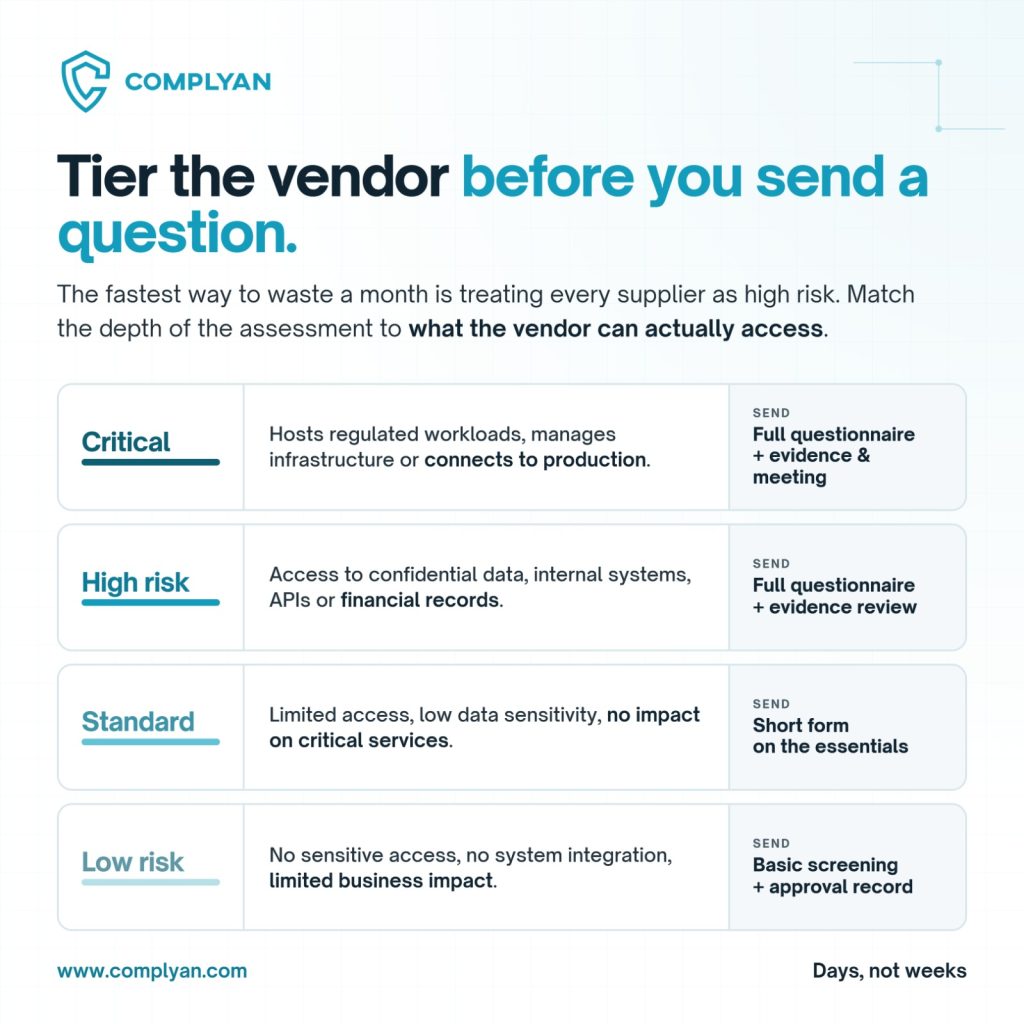
A vendor that handles public marketing content should not receive the same questionnaire as a cloud provider hosting customer records or a payment processor touching regulated data. The fastest way to waste time is to treat every supplier as high risk.
Security teams should tier vendors before sending any questionnaire. The tier should be based on what the vendor can access, what service they provide, what data they process, whether they support critical operations, and whether they have privileged access to systems.
A practical model should look like this:
Critical vendors: suppliers that support core operations, process sensitive data, host regulated workloads, manage infrastructure, provide security services or connect to production systems.
High-risk vendors: suppliers with access to confidential data, internal systems, APIs, customer information, financial records or important business workflows.
Standard vendors: suppliers with limited access, low data sensitivity and no direct impact on critical services.
Low-risk vendors: suppliers with no sensitive access, no system integration and limited business impact.
This helps the team send the right level of assessment. A critical vendor may need a full questionnaire, evidence review, contract review and security meeting. A low-risk vendor may only need basic screening and approval records.
Why Questionnaires Drag Out in the First Place
A few patterns show up in nearly every organization losing a month to this process.
Every vendor gets the same questionnaire, regardless of risk: a marketing analytics tool with read-only access to a product catalog receives the identical 300-question form sent to a payment processor handling cardholder data. Reviewers waste hours combing through irrelevant sections while the genuinely high-risk answers sit buried in the same pile.
Evidence collection happens over email, one attachment at a time: a reviewer flags a missing SOC 2 report, emails the vendor, waits days for a reply, then finds the report only covers last year and has to ask again. Each round trip adds days that never needed to exist.
Nothing gets reused across engagements: the same vendor, already vetted for one business unit, gets sent an entirely fresh questionnaire when a second team wants to work with them, duplicating work that already happened months earlier.
Legal and security review every response in sequence rather than in parallel: a questionnaire sits waiting for a security analyst’s sign-off before legal even opens it, when the two reviews rarely depend on each other.
Follow-ups depend on someone remembering to chase them: a questionnaire sent three weeks ago with no response sits untouched until someone happens to notice, rather than triggering an automatic reminder on a defined schedule.
Tiering Vendors Before Sending Anything
The single highest-leverage fix is deciding how much scrutiny a vendor needs before drafting a single question. A vendor handling regulated data, financial transactions, or privileged system access deserves a full assessment: technical controls, process maturity, and people-focused questions covering training and access management. A vendor with no access to sensitive data and a narrow, low-impact function deserves a short form covering the essentials: whether they collect personal data, whether they carry basic certifications, and how they handle an incident if one occurs.
Sending a full assessment to every vendor regardless of tier is the single biggest reason review queues back up, since reviewers spend equal time on vendors carrying wildly unequal risk.
Structuring the Questionnaire Around What Gets Assessed
A well-built questionnaire covers four distinct areas, each answering a different question:
Data and risk identification: what data the vendor touches, where it lives, and which regulations apply to it.
Technical controls: encryption, multi-factor authentication, patching cadence, and network security measures protecting whatever the vendor holds.
Process controls: incident response plans, business continuity planning, and whether the vendor has undergone a recent audit or penetration test.
People controls: access management practices, security awareness training, and clarity around who inside the vendor’s organization owns security decisions.
Structuring around these four areas, rather than a single undifferentiated list, makes review faster because a reviewer can jump straight to the section relevant to a specific concern instead of scanning an entire form for scattered answers.
Where the Real Time Savings Come From
Pre-fill known answers from prior engagements: a vendor already assessed for one contract should not have to answer the same baseline questions again for a second one. Reusing verified answers cuts the vendor’s response time and the reviewer’s re-verification time simultaneously.
Run legal and security review in parallel, not sequentially: most questions do not require both teams to weigh in before the other starts, and running reviews concurrently removes days that add no real value sitting in sequence.
Automate reminders on a fixed schedule: a questionnaire with no response after five business days should trigger a follow-up automatically, rather than depending on a reviewer’s memory to notice the silence.
Layer in continuous monitoring instead of relying on the questionnaire alone: a point-in-time snapshot goes stale the moment a vendor’s environment changes. Complyan’s audit and compliance management tools close this gap, flagging posture changes between formal reassessment cycles rather than waiting for the next scheduled questionnaire to catch drift that happened months earlier.
Common Mistakes That Add Weeks Without Anyone Noticing
Treating every response as requiring a follow-up call: a scheduling delay to discuss an answer that could have been clarified in a single email adds days for no real benefit.
Waiting for a perfect answer instead of an acceptable one: minor gaps with a documented remediation plan are often an acceptable risk, and insisting on a flawless questionnaire before proceeding stalls low-risk engagements that never needed that level of scrutiny.
Losing the paper trail across email threads: when evidence and responses live scattered across inboxes rather than a centralized record, reconstructing the assessment history for a future audit becomes its own multi-day project.
Use Automation to Remove the Manual Drag
Questionnaire work becomes slow because too much of it depends on human chasing. Someone sends the questionnaire. Someone reminds the vendor. Someone downloads documents. Someone checks missing answers. Someone updates a tracker. Someone emails procurement. Someone prepares a risk note for approval.
Complyan Third-Party Risk Management centralizes vendor records, automates risk assessments, supports SAQs during vendor evaluation or onboarding, monitors third-party risk and integrates with systems such as procurement or contract management tools. That matters because the questionnaire should be part of a governed workflow, not another disconnected spreadsheet.
With a structured TPRM process, teams can assign questionnaires based on vendor tier, track completion, request evidence, score responses, flag gaps, assign remediation actions and report vendor risk without rebuilding the process every time a new supplier appears.
Where Complyan AI Fits
AI is useful in vendor questionnaires when it removes repetitive review work without removing human approval. Complyan AI automates assignments, evidence requests and status updates across teams. It also supports unified controls by mapping overlapping requirements across frameworks such as ISO 27001, SOC 2, NIST and GDPR.
For vendor reviews, this means faster sorting of responses, clearer follow-up, better routing of missing evidence and less time spent comparing answers manually. Complyan AI is also available in beta across selected modules such as Vendor Risk Management and Questionnaire Automation, with customer data kept away from external model training or third-party access.
The reviewer still makes the risk decision. The platform helps reduce the time wasted on chasing, sorting and repeating the same questions across vendors.
Conclusion
A vendor security questionnaire does not need a month to complete. It needs a process that tiers risk before sending anything, structures questions around what gets assessed, runs reviews in parallel rather than in sequence, and reuses prior answers instead of starting from zero every time. Organizations that build the process this way turn vendor onboarding from a recurring bottleneck into a routine step that keeps pace with how fast the business needs to move.