




 Governance and Policy Management
VARA Compliance in Dubai: What Virtual Asset Businesses Need to Get Right

Getting a VARA licence is only the beginning. The harder task is maintaining the governance, risk controls, cybersecurity evidence, AML processes, customer protections, and operational records required after the business begins operating.
For Virtual Asset Service Providers in Dubai, compliance is cumulative. A VASP must meet the four compulsory VARA Rulebooks, then add the requirements connected to the specific virtual asset activities covered by its licence. VARA regulates virtual asset activity across mainland Dubai and its free zones, excluding the Dubai International Financial Centre.
That structure creates a practical GRC problem: one VASP may need to manage hundreds of obligations across governance, risk, cybersecurity, AML/CFT, data protection, market conduct, outsourcing, and activity-specific requirements at the same time. Complyan gives compliance teams a way to bring those obligations into one control environment, assign ownership, connect evidence, and track gaps before they turn into regulatory issues.
VARA Compliance Is a Layered Model
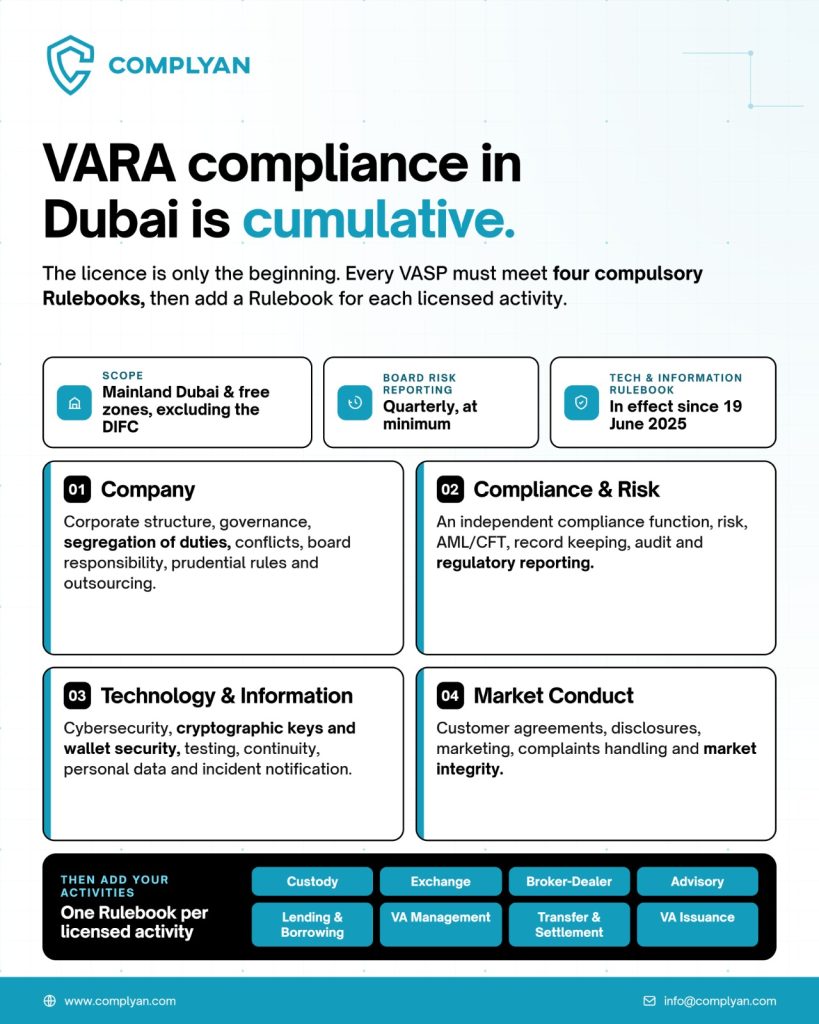
Every licensed VASP must comply with four compulsory Rulebooks:
Company Rulebook: corporate structure, governance, segregation of duties, conflicts, board responsibilities, senior management, prudential requirements, and outsourcing.
Compliance and Risk Management Rulebook: compliance management, risk, AML/CFT, record keeping, audit, employee controls, and regulatory reporting.
Technology and Information Rulebook: cybersecurity, technology governance, cryptographic keys, wallet security, testing, business continuity, personal data, algorithms, and incident notification.
Market Conduct Rulebook: customer agreements, disclosures, marketing, complaints, market integrity, and conduct requirements.
The obligation does not stop there. A VASP must also comply with each activity-specific Rulebook relevant to its licence, including areas such as Custody, Exchange, Broker-Dealer, Advisory, Lending and Borrowing, VA Management and Investment, Transfer and Settlement, or VA Issuance.
This is why VARA compliance becomes difficult to manage through spreadsheets. A single control may support requirements across several Rulebooks, while one regulatory change may affect policies, evidence, training, risk registers, and technical controls simultaneously.
The Compliance Management System Has to Work
VARA requires VASPs to establish and maintain an effective compliance management system. The system must cover the relevant parts of the business, remain independent from operational functions, support access to records, include suitable resources, and maintain a risk-based testing and monitoring programme.
The Compliance Officer carries significant responsibility. VARA requires the CO to be suitably experienced, approved as Fit and Proper, resident in the UAE or a UAE passport holder, employed full-time by the VASP, and reporting directly to the Board. The CO is also responsible for policies, staff training, compliance reporting, corrective action, and escalation of material non-compliance. For GRC teams, that creates an evidence requirement. It is not enough to say that compliance is being monitored. The VASP needs records showing what was reviewed, which controls failed, who owns remediation, what was reported to the Board, and whether corrective actions were closed.
Complyan Audit and Compliance Management helps teams manage control ownership, gap assessments, evidence, findings, remediation, and audit activity within one workflow.
Risk Management Needs Board Visibility
The Technology and Information Rulebook makes cybersecurity part of the regulatory operating model. VASPs must establish a technology governance and risk assessment framework supported by policies, procedures, processes, and controls designed around identified risks. The current Technology and Information Rulebook has been effective since 19 June 2025.
The requirements reach across cybersecurity policy, key and wallet management, technology testing, algorithm governance, business continuity, incident management, CISO responsibilities, staff competence, personal data, and notification to VARA.
This is particularly important for exchanges, custodians, and transfer providers. Weak key management, poor segregation, ineffective access controls, or incomplete incident response evidence can create both security exposure and compliance exposure.
Compliance teams therefore need technical evidence tied directly to the relevant VARA requirement: penetration test records, access reviews, backup testing, wallet controls, security monitoring, incident exercises, risk assessments, and policy approvals.
AML/CFT and the Travel Rule Need Continuous Control
Virtual asset businesses also carry significant AML/CFT responsibilities.
VARA requires VASPs to comply with UAE Federal AML/CFT laws. The current regulatory set includes Federal Decree-Law No. 10 of 2025 and Cabinet Resolution No. 134 of 2025, which replaced earlier AML legislation and implementing rules.
The Travel Rule is another major requirement. VARA requires prescribed originator and beneficiary information for qualifying virtual asset transfers and expects VASPs to perform risk-based due diligence on counterparty VASPs. The framework also addresses unhosted wallets, anonymity-enhanced transactions, and attempts to structure transactions around reporting thresholds.
These obligations need more than onboarding documentation. VASPs need working KYC processes, screening records, risk-based due diligence, transaction monitoring, escalation procedures, and evidence that controls remain effective.
Third Parties Can Create Regulatory Exposure
Virtual asset businesses depend heavily on third parties: cloud providers, blockchain infrastructure vendors, KYC services, custody technology, wallet providers, payment partners, analytics platforms, security vendors, and outsourced operations.
That dependence has to be governed. Supplier risk should connect to the same compliance structure as internal controls. The organization needs to know which providers support regulated activities, what data they handle, what systems they access, what contractual obligations apply, and what happens if the service fails.
Complyan Third-Party Risk Management centralizes vendor records, risk assessments, supplier questionnaires, monitoring, and remediation.This gives VASPs a clearer way to show that supplier risk is being assessed throughout the relationship rather than only during onboarding.
Data Protection Cannot Sit Separately
VARA’s Technology and Information Rulebook also includes specific requirements around personal data protection and confidential information.
For VASPs collecting identity documents, transaction records, wallet information, customer profiles, screening data, or behavioral information, privacy governance needs to connect directly to compliance.
Complyan Data Privacy and Governance supports processing records, data flow mapping, privacy assessments, and documentation of personal-data risks.
That connection matters because the same customer data may touch KYC, AML, cybersecurity, third parties, incident response, and regulatory reporting.
Turning VARA Rules Into a Working Compliance Program
A practical VARA program starts by identifying every Rulebook applicable to the VASP’s licensed activities. The requirements should then be mapped into a unified control library rather than managed as separate regulatory documents.
From there, each control needs clear ownership, supporting evidence, testing frequency, associated risks, findings, and remediation status. Changes to the Rulebooks should trigger a review of mapped controls instead of another manual compliance project.
This is where Complyan fits well: VARA obligations can be managed alongside cybersecurity controls, risk registers, third-party assessments, privacy requirements, audit evidence, and remediation workflows.
For virtual asset businesses in Dubai, regulatory readiness comes down to one question: can the organization prove that the controls behind its licence are operating today?
VARA compliance becomes much easier to defend when the answer sits in one system rather than across spreadsheets, inboxes, policies, and audit folders.