


 Governance and Policy Management
Automated Evidence Collection: How Compliance Teams Stop Rebuilding Audit Proof Every Quarter

Automated evidence collection helps compliance, GRC, and security teams replace last-minute audit scrambling with a live evidence process. Instead of chasing screenshots, exports, access review records, cloud settings, policy approvals, ticket histories, and vulnerability reports weeks before an audit, teams can collect proof from connected systems on a defined schedule and map it directly to controls.
The pressure is familiar. SOC 2, ISO 27001, PCI DSS, GDPR, NCA ECC, SAMA CSF, CBK CORF, and internal audits all ask for evidence. The same proof is often requested in different formats, by different teams, across different audit cycles. Manual collection turns compliance into a recurring interruption.
Automation changes that pattern. Vanta describes automated evidence collection as the use of integrations, APIs, and rule-based checks to gather, organize, and store documentation that supports compliance. It also notes that these capabilities are usually built into compliance software to keep readiness tasks in one place.
Manual Evidence Collection Breaks at Scale
Manual evidence collection may work for a small team preparing for one audit. It fails when the organization has multiple frameworks, several business units, cloud infrastructure, third-party vendors, hybrid work, and recurring customer assurance requests.
The problem is not only effort. Manual evidence is easy to misplace, duplicate, mislabel, or collect too late. A screenshot taken today may not prove the control worked last month. A policy in a folder may not show approval history. A vulnerability report may not show remediation closure. An access review spreadsheet may not prove who reviewed it, when it was approved, or what exceptions were accepted.
That creates audit friction. It also weakens management confidence because leadership cannot tell whether controls are current or only documented
Evidence Should Be Connected to Controls
Evidence has value only when it proves something specific. A cloud configuration export should map to a control. A ticket should map to remediation. An access review should map to identity governance. A vendor report should map to third-party risk. A backup test should map to resilience.
Without this mapping, teams end up with folders full of files and no clear audit story.
A better model links every control to:
Control owner
Evidence source
Collection frequency
Framework requirement
Review status
Exceptions
Remediation action
Auditor-ready proof
This is where automated evidence collection becomes more than file storage. It becomes a control assurance process.
The Three Layers Behind Real Automation
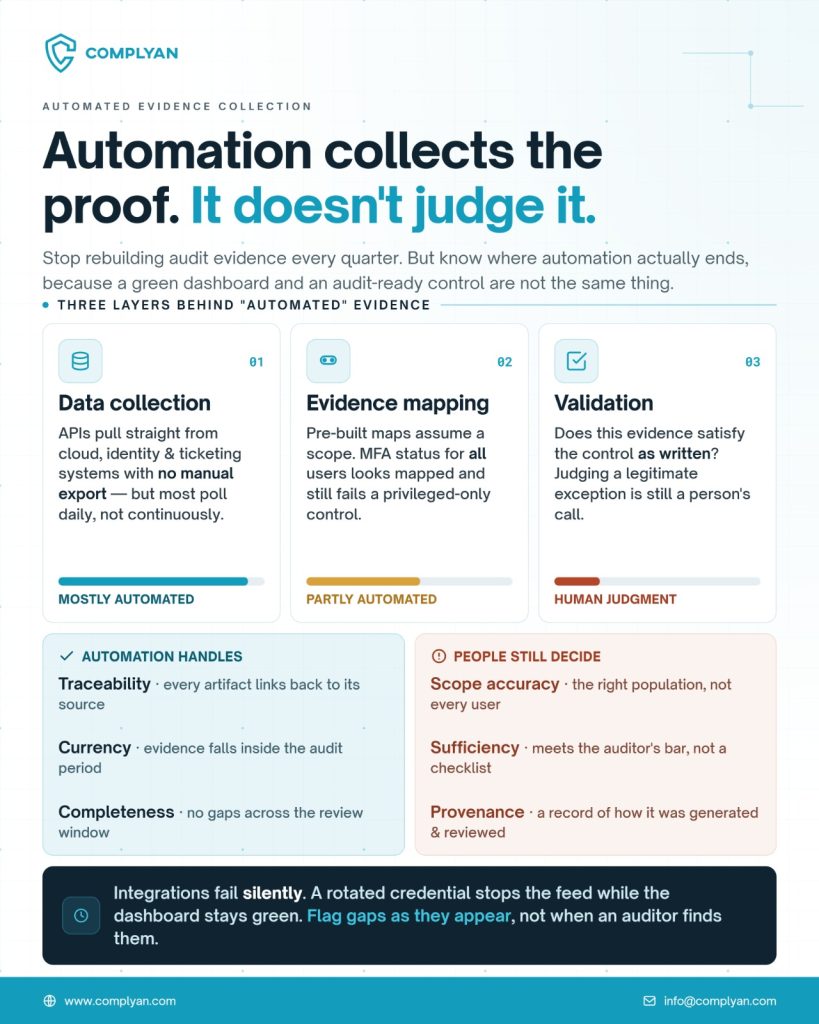
Data collection is where automation is most complete. Platforms pull raw information directly from source systems through API integrations, covering cloud environments, identity providers, and ticketing tools without a human exporting anything manually. Even here, gaps hide in the details. Most platforms poll on a daily cadence rather than truly continuously, integrations only cover the scope they were originally set up with, and a token expiring or a permission getting revoked can stop data collection silently while the dashboard keeps showing green.
Evidence mapping links raw data to specific control requirements, and automation here is only partial. Pre-built mappings connect data fields to control IDs across common frameworks, but they assume a specific population and scope. A report showing multi-factor authentication status across every user can look correctly mapped while failing the control entirely, if the requirement only applies to privileged accounts.
Validation answers the real question an auditor cares about: does this evidence genuinely satisfy the control as written. Automated checks can catch a missing account or a report pulled outside the audit window, but judging whether an exception was legitimate, or whether an auditor’s sufficiency standard has been met, still requires a person.
Six Properties Auditors Check
Regardless of how evidence was collected, auditors evaluate it against the same six qualities. Traceability confirms every artifact links back to its source system. Currency confirms evidence falls within the correct audit period. Scope accuracy confirms the evidence covers the right population and systems. Completeness confirms no gaps exist across the full review window. Sufficiency confirms the evidence meets the standard an auditor applies, not just an internal checklist. Provenance confirms a documented record exists of how the evidence was generated and reviewed.
Automation handles traceability, currency, and completeness reasonably well when integrations are configured correctly. Scope accuracy, sufficiency, and provenance depend on human decisions that no platform can make on its own.
Where This Breaks in Practice
Data collected but never properly mapped. Information flowing into a platform without being tied to a specific control requirement is not evidence. It is storage with a dashboard attached.
Integrations that fail silently. A routine credential rotation or IAM cleanup can quietly stop a data feed. The compliance dashboard keeps reflecting the last known state rather than the current one, and the gap only becomes visible when an auditor asks for evidence covering a period where none exists.
Evidence that was mapped but never validated. A report can sit under the correct control in the correct framework and still fail an audit if it covers the wrong population or the wrong time window. Mapping is a filing exercise. Validation is a judgment call.
Manual uploads disguised as automation. A meaningful share of what gets marked as “evidenced” in many compliance platforms was uploaded manually by a control owner rather than pulled through an integration. The platform organized it well, but the underlying artifact carries the same weak provenance as anything compiled outside the system.
Why This Matters More as Audit Cycles Get Longer
The stakes get sharper any time an audit covers a sustained period rather than a single point in time. Reviewers checking evidence from month three of a longer observation window are checking not only whether it is correct, but whether it has remained intact since collection. Complyan’s audit and compliance management tools are built around exactly this demand: real-time monitoring that flags potential gaps as they appear, so evidence stays current throughout the year instead of getting reconstructed under pressure once an audit date is set
Where Complyan Supports Evidence Automation
Complyan Audit and Compliance Management helps organizations manage compliance documentation, evidence of compliance, audit readiness, gap assessments, and reporting across cybersecurity frameworks. Its audit and compliance page highlights tools for creating and maintaining compliance reports, evidence, and documentation.
Complyan Integrations also support evidence collection from connected systems. The integrations page references compliance evidence from tools such as Microsoft Purview, DLP policy coverage, sensitivity-label deployment, audit-log retention configuration, SecurityScorecard ratings, and portfolio-level risk trends.
For teams managing wider governance work, Complyan Cyber Risk Management helps connect evidence to cyber risks, owners, KRIs, mitigation plans, and reporting. That matters because missing evidence is often a sign of a deeper issue: unclear ownership, weak control operation, or delayed remediation.
Questions Worth Asking Before Trusting a Platform
Does it pull evidence directly from source systems, or rely on manual uploads? The answer determines whether evidence carries a genuine timestamp and audit trail.
Does mapping account for scope, or apply generic defaults? A pre-built mapping that ignores your organization’s actual control scope produces evidence that looks complete and fails under scrutiny.
Does it flag broken integrations, or stay silent? A platform that cannot tell you when a data feed stops working leaves gaps invisible until an auditor finds them.
Can every artifact be traced back to its source system? If reconstructing an artifact’s origin requires asking a person to remember how it was generated, it was never truly automated in the first place.
Conclusion
Automated evidence collection helps compliance teams move away from audit panic and toward continuous assurance. The value is not only speed. The value is cleaner ownership, fresher evidence, better control visibility, and fewer surprises during review.
The right approach is simple: define the control, assign the owner, connect the evidence source, automate what can be automated, review exceptions, and track remediation until closure.
For GRC teams, the goal is not to gather more files. The goal is to prove that controls are working before the audit starts.