

 Governance and Policy Management
Common Control Framework: How Compliance Teams Reduce Duplicate GRC Work

Compliance teams are dealing with more frameworks, more audits, more customer questionnaires, and more evidence requests than ever before. The problem is that many organizations still manage each requirement separately. ISO 27001 has its control set. SOC 2 has another. PCI DSS, NIST CSF, GDPR, UAE IA, SAMA CSF, NCA ECC, DORA, and other mandates all bring their own wording, audit expectations, and evidence demands.
That creates duplication. The same access review may support several frameworks. The same incident response plan may satisfy multiple requirements. The same vendor assessment may prove different obligations across privacy, security, and resilience. Yet many teams keep collecting the same proof repeatedly because their controls are not mapped into a shared structure.
A Common Control Framework solves a problem most compliance teams create for themselves without realizing it: mapping the same underlying safeguard five separate times because five different frameworks each demand their own version of proof. Complyan’s governance and policy management tools are built around removing exactly that duplication, treating every control as something defined once and reused everywhere it applies.
What a Common Control Framework Is
A Common Control Framework, or CCF, is a consolidated set of control requirements aggregated, correlated, and rationalized from across the major industry security and privacy standards. Instead of building a separate control set for ISO 27001, another for SOC 2, and another for PCI DSS, a CCF defines each safeguard once: access control, encryption, incident response, vendor oversight: and maps it against every framework it happens to satisfy.
This approach exists because most compliance frameworks share the same underlying security principles. The differences usually sit in evidence format and audit language, not the substance of what needs protecting. A CCF strips that duplication out at the source.
What a Common Control Framework Should Do
A proper Common Control Framework is more than a spreadsheet crosswalk. It should define the control, map it to relevant framework requirements, assign ownership, specify evidence, define testing frequency, link risks, and track remediation when the control fails.
For example, one access control may map to ISO 27001, SOC 2, PCI DSS, NIST CSF, and GDPR. The control owner should not need to prove the same activity five times in five separate formats. The organization should maintain one control record that shows what the control does, which obligations it supports, what evidence proves it, who owns it, and when it was last reviewed.
The Secure Controls Framework, one of the better-known common control models, positions itself as a metaframework that normalizes requirements from more than 200 cybersecurity and privacy laws, regulations, and frameworks into a unified control catalog. That reflects the wider value of the approach: reduce duplicated interpretation and make assurance easier to maintain.
The Evidence Problem
A control without an owner is a future finding. Manual GRC programs often hide this problem because ownership sits in old trackers or depends on someone remembering who handled the last audit.
Security compliance automation makes ownership visible. Every control should have a business owner, technical owner, evidence source, review frequency, status, linked risks and remediation workflow. When something fails, the platform should show who owns the fix, when it is due and what proof is needed to close it.
This changes the compliance team’s role. Instead of chasing every file, the team manages the system of accountability. That is a stronger use of compliance expertise because the team can focus on risk, exceptions, control design and management reporting
How to Build a Common Control Framework
Start by listing the frameworks and obligations the organization must meet. Then identify where requirements overlap. Access control, incident response, asset management, vulnerability management, logging, encryption, vendor risk, business continuity, data protection, and policy management are common areas where one control can support multiple frameworks.
Next, define the control in business language. The control should be clear enough for the owner to operate and specific enough for an auditor to test. Then map the control to framework requirements, define the evidence required, assign ownership, set a review cycle, and connect failures to remediation.
The strongest programs review mappings regularly. New regulations, framework updates, system changes, business expansion, and audit findings can all change how a control should be mapped.
What a CCF Approach Delivers in Practice
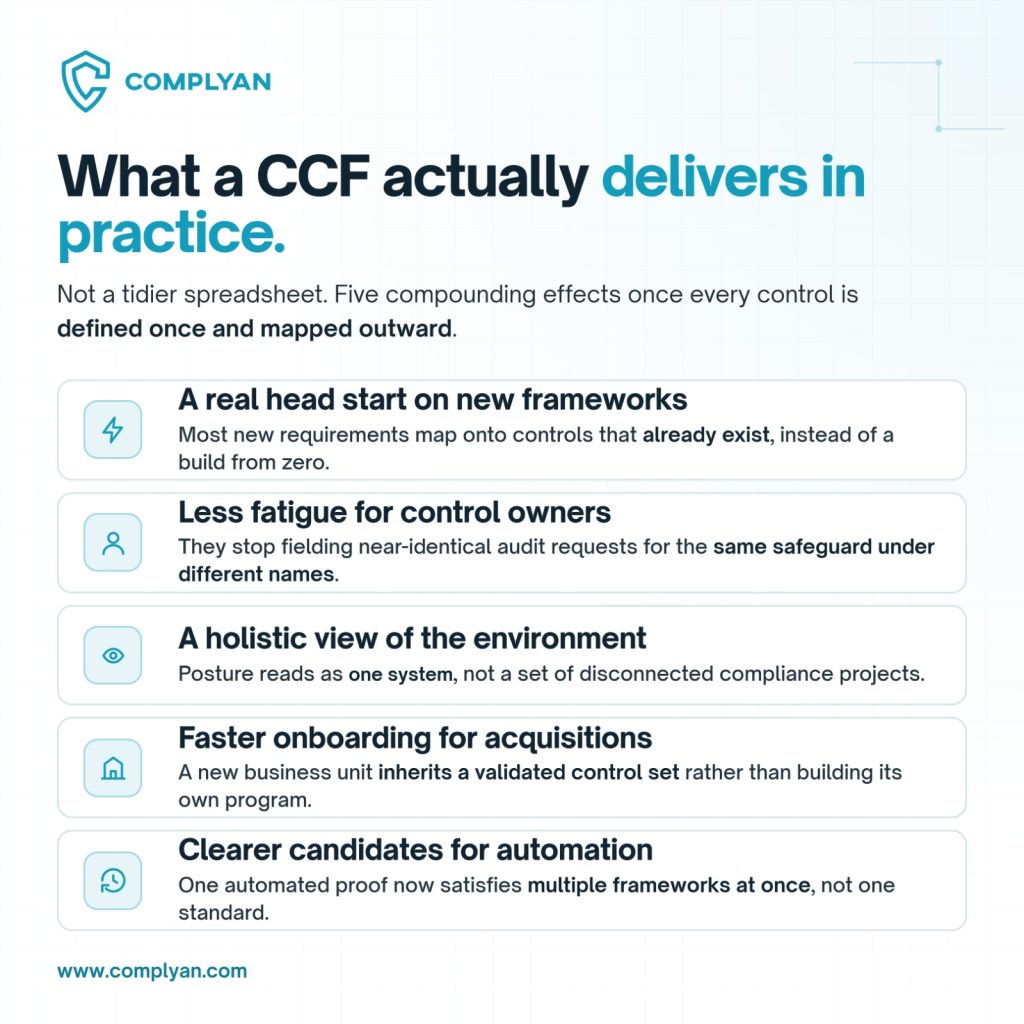
A real head start on new frameworks: Adopting a validated baseline control set means most new compliance requirements map onto controls that already exist, rather than requiring a build from zero.
Reduced compliance fatigue for control owners: The people responsible for operating a control, not just documenting it, stop fielding near-identical audit requests for the same safeguard under different names.
A genuinely holistic view of the control environment: Because every control lives in one place and maps outward to every framework it satisfies, an organization can see its actual security posture as a single system rather than a set of disconnected compliance projects.
Faster onboarding for new business units and acquisitions: A newly acquired company can inherit an existing, validated control set rather than building its own compliance program from scratch, cutting the time to full compliance considerably.
Clearer candidates for automation: Once controls are consolidated and mapped, it becomes far easier to identify which ones are good candidates for automated evidence collection, since the same automated proof now satisfies multiple frameworks at once instead of one.
Building a CCF Program That Holds Up
Define the common control set first: Start from a validated baseline, whether the SCF or another recognized foundation, and adapt it to reflect the organization’s actual environment rather than adopting it unmodified.
Map every control to every framework it satisfies: This is the step that turns a static control list into genuine efficiency: one access control mapped simultaneously against ISO 27001, SOC 2, and PCI DSS turns three separate compliance efforts into a single one.
Assign clear ownership and document how each control operates: A control needs a named owner, a defined frequency, and a documented method of proof, or accountability quietly disappears the moment the control needs updating.
Attach evidence once and reuse it everywhere it applies: Complyan’s cybersecurity compliance platform is built around exactly this principle, letting evidence collected for one control satisfy every framework that control maps to, rather than repeating collection for each standard separately.
Monitor and refine continuously: As new frameworks get adopted or existing ones update, a CCF should extend the existing control set rather than starting over, which is the entire point of building this way in the first place.
Conclusion
A Common Control Framework gives compliance teams a better way to manage multi-framework obligations. It reduces duplicated work, improves evidence reuse, strengthens ownership, and gives leadership a clearer view of control health.
For organizations using Complyan, the value is direct: map overlapping requirements once, assign owners clearly, collect evidence against the right controls, connect gaps to risk, and report readiness across multiple frameworks without rebuilding the same work for every audit.
Compliance will always require proof. A Common Control Framework makes that proof easier to manage, easier to reuse, and easier to defend.