



 Governance and Policy Management
Security Metrics That Matter: KPIs Every CISO Should Track

Security teams can measure almost everything. That does not mean every number deserves a place on the CISO dashboard.
Counts of blocked attacks, raw alert volume and the number of vulnerabilities discovered may look impressive, but they rarely explain whether business risk is increasing or whether a control is working. NIST’s current information security measurement guidance puts the focus in the right place: select measures that support decision-making, evaluate control performance and show meaningful trends.
For a CISO, the strongest KPI set should answer three questions: Where are we exposed? Are our controls reducing that exposure? Are we improving fast enough?
Start With the Decision
A metric earns a place on the dashboard when someone can name the decision it changes. This is practical guidance: for each candidate, write down the decision it informs, the system that produces the data, the person who owns it, and the review cadence. Decryption Digest maps typical sources: the SIEM for detection and response times, the vulnerability platform for patch timelines, EDR for endpoint coverage, and the identity provider for MFA enrollment. A metric with no decision and no owner is decoration.
Detection and Response
Mean time to detect: the time from an incident occurring to its detection, per Cybelangel. Decryption Digest advises tracking it per incident type, because ransomware detection is a different capability from business email compromise detection.
Mean time to remediate: the full lifecycle from detection through complete resolution, per Cybelangel, which also notes that mean time to contain measures an earlier stage. Reporting only one of the three can hide problems in the others.
Regulator notification time: this is practical guidance for the Gulf. Under the CBUAE Operational Risk Management Regulation, institutions must notify the central bank within four hours of events significantly affecting Critical Operations, so the elapsed time from classification to notification is a metric worth tracking against that clock.
Exposure
Critical vulnerability aging: how long critical vulnerabilities stay open, which Cybertronics lists alongside patch latency by severity. An average hides the long tail, so report the oldest open items as well.
Coverage of critical assets: the share of critical systems covered by monitoring, scanning, or protection. UINAT warns that coverage figures can mislead: “95 percent of assets scanned” says nothing about whether the missed five percent matter.
Identity and Access
Cybertronics names four identity measures that board packs often lack: privileged access review completion, MFA coverage for administrators, dormant account count, and time to deprovision after termination. Each links directly to a control owner and a fix, which makes them stronger than a general phishing rate.
Recovery
Backup coverage: Decryption Digest defines it as the share of critical systems with tested, current backups.
Time to restore: Erdal Ozkaya’s board reporting guide lists tested recovery time for mission-critical systems among five core board metrics. Measure it in exercises, so the number reflects practice instead of a vendor claim.
Third Parties and Compliance
Third-party access review completion: Cybertronics lists it among actionable measures. It shows whether supplier access is being checked on schedule. Confirm the supplier list first, so the review covers every provider with privileged access and not only the ones people remember.
Controls with current evidence: this is practical guidance. The NCSC’s NBCC requires an annual self-assessment and evidence available on request, per RSM, so the share of controls with dated, retrievable evidence tells you how long an assessor request would take.
A Starter Set of Eight
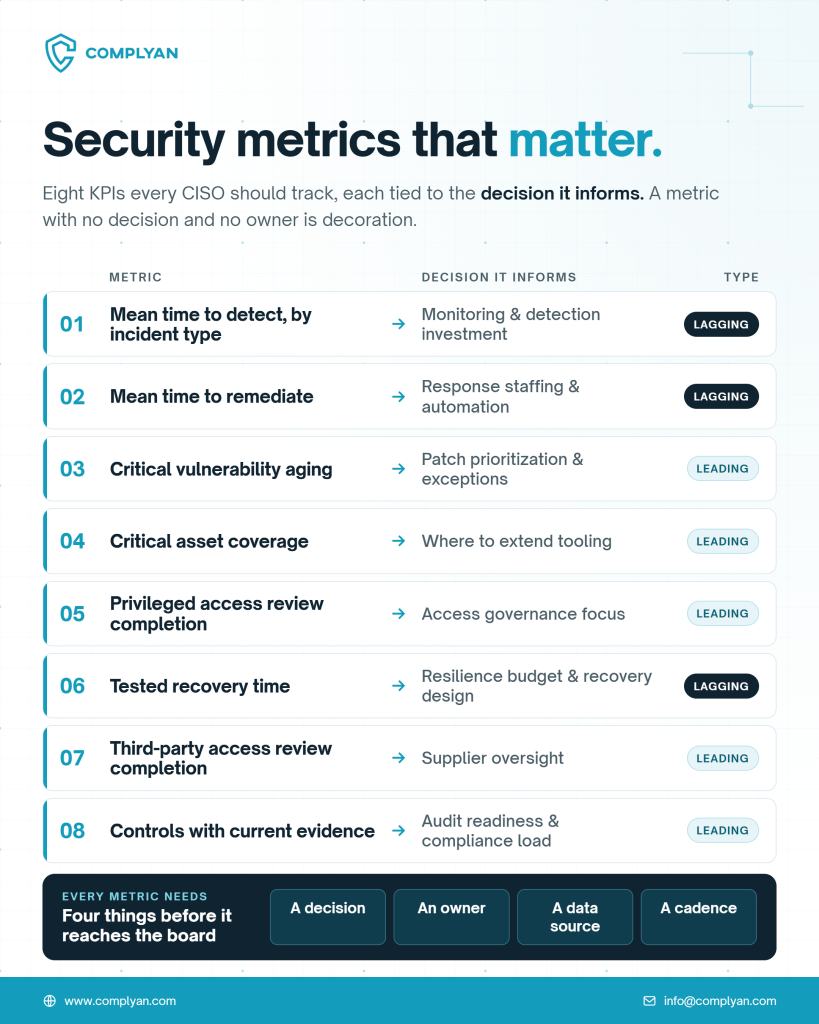
| Metric | Decision it informs |
|---|---|
| Mean time to detect, by incident type | Monitoring and detection investment |
| Mean time to remediate | Response staffing and automation |
| Critical vulnerability aging | Patch prioritization and exceptions |
| Critical asset coverage | Where to extend tooling |
| Privileged access review completion | Access governance focus |
| Tested recovery time | Resilience budget and recovery design |
| Third-party access review completion | Supplier oversight |
| Controls with current evidence | Audit readiness and compliance load |
Pair Leading and Lagging Indicators
Decryption Digest advises measuring leading indicators alongside lagging ones. Patch timelines and review completion rates are leading, because they move before an incident does. Incident counts and recovery times are lagging, because they report what already happened. A dashboard with only lagging measures explains the past, and one with only leading measures cannot show whether the work paid off.
How to Build a CISO Metric Set
Start with decisions, not available data. Every KPI should have an owner, a defined calculation, a reporting frequency and a threshold that triggers action.
Use a small executive set for the board and a deeper operational set for security managers. The board needs risk exposure, trend, material control weakness and treatment progress. Security teams need the supporting detail required to act.
Metrics should also be stable enough for comparison. Constantly changing definitions makes quarter-over-quarter reporting unreliable. When a calculation changes, record the change so the trend is not misread.
Connect Metrics to Frameworks and Risk
Security measurement becomes more useful when the KPI is connected to the controls and risks it represents. A patching metric can support vulnerability-management requirements across multiple standards. An access-review metric can support identity controls across the same control library.
Complyan’s common control framework approach helps teams connect one control to multiple requirements, while dashboards provide a single view of control and compliance status. This keeps reporting tied to the work that produces assurance.
Conclusion
The metrics that matter are the ones tied to a decision, defined precisely, owned by a named person, and presented to each audience in the terms it uses. Organizations that retire vanity measures, track a small set across detection, exposure, identity, recovery, suppliers, and evidence, and translate them into business terms give leadership something to act on.
Frequently Asked Questions About Vendor Risk Scoring
What security metrics should a CISO report to the board?
Board reporting should focus on business-relevant measures such as cyber risk exposure, material control weaknesses, critical vulnerability remediation, incident detection and recovery performance, third-party risk and progress against major treatment plans. Highly technical operational metrics are better kept in management-level dashboards.
What is the difference between a security KPI and a security metric?
A security metric is any measurable data point about security performance. A KPI is a metric selected because it indicates progress against an important security or business objective. Every KPI is a metric, but many operational metrics do not need executive attention.
How many cybersecurity KPIs should a CISO track?
There is no universal number, but executive dashboards should stay focused. A small group of stable KPIs covering risk, control effectiveness, resilience, exposure and remediation is more useful than dozens of disconnected measures. Operational teams can maintain a broader set beneath the executive view.
Why are raw vulnerability and alert counts weak executive metrics?
Raw counts lack context. A rise in detected vulnerabilities may result from better scanning rather than higher risk, while higher alert volume may reflect a change in tooling. Metrics become more useful when they include asset criticality, severity, exploitability, ageing, remediation performance and business impact.
How can CISOs make security metrics more useful for decision-making?
Each KPI should have a defined calculation, owner, reporting frequency, target or threshold and an agreed action when the threshold is breached. Connecting the metric to business risk, controls and regulatory obligations also makes it easier to explain why leadership should act.