



 Governance and Policy Management
Data Residency Requirements Across GCC Nations: A Compliance Mapping Guide

Whether data can be hosted abroad depends less on the country than on the kind of data. In the UAE, Article 13 of Federal Law No. 2 of 2019 bars storing health data abroad except in cases the health authority sets, while the federal PDPL does not require personal data to stay in the country, per iConnect IT.
Data residency requirements across GCC nations follow that pattern, and no regional regime links the six states. Complyan’s overview of data privacy regulations covers the privacy laws. This guide covers the hosting rules underneath them and how to map each one.
Where Residency Rules Come From
Residency obligations arrive from three directions, and they do not always agree.
Privacy laws: these govern transfers of personal data, usually through adequacy, safeguards, or consent. They rarely require storage in-country. In Saudi Arabia, Azizme notes a PDPL sensitive-data label alone does not impose blanket localization.
Classification and hosting rules: government and critical systems face hosting rules tied to a classification scheme.
Sector regulators: health and finance rules are usually the binding constraint. MassiveGRID advises checking the sector rule before the general one.
Free zones: MassiveGRID notes the DIFC and ADGM run their own data protection regimes within the UAE, so which group company holds the data decides which regime applies.
The Country Map
Country | Where binding hosting rules appear |
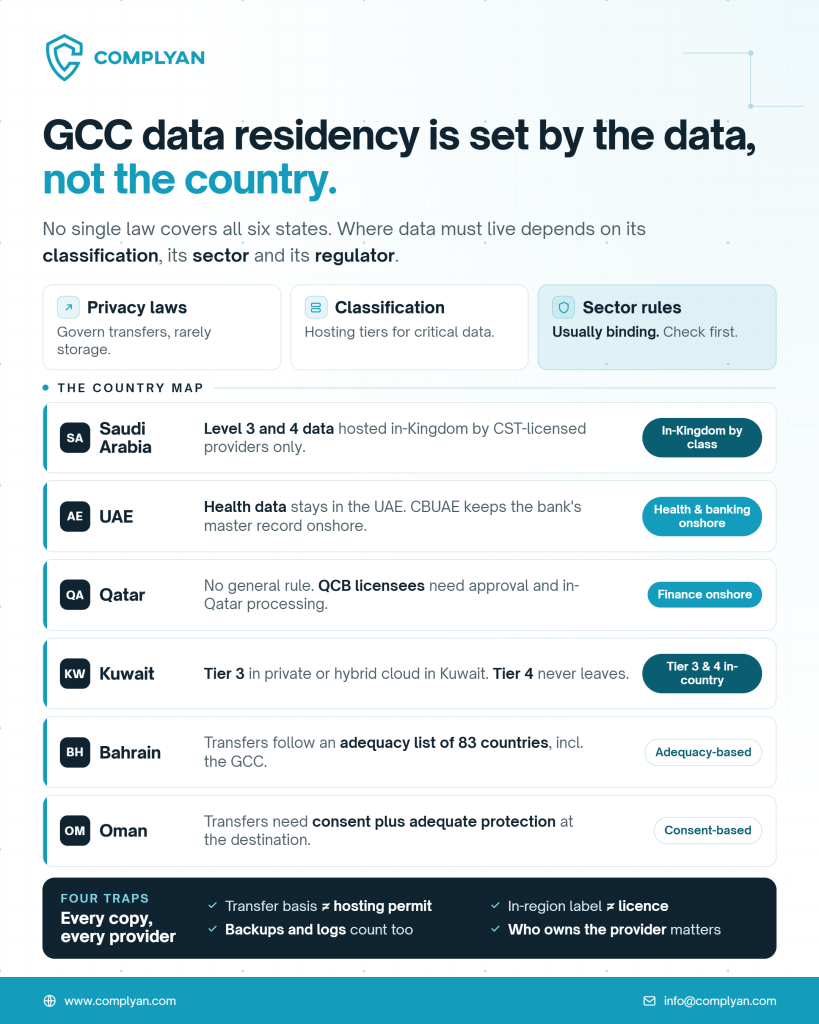
Saudi Arabia | CST’s Cloud Computing Regulatory Framework requires Level 3 and Level 4 data to be hosted in-Kingdom by CST-licensed providers, per VLink. GRC Vantage reports CCC-2:2024 deleted its own in-Kingdom delivery subcontrols and moved localization to the NDMO, while CSCC control 4-2-1-1 still limits where critical systems can be hosted |
UAE | Article 13 of Federal Law No. 2 of 2019 bars storing, processing, or transferring health data outside the UAE except in cases set by the health authority. Ministerial Decision No. 51 of 2021 lists ten exception types, per trade.gov. iConnect IT reports CBUAE rules keep the master system of record in the UAE |
Qatar | The Cloud Policy Framework says residency is no longer a general requirement, as quoted by TechYorker. QCB licensees face more: approval before a cloud arrangement, and personal and financial information processed within Qatar, per Safeguard’s summary of QCB’s regulation |
Kuwait | Under the CITRA framework, Tier 3 data stays in private or hybrid cloud inside Kuwait and Tier 4 data stays in Kuwait for any purpose, per Rukn. RSM notes the NBCC adds a cloud security appendix. Chambers reports no general localization rule for private companies |
Bahrain | Transfers follow an adequacy list of 83 countries including the other GCC states, per Recordinglaw. MassiveGRID describes a data embassy approach for foreign customers’ data |
Oman | Transfers require consent plus adequate protection, per Softcery |
Every row simplifies a longer text. MassiveGRID adds that all these instruments have been amended or supplemented, so verify against current texts.
Four Traps the Map Prevents
Treating privacy transfer rules as hosting rules: a lawful transfer basis does not authorize hosting health data abroad in the UAE.
Trusting an in-region label: a region name is not a licence. Saudi hosting depends on provider registration class, and Qatar’s financial rules depend on approval.
Forgetting copies: the Kuwait framework bars Tier 3 and 4 storage outside the country temporarily or permanently, per Rukn, which reaches backups, replicas, and exported logs. Ozanix makes the same point for UAE health data.
Ignoring provider ownership: MassiveGRID notes procurement increasingly asks who owns the operator, because a foreign parent may face legal process at home regardless of where the servers sit.
A Mapping Method That Scales
MassiveGRID’s method works well for six countries, and these steps adapt it:
Classify once, centrally: record what data you hold, whose it is, its sensitivity, and the sector rules touching it. Complyan’s data flow and mapping tools trace data by system and destination, so overseas processing shows up.
Hold one processing record: Complyan’s data processing activity tools keep purpose, lawful basis, recipients, and location in one place.
Build one control set at the highest common standard: MassiveGRID points to ISO 27001 with ISO 27701 as a practical spine. Complyan’s cybersecurity compliance tools map one control record across frameworks.
Vary only placement and paperwork: what differs by country is where categories of data may sit and what documentation the regulator expects.
Keep a per-country register: record each conclusion and its reason, so a legal change prompts one reassessment instead of six. Complyan’s data privacy and governance tools hold the register and owners.
Questions to Put to a Cloud Provider
This is practical guidance. Ask where primary data, backups, replicas, logs, and encryption keys sit, and where support staff can reach them from. Ask which licence, registration, or approval the provider holds for each country and when it was last verified. Ask which sub-processors touch the data, and how the provider notifies customers when a region or sub-processor changes. Keep the answers in writing, because a verbal assurance will not satisfy a regulator.
The Residency Record for Each Workload
This is practical guidance. For every workload, keep one record containing:
Classification: the data class and the rules that attach to it.
Locations: primary hosting, backups, replicas, logs, encryption keys, and support access.
Provider status: licence class, approval, or certification, with the date checked.
Transfer basis: the legal basis for anything leaving the country.
Regulator approvals: QCB approval, health authority exceptions, or CITRA tier decisions.
Review date: the next scheduled check.
Complyan’s third-party risk management tracks where suppliers host and process data, and Complyan’s audit and compliance management platform keeps the evidence attached. For Kuwait specifics, see Complyan’s CITRA guide.
Frequently Asked Questions About Vendor Risk Scoring
This is practical guidance. For every workload, keep one record containing:
Classification: the data class and the rules that attach to it.
Locations: primary hosting, backups, replicas, logs, encryption keys, and support access.
Provider status: licence class, approval, or certification, with the date checked.
Transfer basis: the legal basis for anything leaving the country.
Regulator approvals: QCB approval, health authority exceptions, or CITRA tier decisions.
Review date: the next scheduled check.
Complyan’s third-party risk management tracks where suppliers host and process data, and Complyan’s audit and compliance management platform keeps the evidence attached. For Kuwait specifics, see Complyan’s CITRA guide.