

 Governance and Policy Management
AI for Continuous SOC 2 Compliance: What to Automate and What Stays Human

A SOC 2 Type II report asks whether controls operated across a period, so a gap in month four counts as much as a clean week before fieldwork. Complyan’s SOC 2 compliance guide covers the framework. This piece covers the part that has changed most: how AI supports the months between audits, which tasks it handles well, and which decisions auditors still expect a person to make and sign
Why Continuous Work Matters for Type II
SmartSuite notes a Type I report covers control design as of a single date, while a Type II covers design and operating effectiveness over a period and lists the tests and results. That period is where programs slip. An access review skipped in a busy quarter, a backup that failed unnoticed, or a policy that lapsed all show up when an auditor samples across the window. Continuous monitoring exists to catch those slips while they can still be fixed. Network Intelligence describes continuous platforms that track drift and the audit period for the Type II observation window, so the team always knows how much of the period remains and where evidence is thin.
Where AI Helps Across the Audit Period
Activity | What AI does | Source |
|---|---|---|
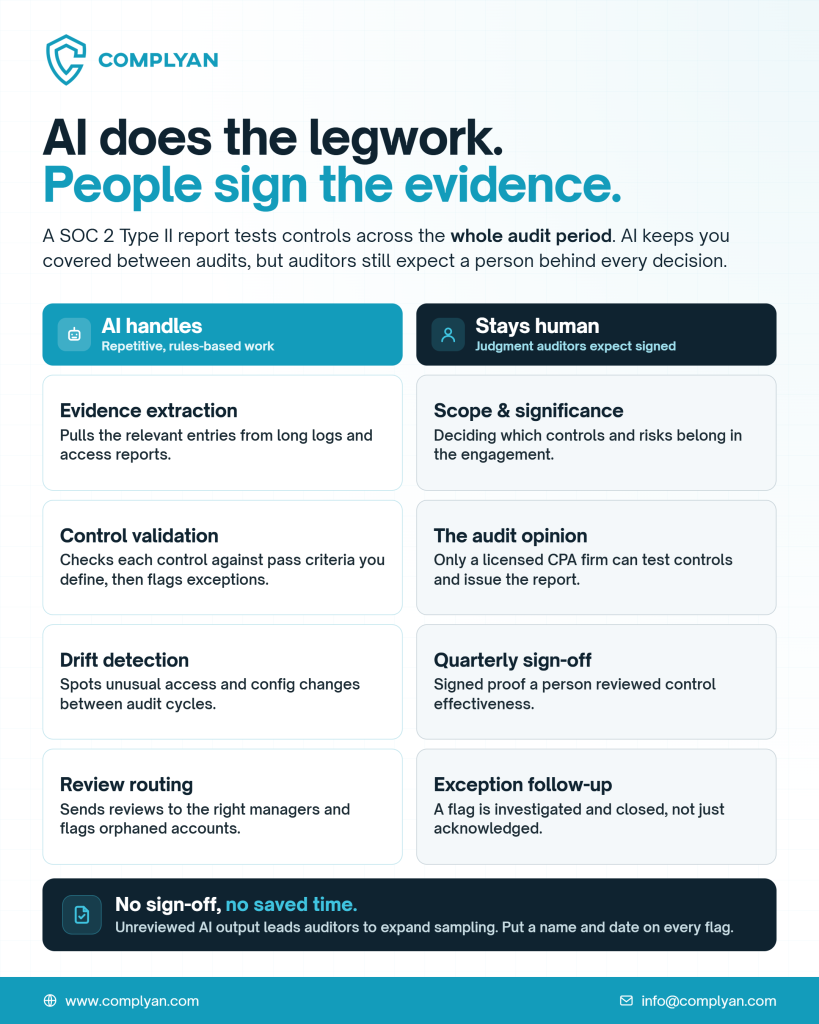
Evidence extraction | Pulls relevant entries from lengthy logs and access reports and flags items for review | Fieldguide |
Mapping and summaries | Maps systems to controls and summarizes risk data | Fieldguide |
Control validation | Checks operation against pass criteria, deviation rates, and approval rules that practitioners define, then flags exceptions | Fieldguide |
Drift detection | Flags unusual access patterns and configuration changes between audit cycles | NextBillion, Network Intelligence |
Review routing | Sends review requests to the right managers and flags orphaned accounts | Dsalta |
Drafting | Drafts policies and prefills security questionnaires | HackerNoon |
Fieldguide, an audit-technology provider, describes the pattern: AI handles repetitive, rules-based work, and auditors retain responsibility for all control evaluations and conclusions.
What Stays Human
Significance and scope: Fieldguide notes attestation standards establish that AI cannot decide which controls, processes, or risks are significant enough to include in a SOC 2 engagement.
The opinion: NextBillion states AI cannot replace independent attestation, because a licensed CPA firm must test the controls and issue the report.
Management review: TheNeuralBase, a practitioner guide, reports auditors expect signed evidence that a person reviewed control effectiveness each quarter, which an AI summary does not replace.
Exception follow-up: Censinet’s guidance stresses assigning control owners who verify evidence even when AI handles the first pass, so a flagged exception is investigated and closed, not acknowledged and dismissed.
The Audit Risk of Unreviewed AI Output
TheNeuralBase warns of a common mistake: teams add AI-driven alerting for SOC 2 controls but no human review step, so an auditor sees alerts with no signed evidence of investigation. It also reports that AI-generated summaries without review checkpoints lead auditors to treat those sections as low confidence and expand their sampling, which erases the time the automation saved. This comes from one practitioner guide, so confirm expectations with your own auditor.
Guardrails That Make AI Evidence Defensible
This is practical guidance.
Write the pass criteria down first: Fieldguide’s model depends on practitioners configuring what counts as a passing test, acceptable deviation, required approvals, and mandatory documentation.
Keep the source and the timestamp: each piece of evidence should link back to the system record it came from.
Require a human sign-off on exceptions and periodic summaries: record who reviewed, when, and what they decided.
Log what the AI did: keep a record of each automated action so an auditor can reconstruct it.
Sample the AI’s work: have a control owner re-check a small set of outputs each month and record the result.
Where to Start
This is practical guidance. Begin with the recurring, high-volume controls where evidence is repetitive: access reviews, change management approvals, and vulnerability remediation. Fieldguide’s own example is the quarterly access review, where AI extracts relevant items from long reports and flags them for the practitioner. Prove the review-and-sign-off loop on one or two controls, then extend it.
Questions to Ask Any AI Compliance Tool
This list is practical guidance. Can you see the source record behind every piece of evidence? Can you set your own pass criteria, deviation limits, and approval rules? Does the tool log each automated action? How are exceptions assigned, tracked, and closed? Where is your evidence data stored and processed, given that regional residency rules may apply to some data? A tool that cannot answer these questions will be hard to defend in front of an auditor.
A Continuous Rhythm
This rhythm is practical guidance. Review the exception queue weekly, so flagged items do not age. Hold a control health review monthly, and sign off the access review quarterly. Run a readiness check before the auditor arrives, comparing the evidence file against the control list.
An Illustrative Example
This scenario is illustrative. For the quarterly access review control, the AI extracts the user list, compares it with the HR leavers list, and flags three terminated employees who still hold active accounts. It routes each flag to the system owner. The owner removes the access, attaches the ticket, and signs the review. The auditor later sees the extract, the exceptions, the fixes, and a person’s name and date on each, which is the evidence the control calls for.
When AI Is Part of the System in Scope
If your service uses AI, SOC 2 criteria apply to that system too. NextBillion advises readers of an AI vendor’s SOC 2 report to look for model lifecycle controls, continuous monitoring with documented drift procedures, and oversight of third-party AI subprocessors. Complyan’s third-party risk management keeps those supplier assessments and reports attached to each vendor.
Build the Rhythm in Complyan
This is practical guidance. Hold each control, owner, and test in Complyan’s cybersecurity compliance tools, and keep dated evidence and sign-offs in Complyan’s audit and compliance management platform. Track policies and review dates with Complyan’s governance and policy management tools, and give leadership a live view through Complyan’s executive and board reporting. Complyan’s piece on SOC 2 in client-facing industries shows how the same evidence habits apply outside software.
Conclusion
AI makes continuous SOC 2 compliance practical by handling extraction, mapping, drift detection, and routing, while people define the criteria, review exceptions, and sign the evidence. Organizations that write the pass criteria down, keep a human on every exception and quarterly review, and log what the AI did can arrive at fieldwork with evidence an auditor can verify.