



 Governance and Policy Management
SOC 2 Compliance for Law Firms: How Data Security Became a Client Requirement

Law firms handle information that carries enormous consequences, including merger strategies, litigation plans, personal financial records, medical histories, and privileged communications. A single breach does not just expose data; it can end client relationships, invite regulatory scrutiny, and permanently damage a firm’s reputation. Yet many firms still treat data security as an IT concern rather than a firm-wide business priority.
SOC 2 compliance offers a structured, independently verified way to demonstrate that a firm’s security posture meets a recognized standard. This blog breaks down what SOC 2 compliance means for law firms, what the audit process looks like, and why the cost of skipping it almost always exceeds the cost of pursuing it.
A firm can no longer treat client information protection as something the IT department handles quietly. It is now a factor in pitches, panel reviews, and renewals. SOC 2 compliance has become one of the clearest ways for a law firm to answer the security question well, and to keep answering it as the client roster grows.
What SOC 2 Is
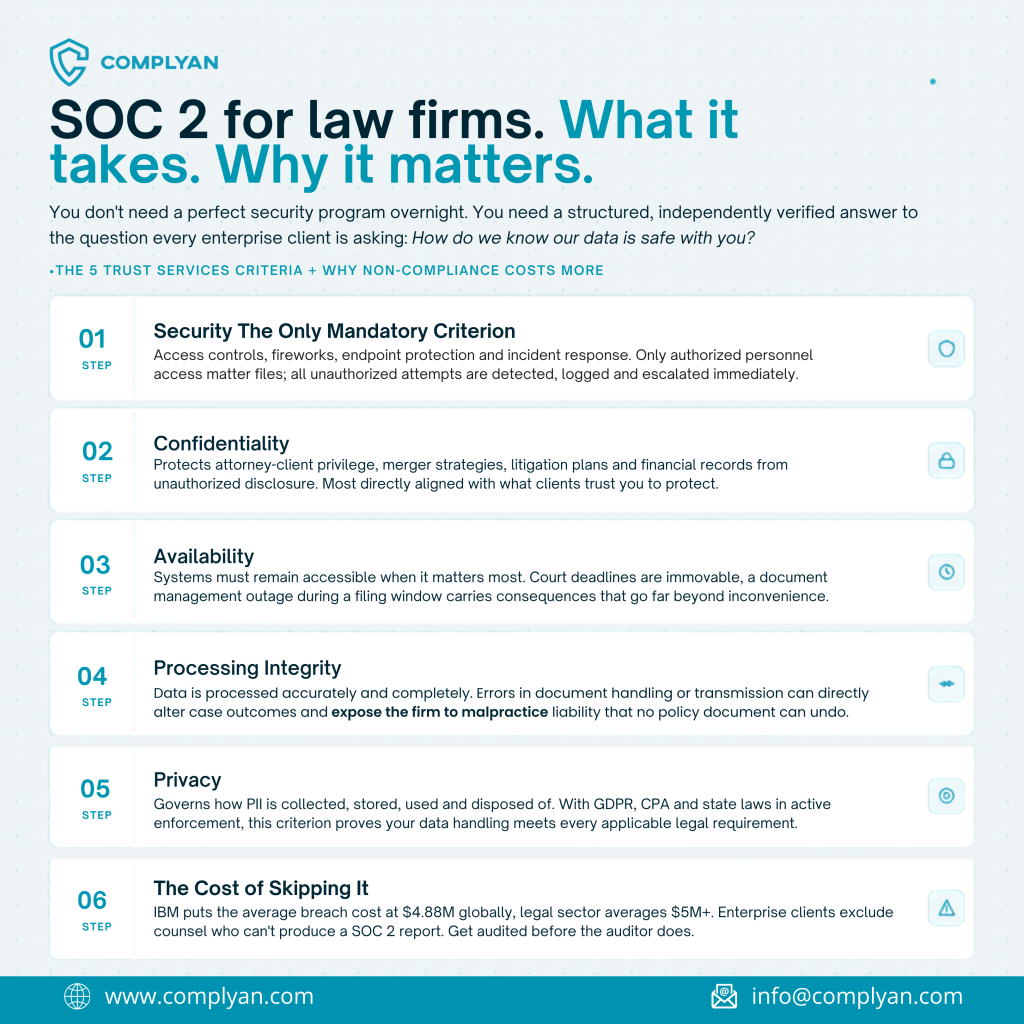
SOC 2, System and Organization Controls 2, is an auditing framework developed by the American Institute of Certified Public Accountants (AICPA). It evaluates how organizations manage customer data against five Trust Services Criteria: Security, Availability, Processing Integrity, Confidentiality, and Privacy.
There are two report types:
- SOC 2 Type 1 evaluates whether security controls are properly designed at a specific point in time.
- SOC 2 Type 2 goes further by testing whether those controls operated effectively over a period, typically six to twelve months.
For law firms, Type 2 is the more meaningful certification because it proves continuous, sustained security practices — not just a well-documented policy that exists on paper.
Security is the only mandatory criterion in every SOC 2 engagement. The remaining four criteria are selected based on the firm’s risk profile and client commitments. A firm handling medical records in litigation matters may include Privacy. One managing time-sensitive court filings may prioritize Availability. Complyan’s SOC 2 compliance framework guide provides a useful breakdown of how these criteria translate into operational controls.
Why Law Firms Specifically Need SOC 2
The legal industry is a high-value target. A 2023 IBM report found that 27% of law firms had already been affected by a security incident, a figure that has continued to climb. Attorney-client privilege makes legal data particularly attractive: adversaries know that the information inside a law firm’s systems can swing litigation outcomes, business negotiations, and regulatory decisions.
Beyond external threats, law firms also face growing pressure from clients. Corporate clients with their own compliance obligations increasingly require their legal counsel to demonstrate equivalent security standards before onboarding. Institutional clients, financial services companies, and healthcare organizations routinely request SOC 2 reports as part of vendor due diligence. A firm that cannot produce one risks losing matters to competitors who can.
There are also ethical dimensions. Bar association rules across jurisdictions require lawyers to take competent and reasonable measures to safeguard client information. Failing to maintain adequate security controls can constitute a professional conduct violation, independent of any breach that may or may not occur.
Why law firms attract attackers
A law firm holds concentrated, high-value information: merger terms, litigation strategy, intellectual property, financial records, and personal data for many clients at the same time. A single firm can serve as a shortcut to dozens of corporate targets, which is why criminal groups treat the legal sector as a priority and ransomware crews return to it year after year. The work itself makes firms attractive, because the most sensitive moment in a deal or a dispute is often the moment a firm is holding the most material.
The numbers reflect that pressure. Industry surveys of US law firms found that roughly one in five reported a cyberattack within the past year, and a meaningful share lost or exposed sensitive data. Reporting places the average cost of a data breach in the legal sector at close to $5 million, with ransomware demands frequently running into seven figures. The direct cost is only part of the damage. A breach exposes privileged material, can stall active matters, and invites scrutiny from regulators and clients alike. Many firms also discover, often too late, how little they had prepared for the reporting obligations that begin the moment an incident is confirmed.
The Five Trust Services Criteria in a Legal Context
Each criterion maps directly to risks that law firms face every day:
Security covers access controls, firewalls, endpoint protection, and incident response. For a firm, this means ensuring that only authorized personnel can access matter files, and that unauthorized access attempts are detected and logged.
Availability ensures systems remain accessible when needed. Court deadlines are immovable. A firm whose document management system goes down during a filing window faces consequences that go beyond inconvenience.
Processing Integrity guarantees that data is processed accurately and completely. In legal work, errors in document handling or data transmission can alter outcomes in ways that expose the firm to malpractice claims.
Confidentiality protects sensitive information from unauthorized disclosure. This is the criterion most directly aligned with attorney-client privilege and the core of what clients expect when they share strategy, financial data, and personal information with their legal team.
Privacy governs how personally identifiable information (PII) is collected, stored, used, and disposed of. With GDPR, CCPA, and a growing list of state-level privacy laws in play, this criterion helps firms demonstrate that their data handling practices meet applicable legal requirements.
What the Compliance Process Looks Like
SOC 2 compliance is not a single event. It is a structured program that typically spans three to six months of preparation before an initial audit, followed by ongoing annual reassessment. Complyan’s GRC platform is one example of how firms can automate evidence collection and control monitoring to reduce the manual burden of this cycle.
The process generally follows these stages:
- Scoping and readiness assessment: Define which systems, processes, and criteria are in scope. Identify gaps between current controls and SOC 2 requirements.
- Gap remediation: Address deficiencies. This often includes tightening access controls, implementing multi-factor authentication, formalizing incident response plans, and establishing data retention and disposal procedures.
- Policy and procedure documentation: Put controls in writing and ensure staff are trained on them. Auditors want evidence of consistent practice, not just documented intent.
- Evidence collection and internal testing: Gather logs, screenshots, records, and reports that demonstrate controls are functioning. Run internal tests before bringing in an external auditor.
- External audit: A qualified CPA firm conducts the formal audit, reviews evidence, tests controls, and issues the SOC 2 report.
Continuous monitoring SOC 2 Type 2 reports are valid for twelve months. Maintaining compliance means treating security controls as an operational discipline, not a one-time project.
The Cost of Non-Compliance
Skipping SOC 2 does not eliminate risk, it transfers it. A data breach at a law firm exposes confidential client communications, creates legal liability, and can trigger regulatory action. Beyond the direct financial costs, which IBM put at an average of $4.88 million globally per breach, the reputational damage to a firm that handles sensitive matters is often unquantifiable.
More practically: a firm that cannot demonstrate a credible security posture will increasingly find itself excluded from enterprise-level engagements. Clients who have invested in their own compliance programs have little tolerance for vendors, including outside counsel, who have not done the same.
Conclusion
SOC 2 compliance gives law firms a credible, third-party-verified answer to the question every sophisticated client is asking: How do we know our information is safe with you?
The preparation process itself has value beyond the certificate. It forces firms to examine how data flows through their systems, where access controls are weak, and where a breach would cause the most damage. That kind of structured self-examination is something every firm should undertake regardless of whether an audit follows.
For firms that have not yet started, the right time was yesterday. The second best time is now.