


 Governance and Policy Management
Cybersecurity Framework Cross Mapping: The Smarter Way to Manage Multi-Framework Compliance

Compliance programs rarely stay limited to a single framework for long. A control that satisfies ISO 27001’s access management requirements likely addresses a comparable requirement in SOC 2 and NIST CSF. Yet without a deliberate cross-mapping strategy, teams rewrite policies, collect duplicate evidence, and brief separate auditors on controls that are functionally identical. The result is wasted hours, inflated audit costs, and a compliance program that grows harder to manage with every new regulation added to the pile.
Framework cross-mapping solves this problem by identifying where two or more security standards share equivalent or overlapping control requirements, then linking them so a single control implementation satisfies multiple frameworks simultaneously.
What Cross-Mapping Means in Practice
Cross-mapping is the discipline of aligning controls across multiple frameworks by drawing explicit connections between their requirements. When an organisation maps ISO 27001 Annex A.9 (access control) against SOC 2 CC6.1 and NIST CSF establishes that a single access management policy, enforced once and evidenced once, can satisfy all three.
The mapping can be done manually using a spreadsheet matrix or through GRC platforms that automate the relationships between controls across frameworks. Manual approaches work for smaller organisations with two or three frameworks in scope. Once the compliance footprint grows, say, an organisation pursuing SOC 2, ISO 27001, GDPR, and PCI DSS concurrently, a structured tool becomes essential.
Two key concepts define effective cross-mapping:
Control equivalence where a requirement in Framework A and a requirement in Framework B are substantively identical and a single implementation satisfies both.
Partial overlap where frameworks share a common theme but differ in scope, depth, or documentation expectations, requiring a shared foundation with some framework-specific additions.
Understanding the difference matters. Treating partial overlaps as full equivalences creates compliance gaps that surface during audits.
The Frameworks Most Commonly Mapped Together
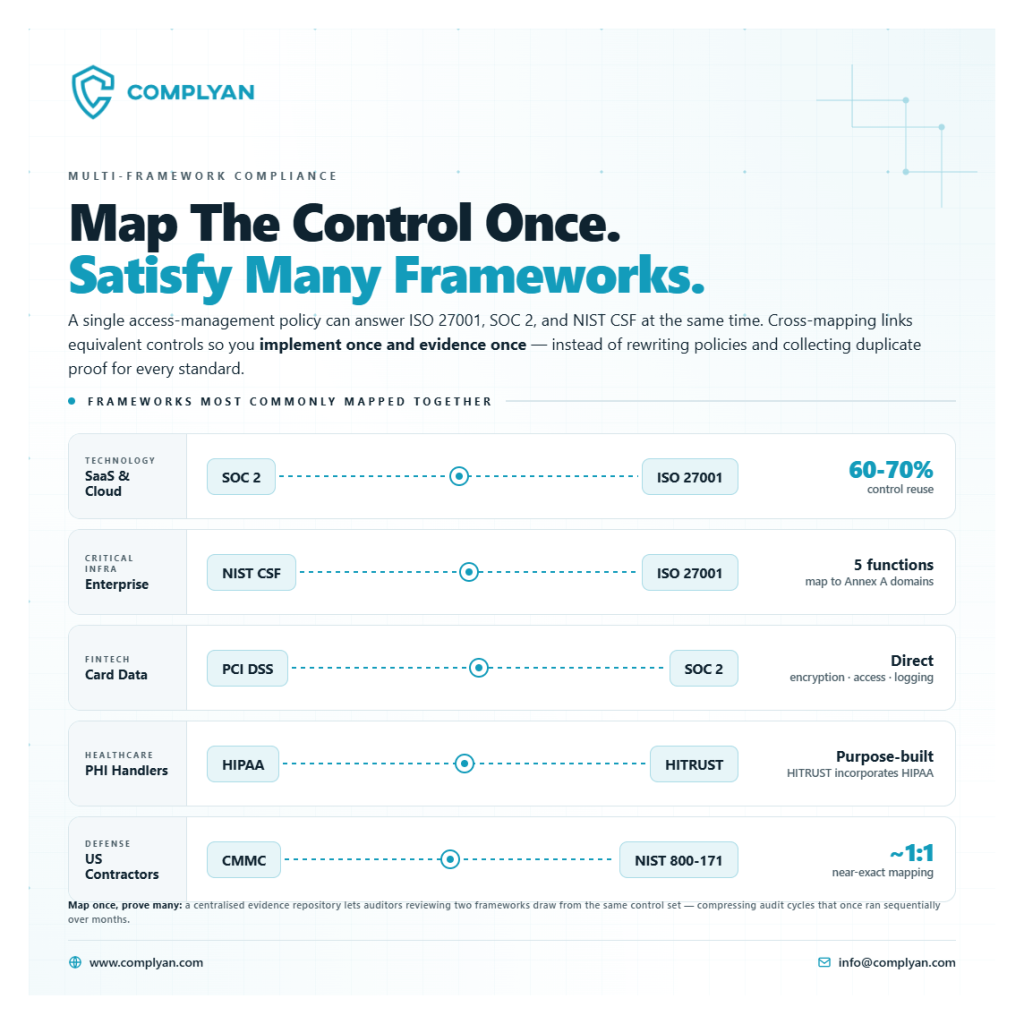
Certain framework pairings recur across industries because their control domains align closely.
SOC 2 + ISO 27001 is the most common pairing for technology companies. Both address access control, incident response, change management, and business continuity. Organisations pursuing both certifications can reuse approximately 60–70% of their controls with appropriate documentation.
NIST CSF + ISO 27001 is common in critical infrastructure and enterprise environments. The NIST CSF’s five functions (Identify, Protect, Detect, Respond, Recover) map well against ISO 27001’s Annex A domains, though NIST CSF provides flexibility that ISO 27001 does not.
PCI DSS + SOC 2 serves financial technology companies that handle card data and must also meet customer assurance requirements. Several PCI DSS requirements around encryption, access, and logging map directly to SOC 2 Common Criteria.
HIPAA + HITRUST is the standard pairing in healthcare. HITRUST was specifically designed to incorporate HIPAA requirements alongside ISO 27001 and NIST, making cross-mapping between the two a structured and well-documented process.
CMMC + NIST SP 800-171 governs defence contractors in the US. Since CMMC was built directly from NIST SP 800-171, the mapping between the two is nearly one-to-one.
Cross Mapping Supports Regulatory Change
One of the less discussed benefits of framework mapping is adaptability.
Regulatory expectations continue expanding across industries. New standards emerge, privacy requirements evolve, and customers introduce additional security obligations.
Organizations with strong cross mapping capabilities can adapt more quickly.
When a new framework appears, teams can evaluate how existing controls align rather than starting from scratch. Existing evidence, policies, and governance structures can often be reused across new requirements.
This reduces the operational disruption that often accompanies regulatory change.
Building an Effective Cross-Mapping Programme
A cross-mapping initiative follows a logical sequence.
Start with a control inventory. Before mapping anything, compile a complete list of controls your organisation has implemented. Include the policy document, the technical control, the evidence currently collected, and the team responsible.
Identify framework requirements side by side. For each control, pull the corresponding requirement text from each framework in scope. Look for shared intent, even when the language differs.
Classify each mapping as full or partial. Document which overlaps satisfy all requirements of both frameworks and require additional work for one of them.
Assign single ownership. Each mapped control should have one owner responsible for maintaining the implementation and collecting evidence. Multiple ownership is how cross-mapping breaks down over time.
Build a centralised evidence repository. Evidence should be stored once and referenced across frameworks, not duplicated. This is where organisations see the clearest time savings.
For organisations managing complex data flows across their compliance programme, Complyan’s data flow and mapping capabilities provide a structured method for connecting data handling practices to the control requirements of multiple frameworks simultaneously.
Where Cross-Mapping Delivers the Most Value
Audit preparation is where the time savings are most immediate. A centralised evidence repository means auditors reviewing SOC 2 and ISO 27001 simultaneously access the same evidence set. Audit cycles that previously ran sequentially over several months can be compressed significantly.
Gap analysis gains clarity when frameworks are mapped together. The delta between what an existing control satisfies and what a new framework requires becomes visible, allowing targeted remediation rather than a ground-up rebuild.
Risk coverage improves because cross-mapping exposes which control areas are addressed by multiple frameworks and which are addressed by only one. Areas with single-framework coverage receive closer scrutiny during risk reviews.
Regulatory change management becomes more manageable. When NIST CSF updated from version 1.1 to 2.0, organisations with cross-mapping programmes could assess the impact across all their frameworks from a single review, rather than conducting separate gap analyses for each.
Conclusion
Cross-mapping is most valuable when it is built into the compliance programme from the start rather than retrofitted after multiple frameworks are already in operation. For organisations adding a second or third framework to an existing programme, the first step is auditing what you have, controls, policies, and evidence, before determining what the new framework requires.
If your team is approaching multi-framework compliance for the first time, or if a growing list of customer contractual requirements is forcing the issue, the right approach combines structured methodology with tooling that handles the relationship management between frameworks automatically.