



 Governance and Policy Management
Cyber Risk Quantification: Turning Security Metrics Into Executive Decisions

Security teams have spent years describing cyber risk using technical language. Critical vulnerabilities. High-risk assets. Elevated threat activity. Security gaps. Exposure levels.
The problem is that executives, boards, and business leaders do not make decisions based on technical severity scores alone.
They make decisions based on business impact.
A chief financial officer wants to know the potential financial exposure associated with a ransomware incident. A board member wants to understand how cyber risk compares to other enterprise risks. Leadership teams need to determine whether additional investments will reduce meaningful risk or simply add more security tools.
This is where cyber risk quantification has become increasingly important.
Rather than describing risk through technical ratings alone, cyber risk quantification seeks to measure cyber exposure in business terms that leadership can understand and act upon
What Is Cyber Risk Quantification?
Cyber risk quantification, often referred to as CRQ, is the process of translating cybersecurity risk into measurable business impact.
Rather than focusing exclusively on technical severity, organizations estimate potential financial consequences associated with cyber incidents.
This may include:
- Revenue loss
- Regulatory penalties
- Business interruption
- Recovery costs
- Legal expenses
- Customer compensation
- Reputational impact
The objective is not to predict the future with perfect accuracy.
The objective is to provide leadership with a realistic view of potential exposure so they can make informed decisions.
Cybersecurity becomes easier to discuss when risk can be expressed in terms executives already use every day.
Why Traditional Risk Assessments Often Fall Short
Traditional risk tools, heat maps, red/amber/green matrices, subjective risk registers are not without value. They help teams identify and communicate broad risk categories. But they carry a fundamental limitation when used as the primary basis for financial decisions.
Two risks that both score “high” on a qualitative scale could represent exposures of $50,000 and $4 million, respectively. Without financial context, the same red cell on a matrix treats them identically. The result is predictable: resources get misallocated, genuinely dangerous exposures go underfunded, and lower-impact risks consume disproportionate attention.
Cyber risk quantification separates severity perception from financial reality. It demands specificity where qualitative methods permit vagueness, and produces outputs that executives, boards, and finance teams can weigh against competing priorities.
The FAIR Framework: The Standard Methodology
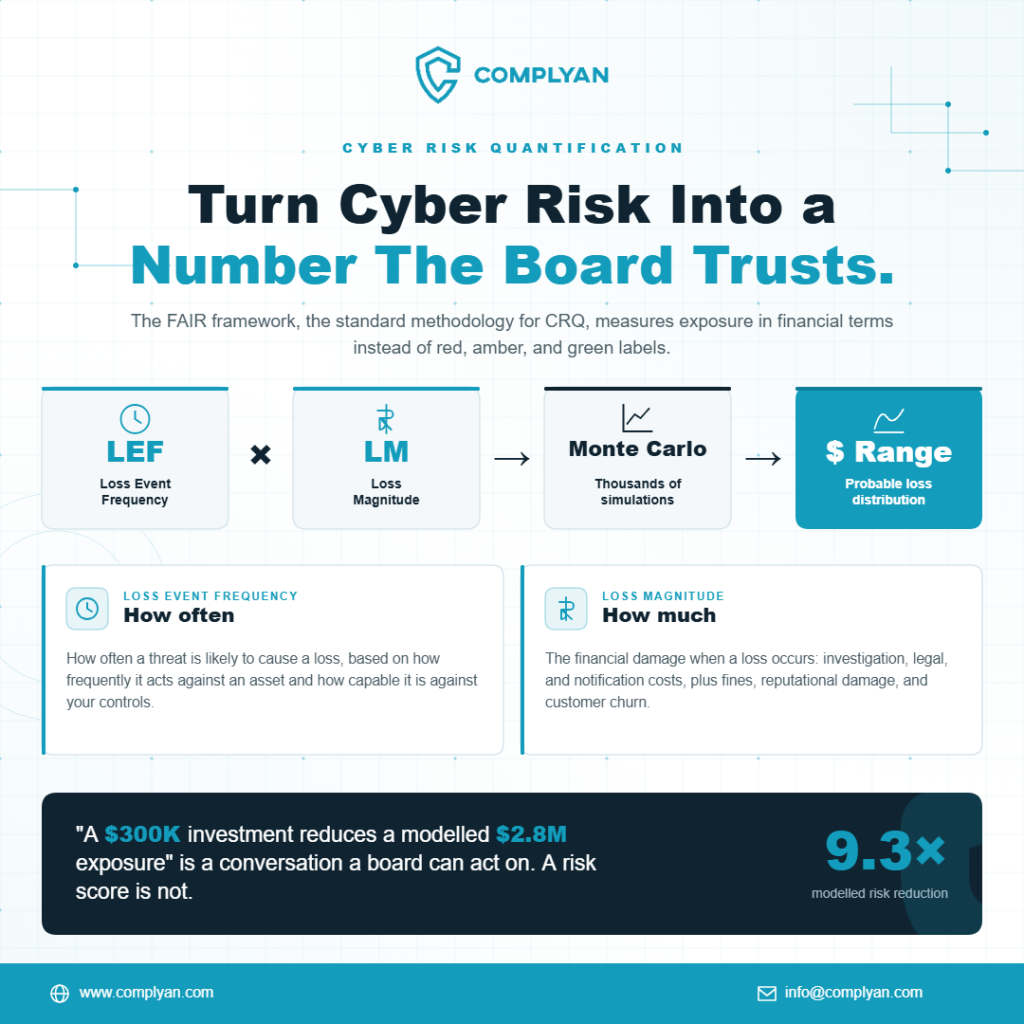
The most widely adopted methodology for cyber risk quantification is FAIR, Factor Analysis of Information Risk, developed by the FAIR Institute, a non-profit organisation dedicated to reducing operational risk through principled measurement.
FAIR structures each risk scenario around two primary components:
- Loss Event Frequency (LEF): How often a particular threat is likely to produce a loss, based on how frequently threats act against an asset and how capable they are relative to existing controls.
- Loss Magnitude (LM): The financial damage when a loss event does occur, covering primary costs such as investigation, notification, and legal response, as well as secondary costs including regulatory fines, reputational damage, and customer churn.
These variables feed into a Monte Carlo simulation, which runs thousands of probabilistic iterations to generate a loss range rather than a single figure. The output is a probability distribution showing the likelihood of different financial outcomes over a defined period, far more honest, and far more useful to decision-makers, than a point estimate.
FAIR integrates with existing frameworks, including NIST CSF, ISO 27001, and COBIT, so organisations do not need to dismantle their current governance structure to adopt it.
What Cyber Risk Quantification Enables
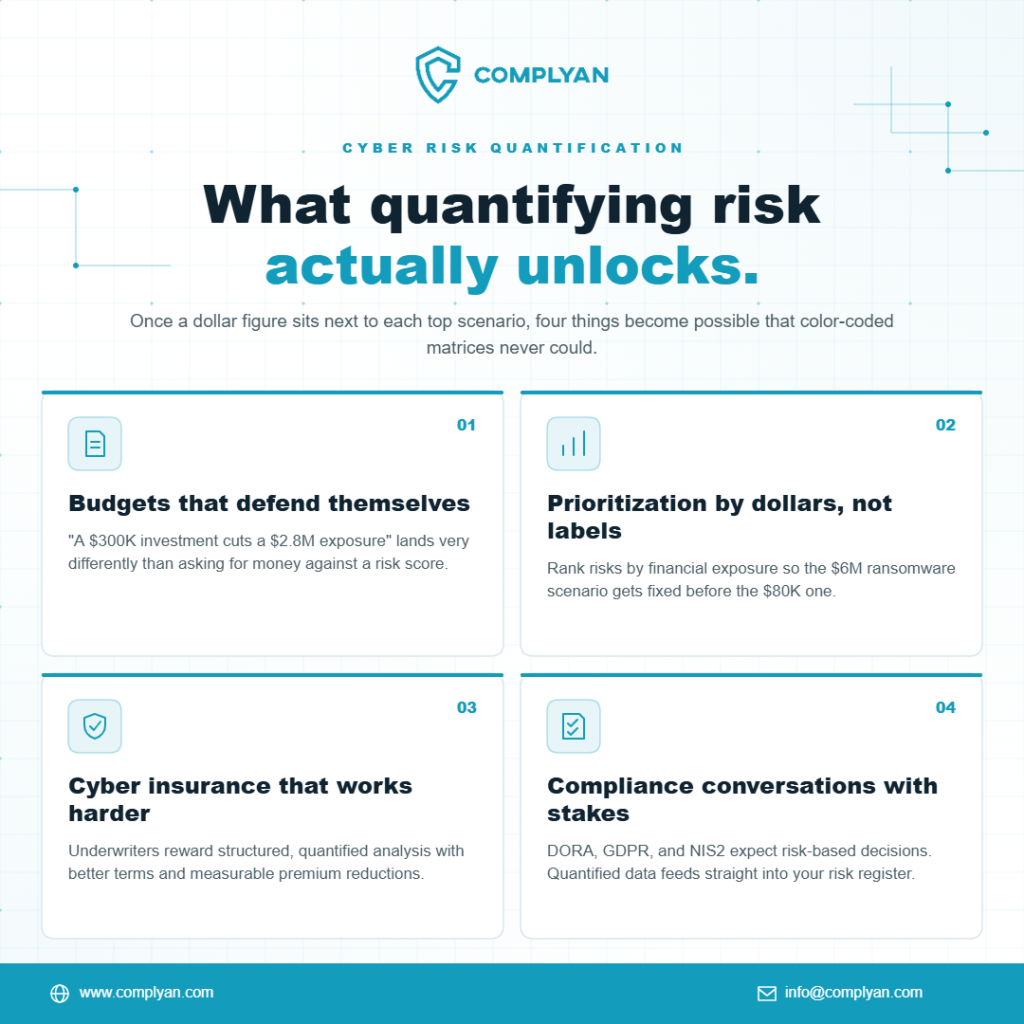
Once financial figures are attached to top risk scenarios, several things become possible that qualitative assessments cannot deliver.
Budget justification becomes defensible. Telling a board that a $300,000 investment reduces a modelled $2.8 million exposure is a fundamentally different conversation from requesting budget based on a risk score. Cyber risk quantification gives security leaders the financial vocabulary that boards and CFOs respond to.
Prioritization becomes objective. Security teams are stretched thin. Ranking risks by financial exposure rather than severity labels cuts through noise and directs effort where it matters. The ransomware scenario threatening $6 million in operational disruption gets addressed before the credential stuffing risk capped at $80,000, not because one sounds more alarming, but because the numbers make the case.
Cyber insurance becomes more strategic. Underwriters increasingly reward organisations that can present structured, quantified risk analysis. Documented financial modelling supports better coverage terms and more accurate premium calculations, and organisations with mature quantification programmes have reported measurable premium reductions as a direct result.
Compliance conversations become richer. Cyber risk quantification does not replace compliance. it strengthens it. Frameworks like ISO 27001 and NIST identify what controls should exist; quantification clarifies why those controls are worth implementing by attaching financial stakes to the gaps. For organisations managing their compliance posture through a platform like Complyan, quantified risk data can feed directly into risk registers and control assessments, creating a continuous loop between risk measurement and compliance management.
Getting Started: A Practical Approach
Cyber risk quantification does not require rebuilding your security programme from scratch. The most effective implementations start narrow and expand deliberately.
- Define two or three high-priority scenarios. Ransomware hitting a critical production system. A breach of customer data held by a third-party vendor. Insider data exfiltration. Begin with scenarios that represent genuine business concern, they tend to be the right starting point.
- Use the data you already have. Asset inventories, vulnerability scan results, incident records, cyber insurance applications, and third-party risk assessments all contain relevant inputs. Perfect data is not a prerequisite. The modelling process itself will surface where data gaps exist.
- Align stakeholders from the beginning. Cyber risk quantification delivers the most value when security, risk, finance, and legal teams participate in the process. This is a shared business exercise, not a security team output to be handed upward after the fact.
- Apply consistent, documented methods. Whether you are working with spreadsheets, a FAIR-certified platform, or an integrated GRC tool, credibility depends on repeatable and transparent methodology. Regulators, auditors, and boards will want to understand how the numbers were derived.
- Connect results to decisions. The final and most important step is using quantification outputs to drive choices: which controls to invest in, which risks to transfer through insurance, which third-party relationships require tighter oversight. Quantification that never influences a decision is expensive documentation.
The Compliance Connection
Cyber risk quantification is gaining particular relevance in compliance risk management. Regulations including DORA, GDPR, and NIS2, increasingly require organisations to demonstrate that their risk management decisions are risk-based, grounded in assessed exposure, not just procedural compliance.
Quantification satisfies that expectation far more convincingly than qualitative ratings. When organisations use platforms built to centralise compliance workflows, such as Complyan’s risk and compliance management module, integrating quantified risk outputs creates a single source of truth spanning assessment, control tracking, and regulatory reporting.
The Bottom Line
Cyber risk will never reach zero. Every organisation must decide how much exposure is acceptable, at what cost, and relative to what alternatives. That decision cannot be made well with colour-coded matrices and instinct.
Cyber risk quantification gives security leaders the tools to participate in strategic financial decisions rather than react to them. It moves cybersecurity from a cost centre that is difficult to justify into a risk management discipline that speaks the language of the boardroom.
The organisations that build this capability now will not only be better protected, they will be able to explain why, in terms that boards, regulators, and insurers are increasingly requiring.