

 Governance and Policy Management
Evidence Collection Checklist for Your First ISO 27001 Audit

The hardest part of a first ISO 27001 audit is rarely writing the policies. It is proving that the Information Security Management System is operating as described. Auditors need documented information, but they also need records that show controls are implemented, responsibilities are active and recurring activities are taking place.
That is why evidence collection should start before the auditor sends the first request list. A strong evidence plan links each applicable requirement to an owner, source, review date and proof of operation.
What the Auditor Reads in Each Stage
Certification runs in two stages. Stage 1 is a documentation review. Kertos describes the auditor checking your documented information, how the scope was drawn, and the Statement of Applicability against the output of your risk assessment. Stage 2 tests whether the system ran, by sampling records across a period, interviewing staff, and tracing risks through to evidence, per CloudSoul.
Stage 1 | Stage 2 | |
|---|---|---|
Subject | Documentation, scope, Statement of Applicability, internal audit, management review | Implementation and effectiveness of Clauses 4 to 10 and the selected controls |
Evidence tone | The system exists and covers what the standard requires | The system operated, with dated records |
History needed | Internal audit and management review exist as processes | CloudSoul suggests around three months of operation |
The Evidence Checklist
Catharsis, Invadel, and CertPro list the same core documented information. The table below follows them.
Clause | Evidence to hold | What the auditor looks for |
|---|---|---|
4.3 Scope | A scope statement | A boundary that makes sense for the business |
5.2 Policy | An approved information security policy | Top management approval, and communication to staff |
6.1.2 Risk method | A documented risk assessment method | Criteria set before risks are scored |
6.1.3(d) Statement of Applicability | All 93 Annex A controls, with a justification for each inclusion or exclusion | A logical link to the risk assessment, and a match with reality |
6.2 Objectives | Measurable security objectives | Owners and plans |
7.2 Competence | Training records and qualifications for security roles | Records tied to the people named in your policies |
8.2 and 8.3 Risk results | The risk assessment results and treatment results | Proof that treatment happened |
9.1 Monitoring | Monitoring and measurement results | Measures that management sees |
9.2 Internal audit | The programme, reports, and follow-up | Coverage of the whole system, objectivity, and findings followed up |
9.3 Management review | Minutes with the required inputs and decisions | Decisions and actions recorded, beyond attendance |
10.2 Corrective action | Nonconformities and corrective actions | Root cause and an effectiveness check |
The Statement of Applicability is the document auditors read most closely, per Catharsis: if it says a control is implemented, they will ask to see it working.
Operational Evidence for Annex A
Annex A:2022 has 93 controls in four themes: organisational (37), people (8), physical (14), and technological (34), per Secureslate. Security Compliance Guide lists the records a Stage 2 auditor reviews as evidence of control operation: logs, access review records, incident reports, training records, patch management outputs, change tickets, and supplier assessment records. CertPro adds that these records should be dated and attributable.
The Two Records Most Often Late
Kertos notes the internal audit and the documented management review carry disproportionate weight at Stage 1, are mandatory, and are routinely scheduled too late, leaving the auditor with no basis to schedule Stage 2. It adds that an internal audit with no findings raises more questions than one with a few documented deviations. Indicium describes the classic weak pattern: a single rushed audit weeks before Stage 2, an empty findings list, and no evidence anything was followed up.
Findings to Avoid
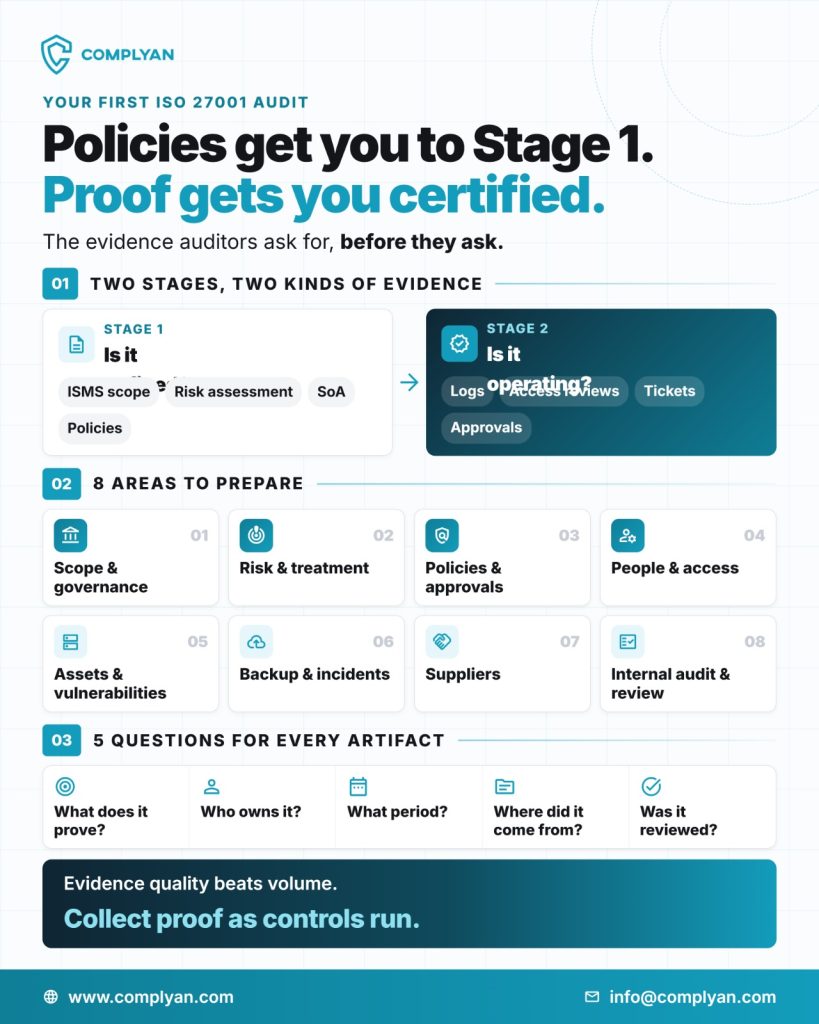
CloudSoul advises asking the people named in your policies what they do, and fixing the policies where the answers differ, because a policy that does not match practice is an easy finding. Catharsis warns that a Statement of Applicability claiming a control that is not in place will be tested. Corrective actions need root cause and an effectiveness check, beyond a closed ticket. If Stage 2 ends with major nonconformities, Security Compliance Guide notes the certification body may accept documented evidence without a return visit or schedule a follow-up audit, so ask about its policy before Stage 2.
A Four-Week Pre-Audit Plan
This plan is practical guidance and assumes the system has already run for a few months.
Week one, scope and Statement of Applicability: confirm the scope and check every justification against the risk assessment.
Week two, evidence index: fill the index and list the gaps, with owners and dates.
Week three, internal audit and corrective actions: run the audit, record findings, and close actions with root cause and an effectiveness check.
Week four, management review and dry run: hold the review with all required inputs, then walk a colleague through the evidence as the auditor would.
How Complyan Keeps the Evidence Ready
Evidence comes from the systems that hold it, is tested on schedule, and counts for every framework that asks for it. Complyan has 390+ integrations available, including Microsoft, AWS, CrowdStrike, Palo Alto Networks, Fortinet, and Okta, and 1,900+ automated checks (catalogue, 4 November 2026). ISO 27001 sits among 36 frameworks and 5,273 controls in production, and 114 Unified Complyan Controls carry each result to every framework that asks for it (measured 4 October 2026). Complyan’s governance and policy management tools hold policy versions, owners, and approvals, and Complyan’s cyber risk management platform keeps the risk register and treatment results together. A person approves every decision.
Conclusion
An ISO 27001 audit asks for the same story twice: the system on paper at Stage 1, and the system at work at Stage 2. Organisations that schedule the internal audit and management review early, check the Statement of Applicability against real records, and keep an index of dated, owned evidence can meet the auditor with a lookup. Proof, not screenshots. To see how Complyan keeps ISO 27001 evidence ready, talk to the Complyan team.
Frequently Asked Questions
What evidence does an ISO 27001 auditor ask for?
The exact evidence depends on the ISMS scope and Statement of Applicability. Auditors commonly review ISMS documents, risk records, policies, access reviews, training records, technical evidence, supplier assessments, internal audit results, management review records and corrective actions.
What is the difference between Stage 1 and Stage 2 evidence?
Stage 1 focuses on ISMS readiness and documented information. Stage 2 examines implementation and operating evidence, including records showing that controls and recurring processes are being performed.
Do I need evidence for every Annex A control?
You need evidence for the controls that are applicable to your ISMS and for the management-system requirements that apply. The Statement of Applicability explains which Annex A controls are included or excluded and the justification.
How old can audit evidence be?
There is no single age that works for every artifact. Evidence should match the control frequency and audit period. A quarterly access review needs recent review records, while an annually approved policy may follow a different cycle.
Can ISO 27001 evidence collection be automated?
Many technical artifacts can be collected through integrations and automated checks. Policies, interviews, management decisions and some governance evidence still require human review and approval.
Conclusion
Both platforms collect evidence once and reuse it. Complyan adds the Gulf regulators as maintained content, a group view, a regulator view, and cyber risk in your currency, tested every day with proof ready before anyone asks. For a GCC organisation, that is the better choice. Proof, not screenshots. To see Complyan against your regulators, talk to the Complyan team.