


 Governance and Policy Management
COBIT Framework and AI Governance: How COBIT Closes the Accountability Gap

AI adoption creates an awkward governance problem for many organizations. New models, copilots and agents are being approved by individual business units while security teams manage technical risk, compliance teams track regulatory requirements and leadership tries to determine who remains accountable when an AI-enabled process fails.
Creating another isolated AI policy does not necessarily solve that problem.
The COBIT Framework offers a different approach. COBIT was designed by ISACA for the governance and management of enterprise information and technology, with responsibility extending beyond the IT department to technology used anywhere across the enterprise. Its current core model contains 40 governance and management objectives supported by processes, organizational structures, information flows, policies, skills and technology.
Complyan previously covered the fundamentals in its guide to the COBIT Framework. In 2026, a more pressing question is how organizations can apply COBIT when AI introduces new decision rights, third-party dependencies and assurance requirements.
AI Governance Has a Governance Problem
Many AI programmes start at the control level.
Can employees upload confidential information? Which models are approved? Does an AI agent need MFA-protected administrative access? How should prompts be logged?
Those controls matter, but COBIT forces organizations to answer an earlier set of questions: who approves the use of AI, who owns the resulting risk, how does the investment support enterprise objectives and how will leadership know whether the controls are working?
That distinction has become increasingly relevant. In August 2026, ISACA described AI accountability as one of several areas where organizations accumulate “governance debt.” The problem appears when companies adopt new technology while relying on old decision structures and disconnected assurance processes. ISACA argues that COBIT can provide an integrating governance layer rather than requiring a completely separate governance programme for every new technology.
For AI, that means governance should begin before deployment rather than after the first audit request.
Where COBIT Applies to AI
Mark Thomas, writing in an ISACA Now analysis dated 4 August 2026, calls the lag between technology and governance “governance debt” and maps recurring gaps to COBIT mechanisms. The AI-relevant ones:
Gap | COBIT mechanism, per Thomas |
Policy theater: more policy than control | The components model ties policy to processes, structures, information flows, and evidence |
“Show us,” not “tell us” | The Evaluate, Direct and Monitor (EDM) and Monitor, Evaluate and Assess (MEA) domains make oversight evidential |
Borrowed models, owned risk | Design factors fold AI risk into the governance system already running |
Framework sprawl | COBIT sits above other standards, so teams extend rather than duplicate |
Resilience mistaken for recovery | End-to-end coverage links continuity to enterprise objectives |
Borrowed Model, Owned Risk
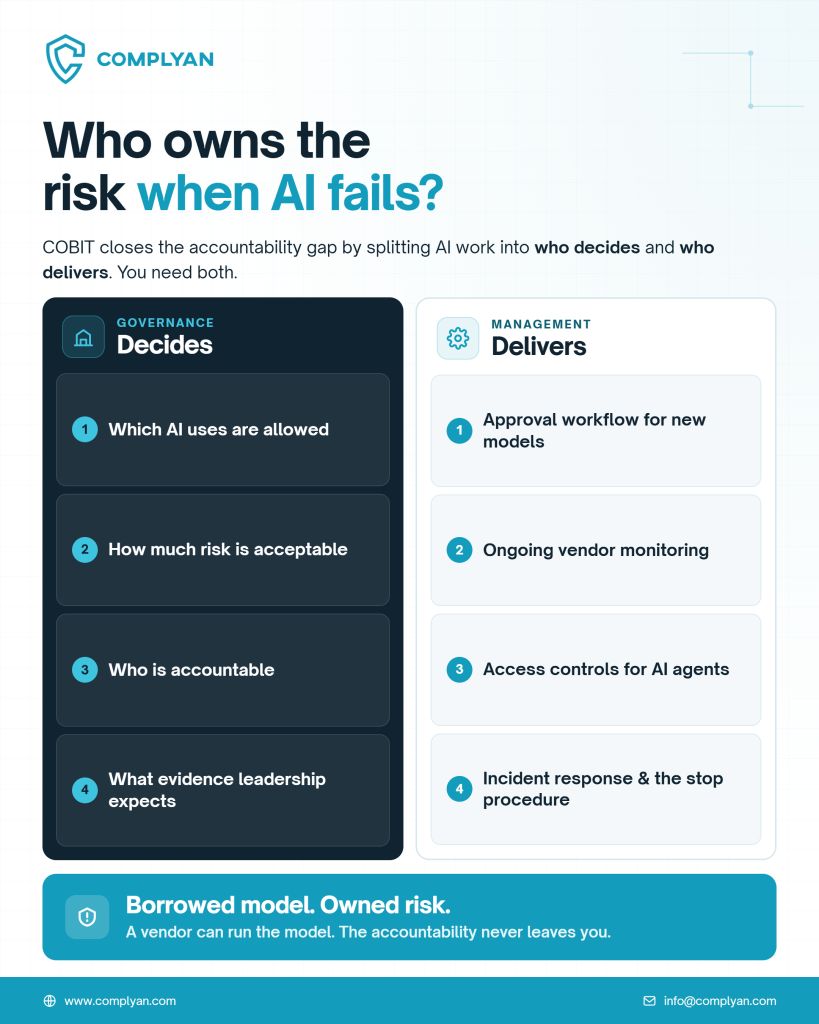
Thomas’s central point for AI is that building on a third-party or foundation model transfers the operation, never the accountability. Governing the decision matters more than governing the tool. In practice, that means an executive owner signs off on each AI use case, and the vendor’s model is approved only once the organization’s own controls sit around how it is used.
Governance Versus Management for AI
COBIT separates governance, where leadership evaluates, directs, and monitors, from management, where teams plan, build, run, and monitor. Complyan’s guide lists that distinction among COBIT 2019’s six principles. For AI, it gives each group a clear job.
Governance decides: which AI uses are permitted, how much risk is acceptable, who is accountable, and what evidence leadership expects to see.
Management delivers: the approval workflow for new models, vendor monitoring, access controls for agents, incident response, and the stop procedure.
Problems appear when management runs AI projects with no direction from governance, or governance issues principles that no management process carries out.
What This Looks Like in Practice
The steps below apply COBIT’s logic to AI. They are application guidance, not COBIT text.
Set direction at the top (EDM): the board or its technology committee decides which AI uses are in scope and what risk it will accept. Complyan’s executive and board reporting gives leadership a current view of that exposure.
Make policy operate: an AI acceptable-use policy needs an owner, a linked process, and a review date. Complyan’s governance and policy management tools hold those together.
Own the vendor decision: each foundation model or AI service needs an assessment before approval and monitoring after. Complyan’s third-party risk management keeps that record current.
Quantify and baseline the risk: Complyan’s cyber risk management platform scores AI risks alongside the rest of the register, and Complyan’s cyber maturity assessment gives a baseline to measure improvement against.
Build evidence for MEA: logs, approvals, and review records need to exist before anyone asks. Complyan’s audit and compliance management platform maps evidence to controls so a request becomes a lookup.
Map once across frameworks: COBIT sits alongside standards such as ISO 27001 and NIST CSF, and Complyan’s cybersecurity compliance tools let one control count toward each.
Test the Stop Question
Run a tabletop built on the poll’s finding: how fast can the organization halt this AI system, who can authorize it, and what evidence remains afterward? An answer of “we do not know” is the gap COBIT’s EDM and MEA domains exist to close.
Conclusion
COBIT does not need an AI edition to govern AI. Its decision rights, components, and oversight domains already apply, and the work is to extend them to models, agents, and vendors rather than start a parallel program. Organizations that name owners, keep evidence current, and test their stop procedure now can answer the board’s first AI question with facts.
Frequently Asked Questions
What is COBIT?
COBIT is ISACA’s framework for the governance and management of enterprise information and technology. Per Complyan’s guide, COBIT 2019 has 40 governance and management objectives and six principles.
Does COBIT cover AI?
ISACA publishes COBIT-based guidance for AI governance, including a white paper on leveraging COBIT for effective AI system governance. Thomas’s analysis argues AI risk can be folded into COBIT’s existing design factors without a parallel program.
Does COBIT replace NIST CSF or ISO 27001?
No. Per Complyan’s guide, COBIT complements them by addressing governance questions such as who is responsible and whether IT strategy matches business goals.
Do we have to adopt all of COBIT?
No. Thomas describes using COBIT to filter other frameworks, taking only the parts that help the enterprise meet its goals.
How can Complyan help?
Start with Complyan’s cyber maturity assessment, then track owners, vendors, and evidence in one platform.