


 Governance and Policy Management
NIST Cybersecurity Framework 2.0 in 2026: Applying NIST CSF to AI Security and Compliance

The NIST Cybersecurity Framework has always been designed to help organizations make better decisions about cybersecurity risk. In 2026, that role is expanding as AI systems become part of enterprise applications, security operations and business workflows.
NIST CSF 2.0 already anticipated this shift. The framework states that its outcomes apply across IT, OT, IoT, cloud, mobile and artificial intelligence systems. It remains technology-neutral, which means organizations do not need to wait for a separate cybersecurity framework before bringing AI systems into their existing risk programme.
Complyan previously covered what changed with NIST Cybersecurity Framework v2.0. The more relevant question now is how organizations can use CSF 2.0 when models, AI agents and AI-enabled applications become part of the systems they need to secure.
The Cyber AI Profile in Brief
NIST released the preliminary draft of NIST IR 8596, the Cybersecurity Framework Profile for Artificial Intelligence, on 16 December 2025, with comments open until 30 January 2026, according to NIST’s publication page. It is a Community Profile, not a new framework. Law firm summaries describe it as building on CSF 2.0 and the AI Risk Management Framework, which improves AI trustworthiness, so the profile carries AI considerations into a CSF-aligned program. It is voluntary, and NIST has planned an initial public draft after the comment round, so check the page above for the current version before citing control language.
It organizes guidance around three focus areas:
Focus area | Question it answers | Example from the draft |
Secure | How do we protect the AI systems we run or buy? | Extending vulnerability management to AI frameworks, libraries, and hardware |
Defend | How do we use AI to strengthen defense? | Analyzing logs at scale with human confirmation before acting |
Thwart | How do we withstand attackers who use AI? | Tracking AI-specific threat intelligence such as MITRE ATLAS and the OWASP LLM Top 10 |
How the Six Functions Apply to AI
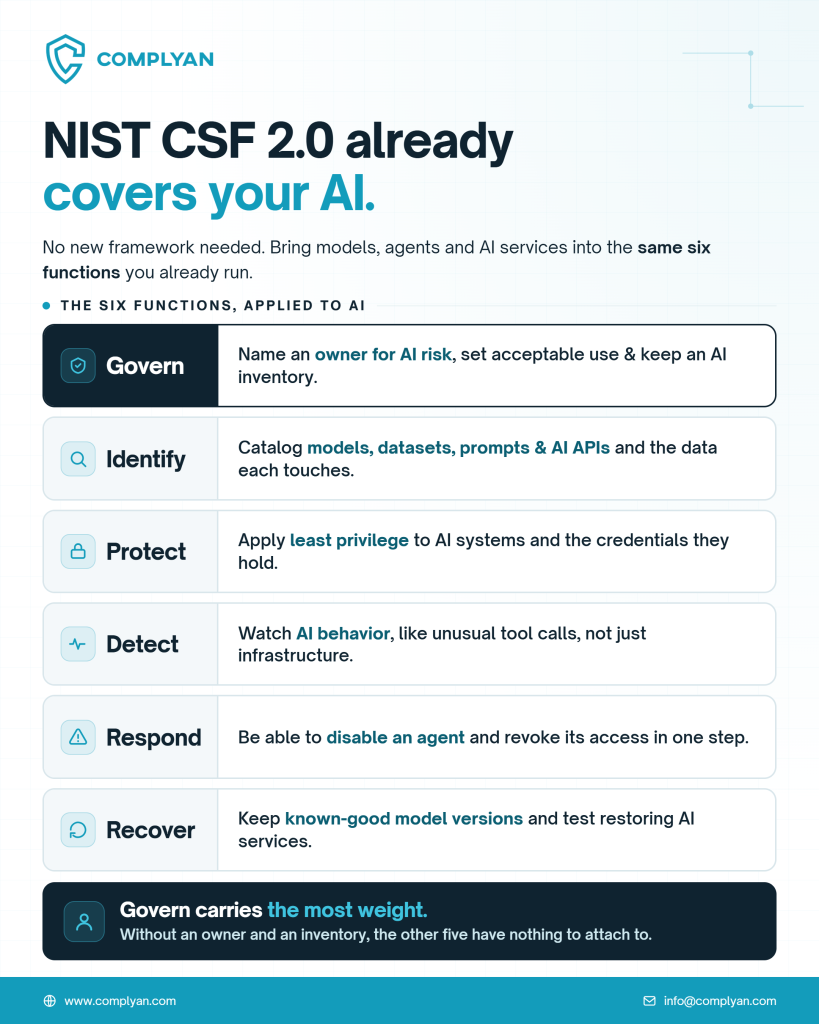
CSF 2.0 function | What it means for AI in practice |
Govern | Name an owner for AI risk, set an acceptable-use policy, and keep an inventory of AI systems |
Identify | Catalog models, datasets, prompts, APIs, and third-party AI services, with the data each touches |
Protect | Apply least privilege, data guardrails, and access control to AI systems and the credentials they hold |
Detect | Monitor AI behavior, such as unusual tool calls or data access, not only the infrastructure underneath |
Respond | Prepare containment for AI-specific incidents, including disabling an agent or revoking its access |
Recover | Keep known-good model versions and data sources, and test restoring AI-dependent services |
Govern carries the most weight. Without a named owner and an inventory, the other five functions have nothing to attach to.
An Illustrative Example: A Customer Support Agent
;;
AI Has Now Been Explicitly Brought Into the Compliance Discussion
One of the more significant GAID developments is Article 43 on Emerging Technologies.
It explicitly refers to artificial intelligence, IoT and blockchain where those technologies are used to process personal data. Organizations deploying or planning to deploy these technologies are expected to take the NDP Act, GAID and relevant regulatory requirements into account.
For AI projects, that should move privacy review much earlier in the deployment process.
Consider an AI system used to review customer applications. Before launch, the organization should know what personal data enters the model, whether sensitive information is involved, which provider processes it and whether data leaves Nigeria. The team also needs to consider whether the output contributes to decisions affecting individuals.
The NDPA already contains provisions covering DPIAs and automated decision-making. AI therefore creates new processing scenarios, but it does not sit outside the existing privacy framework.
A useful control is to make privacy assessment part of the AI approval process. Complyan Data Privacy Impact Management can be used to structure assessments, document identified risks and track mitigation before higher-risk processing moves into production
Where Organizations Are Likely to Get This Wrong
AI sits outside the processing records: a chatbot, scoring model, or summarization tool gets treated as an IT purchase and never appears in the record of processing activities, so no DPIA, lawful basis, or transfer assessment exists for it.
Human review exists on paper only: Section 37 expects human intervention that can change the outcome. A reviewer who approves every automated result without the authority or information to overturn it does not meet that expectation.
DCPMI status goes unassessed: GAID expects organizations to assess whether they are a Data Controller or Processor of Major Importance. IOC Law notes that a small workforce does not place an organization outside the regime if it runs a high-volume digital service, which describes most AI-enabled platforms.
Evidence is assembled late: GAID Article 10 requires risk-based compliance audits, and a DCPMI must file an annual Compliance Audit Return. IOC Law states the deadline as 31 March each year for a DCPMI established before 12 June 2023. The 2025 filing window was extended to 30 May 2026, but extensions are not a planning basis.
Building an NDPA Program That Covers AI
Map AI data flows first: training data, prompts, retrieval sources, outputs, and any overseas processing all need a documented path. Complyan’s data flow and mapping tools track data by system and destination, which surfaces transfers a system-level diagram misses.
Put AI in the processing records: Complyan’s data processing activity tools hold the purpose, lawful basis, recipients, and retention for each AI use, so the record an auditor asks for already exists.
Run DPIAs on a defined trigger: Complyan’s data privacy impact management ties an assessment to each AI deployment, with the DPO review GAID requires recorded alongside it.
Treat AI vendors as ongoing risk: Complyan’s third-party risk management monitors sub-processor changes, hosting locations, and incidents after signature, which is where AI vendor risk tends to shift.
Keep audit evidence current: Complyan’s audit and compliance management platform keeps policies, DPIAs, and records mapped and ready, so the annual return reflects the year rather than a final-week reconstruction.
The Cost of Getting It Wrong
IOC Law reports that the maximum remedial fee for a DCPMI is the greater of NGN 10 million and 2 percent of prior-year gross revenue, and for other controllers and processors the greater of NGN 2 million and 2 percent. Orders, compensation claims, and lost customer trust often cost more than the fee itself.
Add these sections after “The Cost of Getting It Wrong” and replace the current short “Bottom Line” with the stronger conclusion below.
Conclusion
Nigeria’s privacy requirements already reach AI systems whenever personal data is involved. Section 37 of the NDPA addresses solely automated decisions with legal or similarly significant effects, while GAID adds clearer expectations around DPIAs, emerging technologies, audit evidence and accountability. NDPA 2026 Compliance in Nigeria…
For organizations deploying AI, the compliance challenge is therefore practical: know what data feeds the system, document what decisions it influences, identify where processing occurs and maintain meaningful human intervention where automated outcomes can materially affect individuals.
The weakest programmes will treat AI as a technology purchase and try to reconstruct the privacy record later. Stronger programmes will put AI deployments into processing records from the start, assess higher-risk use cases before launch and keep evidence current throughout the year. The existing draft already identifies these as key operational requirements under GAID. NDPA 2026 Compliance in Nigeria…