




 Governance and Policy Management
Cross-Border E-Commerce and Data Sovereignty: Selling Across GCC Markets Without Breaking Privacy Laws

Cross-border e-commerce across the GCC looks like one connected market from a checkout page, but data sovereignty rules treat it as three separate legal territories. A retailer shipping to Dubai, Riyadh, and Manama at the same time is quietly juggling three different data protection regimes, each with its own rules about where customer information can travel and under what conditions. Complyan’s coverage of regional data privacy regulations breaks down exactly why treating the GCC as a single compliance zone creates real exposure for retailers who assume one policy covers everyone.
Cross-border e-commerce and data sovereignty now matter for every regional retailer selling across the UAE, Saudi Arabia, and Bahrain. A customer may buy from Dubai, pay through a Saudi payment gateway, receive support from Bahrain, and have order data processed by a cloud provider outside the GCC. That commercial model works only when privacy, hosting, vendor access, consent, and cross-border data transfer rules are handled properly.
For retail teams, the risk is not limited to a privacy policy sitting at the footer of the website. Data moves through checkout pages, payment processors, delivery partners, CRM platforms, loyalty apps, analytics tools, marketing pixels, customer support systems, cloud storage, and fraud detection tools. Every one of those systems can create a compliance issue if personal data crosses borders without the right legal basis, safeguards, or evidence.
Regional selling creates regional data risk
GCC retailers often operate as one business across several markets, but privacy laws are not identical across the region. UAE, Saudi, and Bahraini rules share common themes: lawful processing, transparency, data subject rights, security controls, vendor accountability, and restrictions on international transfers. The details differ.
That difference matters when a retailer centralizes customer data in one country, uses regional warehouses, shares customer records with couriers, runs a single CRM for all markets, or hosts e-commerce infrastructure with global SaaS providers.
A practical compliance question should be asked before launch: where does customer data go after checkout?
If that answer is unclear, the privacy risk is already bigger than the business assumes.
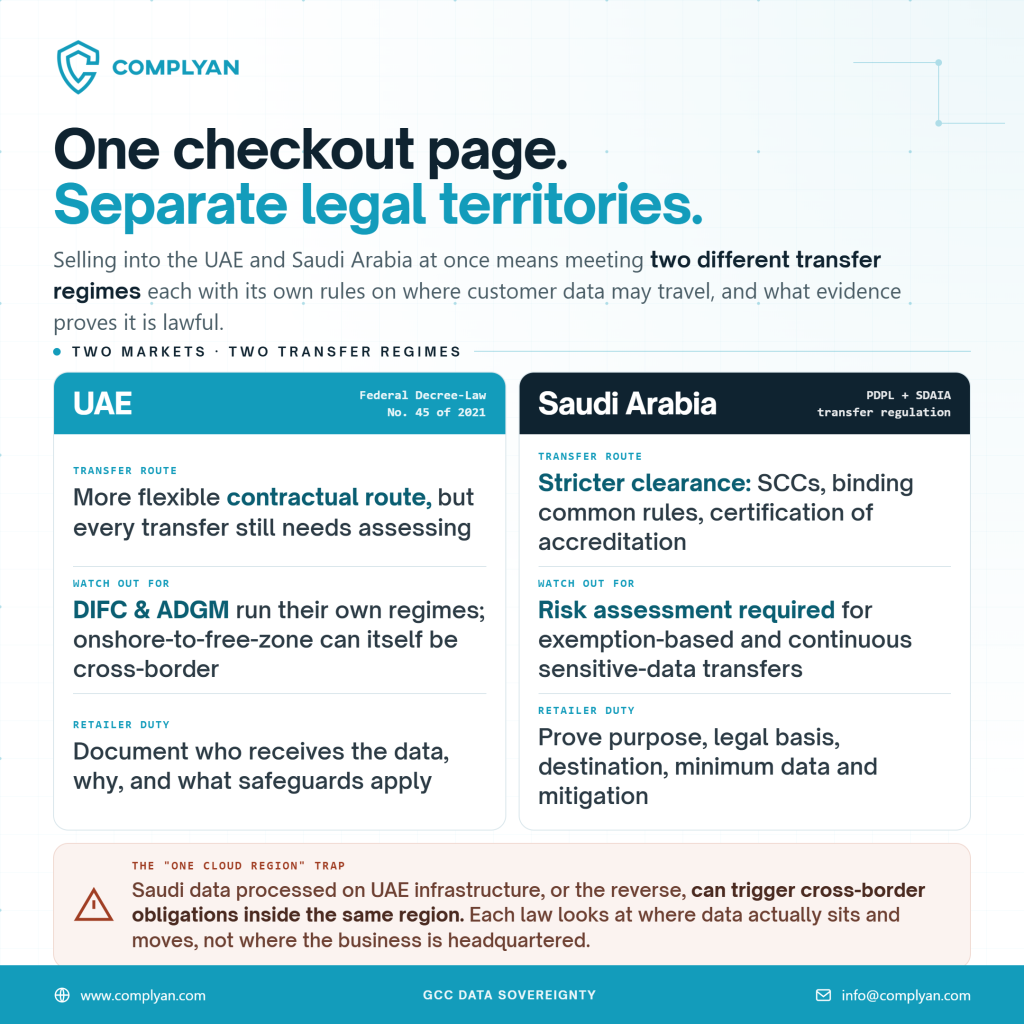
UAE: privacy controls and transfer requirements
The UAE Personal Data Protection Law, Federal Decree-Law No. 45 of 2021, creates a federal framework for personal data protection. The UAE Government portal states that the law protects confidentiality and privacy of personal information and includes requirements for cross-border transfer and sharing of personal data for processing purposes.
For retailers, this means UAE customer data should be handled with clear processing purposes, proper notices, security controls, and vendor management. Transfers outside the UAE should not be treated as a background IT decision. If customer data is being sent to a CRM, helpdesk, marketing tool, cloud region, or outsourced service provider outside the UAE, the transfer needs to be assessed.
Retailers should document who receives the data, why it is transferred, what safeguards apply, and how customer rights can still be fulfilled.
Saudi Arabia: stricter transfer governance
Saudi Arabia’s Personal Data Protection Law and its transfer rules create a more structured approach to data leaving the Kingdom. SDAIA’s regulation on personal data transfer outside Saudi Arabia refers to safeguards such as standard contractual clauses, binding common rules, and certification of accreditation. It also requires risk assessment in specific transfer cases, including certain transfers under exemptions and continuous or widespread transfer of sensitive data.
This matters for retailers operating in Saudi Arabia because order data, customer profiles, delivery addresses, payment-related records, loyalty data, and support tickets may all contain personal data. If that data is processed outside the Kingdom, retailers need to confirm the purpose, legal basis, destination, safeguards, minimum data required, possible impact on individuals, and mitigation controls.
A Saudi e-commerce setup should not rely on vague statements such as “our vendor is compliant.” The retailer needs transfer evidence, contract terms, data maps, access controls, and a documented decision trail.
Why "One Cloud Region" Is a Compliance Trap
A common and costly assumption is that a single Middle East cloud deployment can serve all three markets at once. In practice, Saudi customer data processed through UAE-based infrastructure, or the reverse, can trigger cross-border transfer obligations even within the same general region, since each country’s law looks at where data actually sits and moves, not just where a business is headquartered.
The safer architecture separates workloads by jurisdiction: Saudi customer data processed in Saudi-approved infrastructure, UAE data kept within UAE-compliant environments, and Bahrain-related data handled according to its own Adequacy List. This adds real operational complexity, but it avoids the audit exposure that comes from a shared database quietly moving regulated data across a border nobody tracked.
Vendor Risk Is The hidden pressure point
Start with a country-by-country privacy review: Do not assume one GCC privacy model will satisfy every market.
Build a data flow map for checkout, payment, fulfilment, support, marketing, refunds, and loyalty programs.
Review every vendor that touches customer data: Confirm where data is hosted, who can access it, which subprocessors are used, and what contract safeguards apply.
Limit cross-border transfers where possible: Keep sensitive data local where the business case is weak or the legal basis is unclear.
Create a transfer approval workflow: No new tool, integration, or vendor should process regional customer data without privacy review.
Prepare for incidents: Cross-border vendors must have clear breach notification timelines, evidence duties, and escalation routes.
Building a Compliance Approach That Scales
Map data flows by country, not by system: A single data flow diagram covering “the GCC” hides exactly the jurisdictional distinctions that matter. Complyan’s data flow and mapping tools are built around tracking personal data by originating jurisdiction, which surfaces cross-border movement that a system-level map alone would miss.
Treat each country’s adequacy status separately: Bahrain’s whitelist approach, Saudi Arabia’s stricter clearance model, and the UAE’s more flexible contractual route are not interchangeable. A safeguard that satisfies one regulator does not automatically satisfy another.
Review vendor contracts against all three regimes: Payment gateways, logistics partners, and marketing platforms operating across borders need contractual language that holds up under UAE, Saudi, and Bahraini requirements simultaneously, not just the strictest one assumed to cover the rest.
Classify sensitive data before building infrastructure: Health, biometric, and financial data face tighter restrictions in every one of these jurisdictions. Identifying these categories early shapes where systems can be built, rather than forcing a costly redesign later.
Document safeguards continuously, not reactively: Regulators increasingly expect evidence that transfer safeguards operate day to day, not a policy document produced only when an audit or complaint prompts one.
Common Mistakes Regional Retailers Make
Assuming GDPR compliance covers GCC obligations automatically: These laws share structural similarities with GDPR, but each carries jurisdiction-specific requirements, particularly around data localization and regulatory pre-approval, that a GDPR program alone does not satisfy.
Underestimating free zone complexity in the UAE: The DIFC and ADGM operate their own data protection regimes alongside the federal PDPL, and transfers between onshore UAE and these free zones can themselves count as cross-border movement requiring their own safeguards.
Treating adequacy lists as static: Bahrain’s Adequacy List and similar mechanisms elsewhere in the region get updated periodically. A safeguard that worked last year may need revisiting after a list update.
The Bottom Line
Cross-border e-commerce can scale quickly across the UAE, Saudi Arabia, and Bahrain, but privacy compliance must scale with it. Retailers need to know where customer data sits, where it travels, who processes it, and what evidence proves the transfer is lawful.
The strongest regional retailers will not be those with the longest privacy policy. They will be the ones with clear data maps, reviewed vendors, approved transfer mechanisms, working privacy controls, and evidence ready before expansion creates regulatory pressure.