

 Governance and Policy Management
Compliance Under Fire: Regulatory Pressure Simulation in Times of Regional Conflict

When regional conflict escalates, organizations focus on immediate security threats. Systems are hardened, and access is restricted. What often gets less attention is how regulatory pressure builds at the same time.
Authorities do not pause expectations during instability. In many cases, scrutiny increases. Incident reporting timelines remain strict. Data protection obligations still apply. Third-party accountability does not change.
This creates a difficult situation. Security teams respond to fast-moving threats while compliance teams are expected to maintain structure, evidence, and accountability. The gap between these two functions becomes more visible during disruption.
The organizations that manage this well are not reacting in the moment. They have already tested how their compliance program behaves under pressure.
Why Regulatory Pressure Increases During Conflict
Most people expect regulators to ease off during a crisis. The reality is the opposite.
Geopolitical tension does not reduce regulatory scrutiny; it intensifies it. When conflict disrupts critical infrastructure and displaces workforces, regulators need to confirm that institutions under their supervision are maintaining controls, reporting incidents accurately, and protecting the data they are responsible for. Periods of elevated regional risk are precisely when regulators are most likely to initiate reviews, not least of all because those are the periods when compliance programmes are most likely to fail silently.
Regulators are moving from retrospective enforcement toward continuous, evidence-based oversight. Firms can no longer wait for issues to surface; they must detect, document, and escalate risks before regulators identify them. That shift was already underway before the current conflict. The conflict simply accelerated it.
There is also a financial dimension. Inadequate documentation, incomplete audit trails and poor retention practices remain a significant enforcement trigger, reflecting regulators’ insistence on traceability and evidentiary integrity. Compliance monitoring and oversight weaknesses have resulted in hundreds of millions in penalties, typically reflecting failures to detect, escalate or remediate issues promptly.
For GCC organisations specifically, the current moment carries a compounding risk. Cyber insurance exclusion clauses commonly exclude losses arising from “hostile or warlike action” by a government or sovereign actor. With the majority of active threat groups in the region linked to state-sponsored actors, the financial backstop many organisations assumed they had may not apply, making regulatory fines and reputational exposure the first line of consequence for a compliance failure, not the last.
What It Means to Simulate Regulatory Pressure
Simulation is not a drill. A drill rehearses a known sequence of steps. A simulation tests whether your programme holds when the sequence breaks.
The distinction matters because conflict does not follow a script. It removes people, degrades systems, disrupts vendors, and creates operational stress that most compliance processes were never designed to withstand. Geopolitical tensions contribute to a more uncertain environment, with increased dependence on complex supply chains leading to a more opaque and unpredictable risk picture, while the proliferation of international regulatory requirements adds compliance burden for organisations operating across multiple jurisdictions.
A regulatory pressure simulation recreates those conditions deliberately. It starts with a disruption scenario built around the organisation’s real dependencies, key personnel unavailable, a critical vendor offline, and communication channels compromised. From that baseline, the simulation runs actual compliance processes in real time: incident detection, regulatory notification, evidence retrieval, and third-party escalation. Every stall, every missing handoff, every process that requires physical presence or manual access is a finding.
The output is not a polished summary document. It is a gap list, specific controls that failed, specific process steps that broke, specific people who were single points of failure. Anything that produces a summary document instead of a gap list is not a simulation. It is a performance.
Managing overlapping audit, risk assessment, and disclosure obligations has become a core operational challenge, requiring closer coordination between cybersecurity, privacy, legal, and compliance functions. A simulation surfaces exactly where that coordination fails under pressure before a regulator arrives to find out the same thing.
Three Controls That Fail When Operations Are Disrupted
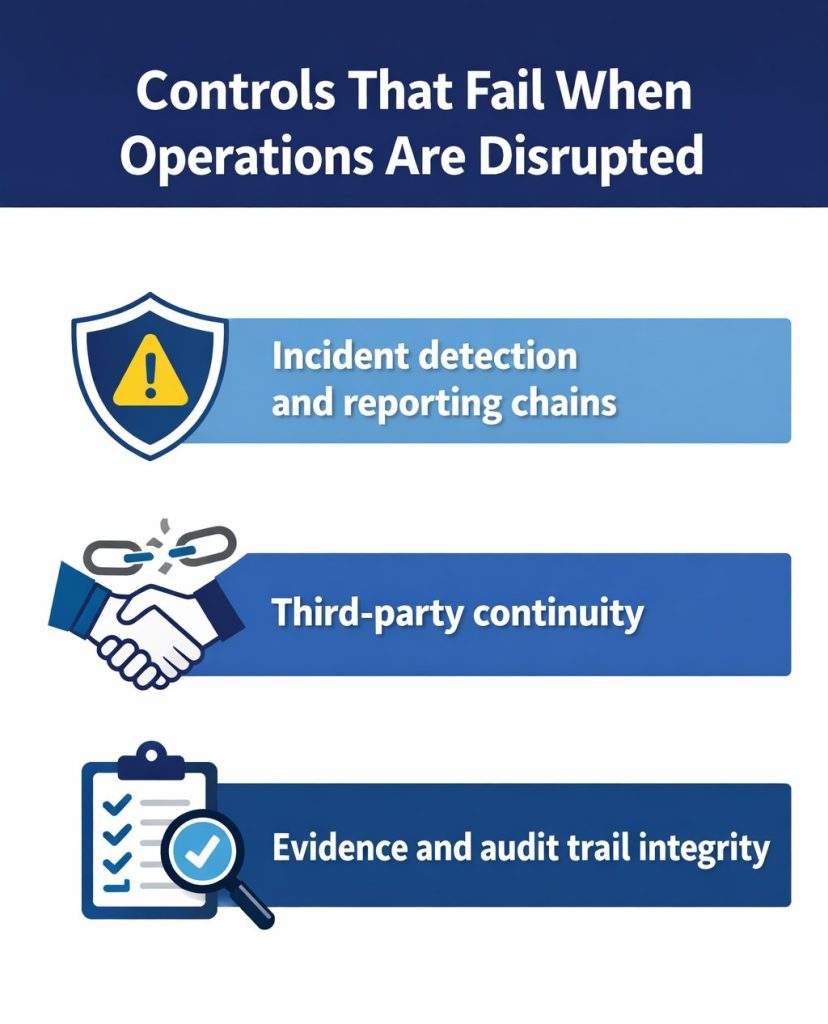
Across all three frameworks, the same categories show up consistently as failure points when organisations face operational stress.
Incident detection and reporting chains. Conflict accelerates the conditions under which incident detection fails, dispersed teams, degraded communication, personnel managing personal crises alongside professional ones. The problem is not just that detection slows down. It is that the chain from detection to documentation to regulatory notification depends on people being reachable in a specific sequence. A single cyber incident during the current conflict could simultaneously trigger reporting obligations to SAMA, the NCA, and the UAE IA, each with its own format, timeline, and contact requirement. Most organisations have never rehearsed that scenario.
Third-party continuity. SAMA’s framework requires conducting thorough risk assessments of third parties, incorporating cybersecurity requirements into contracts including incident reporting and right-to-audit clauses, and implementing continuous monitoring of third-party cybersecurity posture. That looks straightforward until your critical vendor is operating in a conflict-affected area and their incident response team is unavailable. Your compliance posture includes their operational status, which means their disruption becomes your regulatory problem. Complyan’s third-party risk management module is built around this reality, giving GCC organisations live visibility into vendor exposure mapped directly to SAMA, NCA, and UAE IA requirements.
Evidence and audit trail integrity. Regulators do not adjust audit timelines because your operations were disrupted. If anything, periods of elevated regional risk increase the probability of a regulatory review, precisely because regulators want to confirm that obligations were met when the pressure was highest. Organisations that rely on manual evidence collection cannot produce a coherent audit trail quickly under stress. Complyan’s automated, continuous evidence collection means that documentation is always current and audit-ready, regardless of what is happening operationally on a given day.
Running a Simulation That Tells You Something
A credible pressure simulation is not a walkthrough of your existing documentation. It is a recreation of the conditions under which your documentation becomes irrelevant.
For GCC organisations right now, that means starting with a realistic disruption scenario: assume a meaningful portion of your team is unavailable, assume at least one critical vendor has flagged an incident, and assume your normal communication channels are compromised. From that starting point, run your incident response process in real time. Track where it stalls, who it stalls on, and what information is missing at each step.
Then introduce the regulatory clock. SAMA’s five-day detailed reporting requirement and the NCA’s incident notification obligations both start from the moment of detection, not from when things have calmed down. If your simulation does not include a live clock, it is not simulating the actual pressure your organisation would face.
The output of that exercise is not a compliance report. It is a gap list with owners and deadlines. Any organisation running tabletop exercises that produce polished summary documents rather than uncomfortable prioritised action items is not doing the hard work. The hard work is finding out that your incident commander does not have remote access to the system they need, and fixing it before the regulator finds out the same thing.
Conclusion
There is a category of compliance risk that standard audits are structurally unable to detect, not because auditors are incompetent, but because audits test documented controls against documented evidence at a point in time.
Pressure simulation tests whether those controls hold when three things happen simultaneously: your people are stressed, your systems are running on degraded configurations, and your clock is running. That combination is what conflict produces. It is also the combination that exposes the difference between a compliance program that exists on paper and one that functions as actual risk infrastructure.
Regulatory scrutiny is tightening across all sectors, and GCC frameworks emphasise continuous compliance over one-time certifications, meaning organisations must be prepared for ongoing monitoring, reporting, and evidence-based proof of cybersecurity control implementation.
The organisations that satisfy that requirement under conflict conditions are those that built continuous compliance programs before the conflict started, not those that ran their last tabletop exercise in a fully staffed conference room during a quiet quarter.