



 Governance and Policy Management
Dubai Electronic Security Center (DESC) Compliance in 2026: A Guide to Dubai ISR Requirements

Dubai Electronic Security Center compliance in 2026 requires more than having policies mapped to a framework. For Dubai Government Entities, the Information Security Regulation sets the minimum cybersecurity requirements used to protect government information and maintain the continuity of critical services. The harder part is proving that those requirements remain operational as systems, suppliers and cloud services change.
DESC describes the Information Security Regulation as a technology-neutral framework designed to protect the confidentiality, integrity and availability of information handled by Dubai Government Entities. Its scope also extends to employees, consultants, contractors and other parties engaged with those entities.
Organizations that already know the basics can refer to our earlier DESC compliance guide. The more useful question for 2026 is how to turn Dubai ISR requirements into controls that can withstand audit scrutiny.
Who Needs to Consider DESC Compliance?
The core ISR applies to Dubai Government Entities. Private companies should therefore avoid assuming that every organization incorporated in Dubai falls directly under the same ISR obligations.
However, private providers can become subject to specific DESC requirements when supplying certain services to government or semi-government entities. DESC maintains separate standards for cloud service providers, data centers and security operations centers. For example, compliance with the DESC Cloud Service Provider Security Standard is mandatory for CSPs wishing to provide cloud services to Dubai government and semi-government entities.
This distinction matters during scoping. A compliance team first needs to determine whether the organization is directly subject to the ISR, supporting an entity that is, or delivering a service covered by a separate DESC standard.
Getting that boundary wrong can lead to missing controls or performing work against requirements that do not apply.
What DESC and ISR Govern
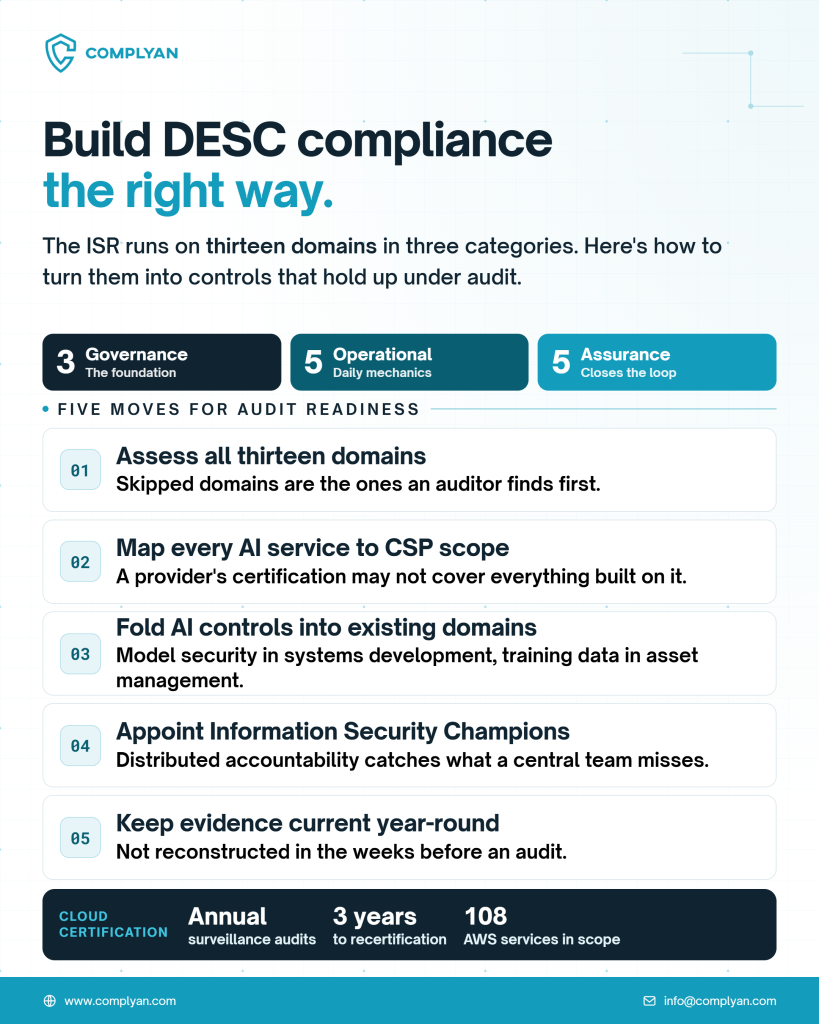
DESC is the authority responsible for setting and enforcing cybersecurity requirements across Dubai’s government entities, semi-government bodies, critical infrastructure operators, and private organizations handling sensitive government or citizen data. ISR is its primary instrument, built around thirteen domains organized into three categories.
Governance domains: set the foundation: information security management, asset management, and risk management.
Operational domains: cover the daily mechanics: incident response, access control, systems and communications management, business continuity, and secure systems development.
Assurance domains: close the loop: compliance management, human resources security, physical security, third-party management, and ongoing monitoring and audit.
Every organization inside DESC’s scope needs controls mapped across all thirteen, calibrated to the sensitivity of the information it handles and its role in Dubai’s broader digital infrastructure.
Dubai ISR Requirements Start With Governance
DESC compliance needs clear accountability before technical controls can be assessed.
Security policies need defined owners. Cyber risks need an approved assessment process. Information assets need responsible custodians. Findings need remediation owners rather than sitting indefinitely in an audit spreadsheet.
Our previous analysis of the current ISR highlights stronger emphasis on asset ownership, documented risk management, access governance and continuous control oversight compared with earlier approaches.
This is where Complyan Audit and Compliance Management becomes relevant. Controls can be assigned to responsible teams, supporting evidence can be attached directly to requirements and unresolved findings can remain visible until remediation is complete.
The key principle is simple: an ISR control should always have an accountable owner and current proof that it is operating.
Asset Management Cannot Be a Static Register
Asset management is one of the areas where compliance programmes often appear stronger than they are.
A register may exist, but it can become unreliable when systems are added through projects, cloud subscriptions or third-party services without being reflected in the compliance scope.
An effective asset record needs to support security decisions. Teams should be able to identify who owns the asset, what information it processes, its classification and the controls that apply to it.
The same applies to cloud applications. A new SaaS platform can create a data-processing dependency even when no physical infrastructure is introduced.
For Dubai ISR compliance, the practical issue is therefore not simply maintaining an asset spreadsheet. Asset information needs to stay connected to risk assessment, access decisions and evidence.
Access Control Must Be Proven Over Time
Access controls can look compliant on paper while weak permissions accumulate quietly.
New accounts may be approved correctly, yet access is not always reduced when employees move roles. Vendor accounts can remain active after maintenance work ends. Privileged access may exist without sufficiently frequent review.
An audit therefore needs more than an IAM policy.
The organization should be able to produce approval records, access reviews, evidence of account removal and documentation for privileged or exceptional access. Where third parties have access, their permissions should also connect to the supplier assessment and contractual controls.
This is one reason continuous evidence matters. Waiting until an audit to reconstruct six months of access decisions creates avoidable gaps.
Third-Party Risk Is Part of the Control Environment
DESC requirements increasingly intersect with suppliers because government services depend on external technology providers.
A vendor may host data, maintain applications or provide monitoring capabilities. Each relationship creates questions around access, security obligations and continuity.
DESC’s CSP certification process explicitly considers third-party data center arrangements and requires assessment of controls used to manage those third-party risks.
Complyan Third-Party Risk Management supports this by keeping supplier inventories, assessments, questionnaires and remediation activity in one workflow. Vendor reviews can then be tied to the actual service and risk rather than stored as isolated procurement documents.
The same principle applies when supplier conditions change. New subcontractors, expired certifications or changes in hosting arrangements should trigger reassessment rather than waiting for contract renewal.
Cloud Certification Does Not Remove Customer Responsibility
Cloud adoption is one of the areas where DESC compliance can be misunderstood.
A provider holding DESC certification does not automatically make every customer workload compliant.
DESC’s CSP Security Standard uses a certification structure aligned with established management system schemes. Certified providers undergo annual surveillance audits and recertification every three years.
AWS provides a useful 2026 example. Its renewed DESC certification for the Middle East UAE Region covered 108 services, including Amazon Bedrock, and was independently assessed before the renewed certificate was issued.
For compliance teams, the important lesson is scope. They need to verify whether the service they intend to use is covered, then assess their own configuration, identities, data handling and operating procedures.
Provider certification supports assurance. It does not replace the organization’s own controls.
AI Is Becoming Part of the Same Compliance Conversation
The inclusion of Amazon Bedrock within AWS’s 2026 DESC-certified service scope is worth noting because it shows that AI services are becoming part of regulated cloud deployments.
That does not create a separate Dubai ISR AI framework. It does mean compliance teams need to apply existing governance principles when AI services are introduced.
An AI service may process government information, connect to business applications or depend on an external provider. Its use can therefore affect information classification, identity management, supplier risk and incident procedures.
AI should be brought into the same control structure rather than managed through a disconnected policy document.
AI Is Becoming Part of the Same Compliance Conversation
DESC announced an ISR Auditor Certification Program in September 2026 aimed at strengthening the quality and consistency of ISR auditing practices.
That development should push compliance teams to pay closer attention to evidence quality.
A screenshot without a date may not prove continuous operation. A policy without an approval record may be incomplete. A risk assessment with no treatment decision creates another gap.
A practical readiness review should therefore confirm five things:
- Every applicable control has an owner.
- Required evidence exists and remains current.
- Exceptions connect to documented risk decisions.
- Open findings have remediation dates and responsible parties.
- Third-party and cloud dependencies remain within the assessed scope.
This is where Complyan can replace fragmented trackers with a single control and evidence structure.
Building Compliance the Right Way in 2026
Run a gap assessment against all thirteen domains, not a subset: Partial coverage leaves exactly the domains an organization skipped as the ones an auditor finds first.
Map every AI service in use against current CSP certification scope: Complyan’s third-party risk management tools extend naturally to this kind of ongoing verification, confirming which specific AI capabilities carry certification rather than assuming a provider’s general status covers everything built on top of it.
Fold AI-specific controls into existing ISR domains rather than treating them separately: Output validation and model security slot into Information Systems Acquisition, Development and Management. Training data handling slots into Information and Information Assets Management.
Appoint Information Security Champions as Version 3.0 expects: Distributed accountability across business divisions catches gaps a centralized security team alone would miss.
Keep evidence current year-round, not reconstructed before an audit: Complyan’s audit and compliance management platform keeps evidence mapped across all thirteen domains continuously, which matters more every year as ISR’s requirements expand.
What 2027 Likely Brings
Expect more cloud providers operating in the UAE to bring additional AI services into certified scope on the same annual cycle AWS just demonstrated. DESC audits repeat yearly, which means this is a recurring checkpoint, not a one-time update. The synthetic data language in ISR Version 3.0 is likely to sharpen from a general acknowledgment into specific, testable sub-controls as AI adoption scales, following the same maturation path most emerging-technology provisions eventually take. Compliance reviews in 2027 are likely to ask pointed questions about exactly which AI services an organization uses, whether those services carry current certification, and what controls the organization itself has layered on top, rather than accepting general cloud provider trust as sufficient.
The Bottom Line
Dubai Electronic Security Center compliance in 2026 still runs through the same thirteen ISR domains it always has, but the substance behind several of them, especially around AI and cloud infrastructure, is actively expanding. Organizations that treat ISR as a living framework, mapping new AI services against existing domains as certification scope grows, are the ones ready for whatever 2027’s sharper requirements bring, rather than the ones explaining a gap an auditor finds first.