
 Governance and Policy Management
CITRA Framework in Kuwait: How Cloud Residency Rules Apply to AI Workloads

CITRA compliance in Kuwait is often reduced to one question: where is the data hosted?
That is too narrow.
The Communication and Information Technology Regulatory Authority regulates cloud services through its Cloud Computing Regulatory Framework, alongside separate privacy rules, licensing requirements and other regulatory decisions. For organizations moving workloads to the cloud, compliance therefore depends on more than choosing a local data center. Provider authorization, contractual responsibilities, cybersecurity controls and the type of information being processed all matter.
AI adds another layer. A company may use an AI assistant through a SaaS platform, call a model through an API or build an application on public cloud infrastructure. The interface may look different, but the underlying compliance questions remain familiar: which provider processes the data, where does processing occur, what information leaves the organization and who remains responsible for it?
Complyan previously covered the foundations of Kuwait’s CITRA Cloud Computing Regulatory Framework. The more important issue now is how organizations should interpret those requirements as cloud architectures and AI workloads become more complex.
Where the Framework Stands Now
CITRA’s Cloud Computing Regulatory Framework is still published, and its official text still refers to four data tiers. According to Rukn’s September 2026 guide, the Data Classification Policy that defined those tiers was repealed in February 2024, as reported by GLA & Company in the Chambers 2026 guide. The same guide reports no general localisation rule for private companies, though government data, sector rules, and contracts can still require local hosting.
The privacy regulation, as amended by Decision No. 26 of 2024, binds CITRA licensees only, according to DLA Piper and Chambers.
The Tier Model That Still Drives Hosting Decisions
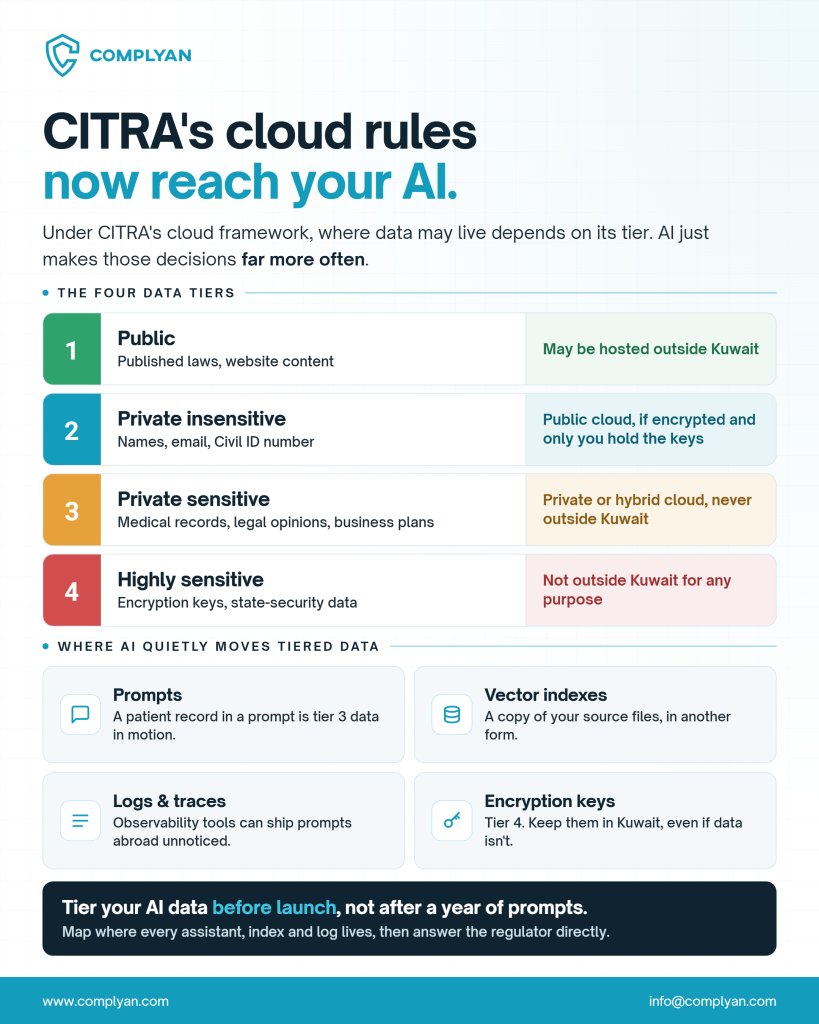
Tier | Examples named by CITRA | Hosting rule in the framework |
1: Public | Published laws, public website content | May use providers outside Kuwait |
2: Private insensitive | Names, email, Civil ID number | Public cloud if encrypted and only the customer holds the keys |
3: Private sensitive | Medical records, legal opinions, business plans | Private or hybrid cloud, not outside Kuwait |
4: Highly sensitive | Encryption keys, state-security information | Not outside Kuwait for any purpose |
Table drawn from Rukn’s reading of the framework articles. Tier 3 and 4 storage is barred outside Kuwait “temporarily or permanently” (Art. 4.2.1.1), which covers backups, replicas, and log exports.
Why AI Workloads Raise the Residency Question
Prompts carry tiered data: a prompt containing a patient record or a legal opinion is tier 3 data in motion. If the framework binds you, sending it to a model hosted abroad is a residency decision, not a software setting.
Retrieval indexes are copies: a vector store built from tier 3 documents is a derived store holding that content in another form. The framework’s wording on storage “in any form” reads broadly enough that a vector store should be treated like its source files, and counsel can confirm the position for your case.
Logs and traces are side doors: Rukn names cross-region backups, disaster-recovery replicas, error trackers, and log shippers as the usual routes sensitive data takes out of a country unnoticed. AI observability tools that capture prompts belong on that list.
Assistants and bots move message content: Rukn warns that a WhatsApp bot or AI assistant may send message content abroad, so the processing location needs checking before launch.
Keys sit in tier 4: under a conservative reading, the keys protecting tier 3 data belong in Kuwait even when the ciphertext does not.
Where AI Can Be Hosted in Kuwait Today
As of 27 September 2026, per Rukn:
- Google Cloud: announced a Kuwait region in January 2023 with no launch date, and Kuwait was not in its live region list. Nearest regions are Doha and Dammam.
- Microsoft Azure: announced its intent to establish an AI-powered Azure region in Kuwait on 6 March 2025, in partnership with CAIT and CITRA, with no timescale.
- AWS: Outposts hardware can be installed in Kuwaiti data centres, connecting to the nearest AWS Region.
- CITRA-licensed providers: CITRA’s register listed 13 companies, including Zain, Wataniya, Gulfnet, and QualityNet, but showed 2025 expiry dates, so each licence needs confirming directly.
Plan around what exists. Design for portability so a later move to a Kuwait region is a migration, not a rebuild.
Who Is Bound
Your situation | What applies |
Government body, or contractor holding government data | The cloud framework (Art. 1.4) |
CITRA licensee | The framework plus the privacy regulation, including breach reporting within 24 hours, per DLA Piper |
Private company with no government data | No general localisation rule per Chambers, though the framework’s subscriber duties and customer contracts may still reach you |
Contract Terms to Demand From an AI Vendor
CITRA does not need a separate rule for every AI model before cloud governance becomes relevant.
Consider a company deploying an AI customer-service system on a cloud platform. Customer records may be sent to the model, retrieved from another database and stored in application logs.
The organization still needs to establish who operates the infrastructure, whether the cloud provider is permitted for the relevant use case, where data processing occurs and which security controls protect the information.
The same applies to agentic AI. An AI agent may connect to several enterprise systems and invoke external cloud services without an employee manually initiating every transfer.
The compliance issue is therefore not whether a workload carries the label “AI.” It is whether the workload changes data processing, cloud dependencies or security exposure.
Kuwait’s cloud infrastructure is also continuing to develop. In September 2026, CITRA reported progress on Google Cloud data-center projects planned across three sites in Kuwait. Citra
More local infrastructure may provide organizations with additional deployment choices, but the existence of a local region does not replace workload-level compliance assessment.
Conclusion
The CITRA framework in Kuwait was written for cloud hosting, and AI has made hosting decisions far more frequent: every new assistant, index, or logging tool is one. Organizations that map where their AI data lives, and tier it before launch, can answer a regulator or a bank customer directly instead of tracing a year of prompts afterward. To see how this maps to your own cloud and AI estate, get in touch with Complyan.
Frequently Asked Questions
Does the CITRA framework apply to AI tools?
Yes, wherever the framework binds you: government bodies, contractors holding government data, and CITRA licensees, per Rukn’s reading of Art. 1.4. Chambers 2026 reports no general localisation rule for other private companies, though contracts and sector rules can still require local hosting. This is a technical summary, not legal advice.
Can I send customer data to an AI model hosted outside Kuwait?
Per Rukn’s summary of the framework, tier 1 data and encrypted tier 2 data with customer-held keys may use providers abroad, while tier 3 and 4 data may not. Art. 4.2.1.1.3 also lists individuals’ personal data among data that should stay, so get legal advice first if the framework binds you.
Was the Data Classification Policy repealed?
According to GLA & Company in the Chambers 2026 guide, yes, in February 2024. The framework still refers to the four tiers.
Is there a Google, Microsoft, or AWS region in Kuwait?
Not as of 27 September 2026, per Rukn. Google and Microsoft have announced regions without launch dates, and AWS Outposts hardware can be installed locally. CITRA-licensed local providers are the in-country option.
What breach timelines apply?
Providers notify subscribers within 72 hours under the framework (Art. 4.2.2.1, per Rukn). CITRA licensees also report personal data breaches within 24 hours under the privacy regulation, according to DLA Piper.
How do I track where my AI data lives?
Start with a data flow map of models, prompts, retrieval sources, logs, and vendors. Complyan’s data flow and mapping tools track data by system and destination, so overseas processing shows up before an auditor finds it.
Dubai Electronic Security Center compliance in 2026 still runs through the same thirteen ISR domains it always has, but the substance behind several of them, especially around AI and cloud infrastructure, is actively expanding. Organizations that treat ISR as a living framework, mapping new AI services against existing domains as certification scope grows, are the ones ready for whatever 2027’s sharper requirements bring, rather than the ones explaining a gap an auditor finds first.