




 Governance and Policy Management
How to Build a Cyber Risk Register

A cyber risk register should tell leadership what can go wrong, why it matters, who owns the exposure and what is being done about it. Many registers fail because they become lists of vulnerabilities, audit findings or vague statements such as “ransomware risk: high.”
A stronger register is scenario-based. It connects a threat event to a business service, the conditions that make the event possible, the impact if it occurs, the controls already in place and the treatment required to reach an acceptable level of residual risk.
NIST’s updated IR 8286 series uses cybersecurity risk registers as a bridge between cybersecurity risk management and enterprise risk management. That is the right starting point: the register should support decisions across the business, not remain confined to the security team.
A cyber risk register fails in one of two ways: it becomes a spreadsheet nobody owns, or a long list nobody can act on. Complyan’s cyber risk management platform is built to avoid both. This guide sets out what an entry needs, how to build the register step by step, and how to keep it current, using the structure NIST publishes in IR 8286.
What a Register Is For
A register exists to support decisions: which risks to fund, which to accept, and who answers for each choice. It is also audit evidence. Wolfia notes that SOC 2, ISO 27001, and NIST CSF all expect documented evidence of ongoing risk identification and treatment. A register with the same fields on every row gives an auditor that evidence without a scramble.
The Fields Every Entry Needs
Compyl reports that NIST IR 8286 Revision 1, published December 2025, specifies 12 fields: ID, priority, risk description, category, likelihood, impact, exposure rating, response type, response cost, response description, owner, and status. GRC Engineering Club lists the same set. The table below groups them with two additions that auditors and boards ask for.
Field | What to record |
|---|---|
ID and category | A stable identifier and a category such as ransomware, third party, or cloud |
Scenario | The threat, exploitable condition, event, affected service, and business consequence, per OC Security Audit |
Likelihood and impact | Scores on a defined scale, with the assessment date |
Exposure rating | The combined result, shown before controls (inherent) and after (residual) |
Existing controls | Listed separately from planned actions, per Wolfia |
Response | Accept, avoid, mitigate, share, or transfer, the five responses from NIST SP 800-39, per GRC Engineering Club |
Action, cost, and due date | What will change, what it costs, and when |
Owner | One named person with authority to fund or accept the response |
Status and next review | Current state and the date or trigger for the next look |
Build It in Seven Steps
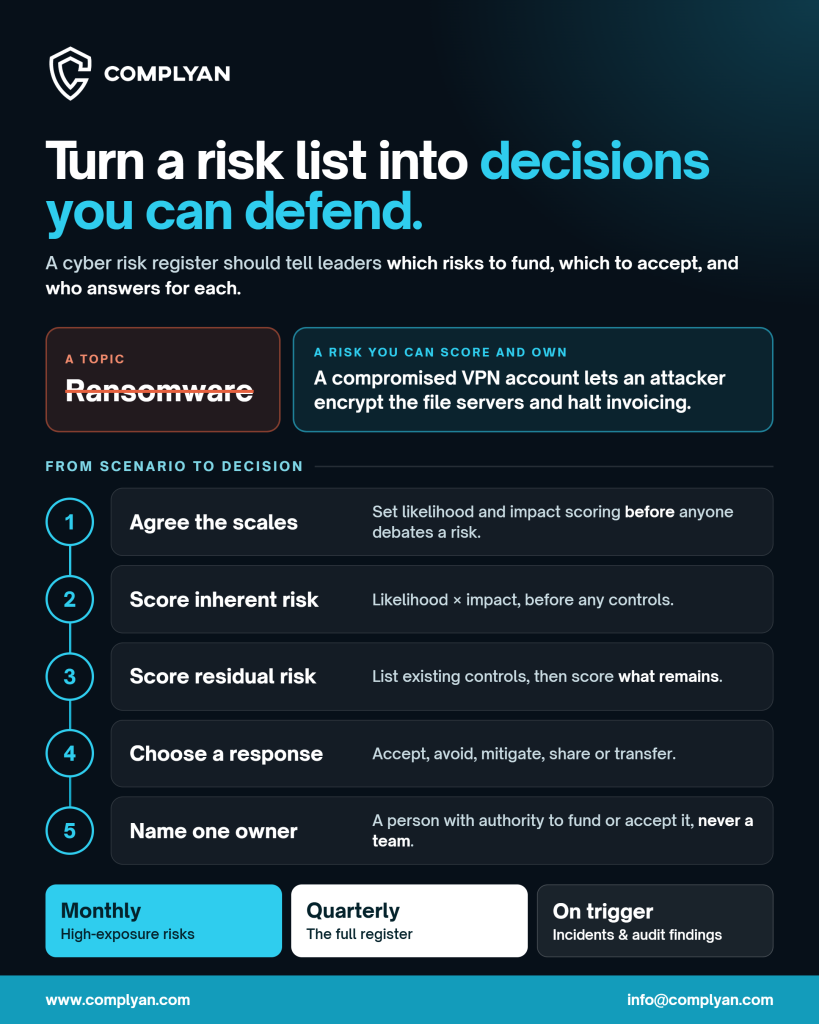
Set the criteria first: agree the likelihood and impact scales before anyone debates a risk. Freeform Agency advises settling the scoring scale before debate starts, and ISO 27001 practice sets risk criteria before identifying risks, per TechJack Solutions.
Identify scenarios from real sources: draw on assets, supplier dependencies, incidents, audit findings, and threat reports.
Write each risk as a scenario: “ransomware” is a topic. “A compromised VPN account lets an attacker encrypt the file servers and halt invoicing” is a risk someone can score and own.
Score inherent risk: combine likelihood and impact before controls, as Scrut describes. A 1 to 5 scale multiplied together is common, per Wolfia.
Record controls and residual risk: note what already operates, then score what remains after treatment.
Choose a response and an owner: NIST defines the owner as the party who owns the loss from a realized scenario, as Compyl quotes. GRC Engineering Club adds that NIST IR 8286C recommends recording both the owner role and the named designee, and confirming the designee periodically.
Set the review rhythm: see below.
Start With What Matters, Then Widen
This is practical guidance. Begin with the scenarios tied to your most critical systems and services, then widen the register as the process settles. A register that tries to capture every conceivable risk on day one tends to stall before anyone reviews it.
What Feeds the Register
New entries should come from steady sources: incident reviews, audit findings, vulnerability and penetration test results, supplier assessments, regulator notices, and architecture or AI changes. Each of these is also a review trigger, so an event that adds a risk should prompt a look at related rows.
Scoring Without False Precision
Simple scales work, but a score of 15 looks more exact than the inputs justify. Freeform Agency suggests placing money values beside technical scores, so leaders see an estimated loss and a treatment cost next to the rating. Complyan’s cyber risk management platform holds scored and quantified risks together, so the board sees both.
Ownership and Acceptance
One owner per risk, not a team, advises Wolfia. ISO 27001 practice requires a named owner who approves treatment and accepts residual risk, per TechJack Solutions. Accepted risks need conditions: Gammal’s template asks for an expiry or mandatory review trigger on every acceptance.
Regional frameworks put the same weight on accountability. The CBUAE Operational Risk Management Regulation requires the Board to approve and review risk appetite and tolerance at least annually, and the UAE IA Standards carry a risk management family of 11 controls, per Dionach.
Review Cadence
Compyl recommends a tiered rhythm: high-exposure risks monthly, the full register quarterly, plus event triggers such as incidents, audit findings, and major architecture changes. OC Security Audit adds that urgent treatment milestones should be checked weekly until blockers clear. A single annual review for every row lets the register go stale. Name who convenes each review and who signs off changes, so the cadence does not depend on one person’s calendar.
Build the Register in Complyan
This is practical guidance. Hold scenarios, scores, owners, and responses in Complyan’s cyber risk management platform, and link each risk to the controls that treat it through Complyan’s cybersecurity compliance tools. Attach dated evidence with Complyan’s audit and compliance management platform, pull in supplier risks from Complyan’s third-party risk management, and report to leadership with Complyan’s executive and board reporting.
Conclusion
A cyber risk register should make risk easier to prioritise, treat and communicate. The best registers turn technical exposure into clear business scenarios, connect those scenarios to real controls and keep accountability visible through the full treatment cycle.
The goal is not to create the longest register. It is to create a reliable record of the risks that matter and the decisions the organisation has made about them.
Frequently Asked Questions About Vendor Risk Scoring
What is a cyber risk register?
A cyber risk register is a structured record of cybersecurity risk scenarios, their business impact, likelihood, existing controls, residual exposure, ownership and treatment status.
What is the difference between a vulnerability register and a risk register?
A vulnerability register records technical weaknesses. A risk register explains how a threat could exploit a condition and affect business objectives. One risk may contain several vulnerabilities, and one vulnerability may contribute to several risks.
How often should a cyber risk register be reviewed?
Review frequency should reflect severity and business change. Material risks should be reviewed more frequently and whenever incidents, major system changes, vendor changes, control failures or regulatory updates affect the scenario.
Who should own cyber risk?
The risk owner should have authority over the affected business outcome and the ability to make or escalate treatment decisions. Security teams can assess and monitor risk without owning every business consequence.
Should residual risk be recorded?
Yes. Residual risk shows the exposure that remains after current controls are considered. It is the level leadership uses to decide whether further treatment or formal acceptance is required.