



 Governance and Policy Management
NCSC Kuwait: What the National Cyber Security Center Expects From Your Organization

Kuwait’s National Cyber Security Center is no longer simply setting strategic direction for cybersecurity. In 2026, its role became far more operational.
Decision No. 2 of 2026 introduced the National Basic Cybersecurity Controls, or NBCC, as Kuwait’s mandatory minimum cybersecurity baseline for entities within the NCSC’s mandate. The controls now give organizations a measurable set of requirements covering governance, assets, access, monitoring, incident response, recovery and cloud security.
The change matters because NCSC compliance is now something covered entities need to demonstrate with evidence.
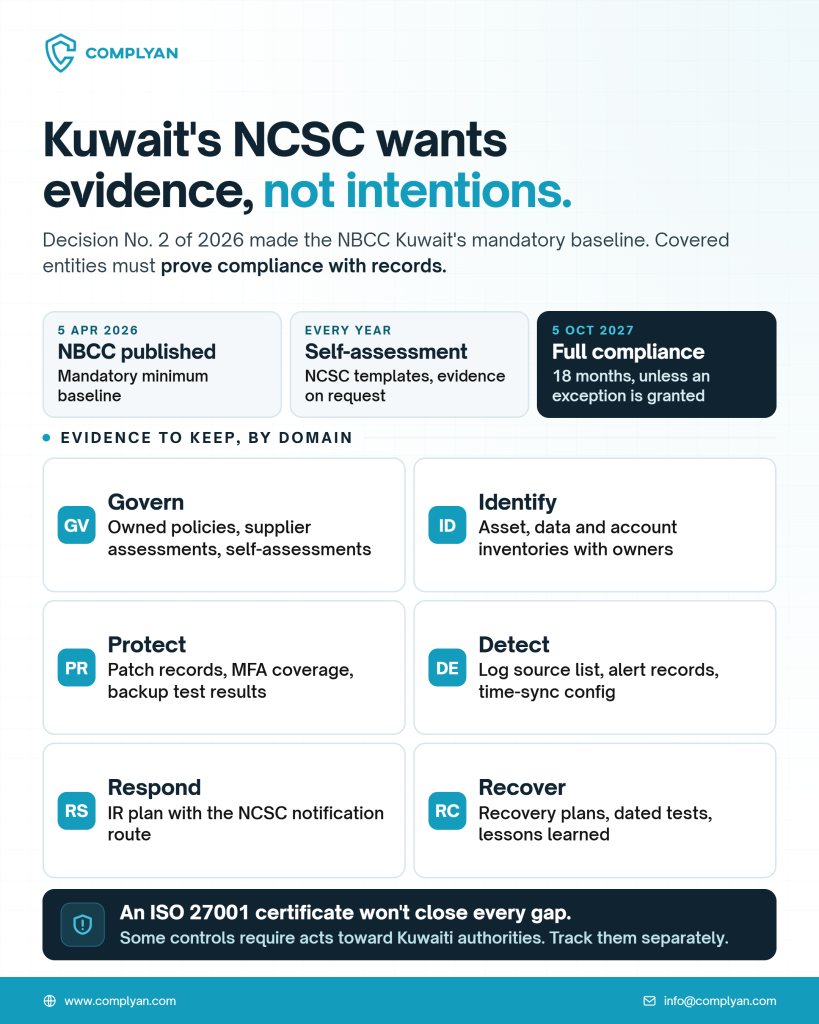
Organizations must conduct at least one self-assessment every year using an NCSC-approved method, retain supporting records and provide them when requested. Covered entities have 18 months from publication to achieve full compliance unless a documented exception is granted. With the decision published on 5 April 2026, that places the implementation window into October 2027.
DTS Solution and Complyan have each covered the controls themselves. This piece covers the authority behind them: who the NCSC is, what it has issued, what it expects you to show, and how to prepare.
Who the NCSC Is for
Amiri Decree No. 37 of 2022 established the NCSC as the competent national authority for cybersecurity, according to RSM in Kuwait’s briefing. Alyaqout Law Firm adds that the decree conferred supervisory authority over national cybersecurity matters. Its Decision No. 2 of 2026, published in the official gazette on 5 April 2026, adopted the National Basic Cybersecurity Controls, known as the NBCC, as Kuwait’s mandatory national minimum baseline.
RSM stresses the NBCC represents essential cyber hygiene, a starting point and not an advanced maturity model.
What the NCSC Has Issued
Instrument | What it does |
Decision No. 2 of 2026, NBCC | Sets the mandatory minimum baseline across six domains: Govern, Identify, Protect, Detect, Respond, and Recover, aligned with NIST CSF 2.0 and CIS Controls v8.1 IG1 |
National Data Classification Framework, Decision No. 1 of 2025 | Classifies data; the NBCC aligns with it |
National Cybersecurity Governance Framework, Decision No. 35 of 2023 | Sets governance expectations; the NBCC aligns with it |
The NBCC also includes a dedicated appendix of mandatory cloud security controls, per RSM. An open-source toolkit by SiteQ8 counts 44 controls and 329 checks in the Annex, which is a community count, so confirm it against the official text.
Who Is in Scope
RSM lists civil government agencies, military authorities, security agencies, and private sector entities related to the NCSC’s functions, particularly those critical to national security or infrastructure, as identified by the center. Other entities may be designated under the decree. Organizations outside scope are urged to adopt the controls voluntarily.
Because private sector scope depends on identification by the center, treat it as a question to settle in writing, not an assumption. This is practical guidance: ask your NCSC contact or legal counsel to confirm whether you are designated.
What the NCSC Expects You to Show
RSM’s summary lists four obligations:
An annual self-assessment: at least one a year, using NCSC-approved templates.
Retained evidence: kept and available to the NCSC on request.
Full compliance in 18 months: counted from publication, unless the NCSC grants a documented exception with a specific timeline. The SiteQ8 toolkit puts the date at 5 October 2027.
Regulatory action for non-compliance: the NCSC may act in line with its mandate.
RSM frames the NBCC as a governance, assurance, and regulatory priority for senior leaders, not a purely technical exercise, so executives need current visibility into where each control stands and who owns the gap. Several controls ask for more than internal hygiene. The Respond domain includes mandatory notification to the NCSC, and Govern covers third-party oversight and self-assessment, per RSM.
Evidence by Domain
RSM’s summary describes what each NBCC domain covers. The right column is practical guidance on what to keep, not NCSC text.
Domain | What it covers, per RSM | Evidence to keep |
Govern | Governance, roles, policies, data classification, third-party oversight, self-assessment | Approved policies with owners, supplier assessments, completed self-assessments |
Identify | Asset, software, data, and account inventories | Inventories with named owners and change history |
Protect | Secure configuration, patching, access control, MFA, awareness, malware protection, data protection, backups, physical security | Patch records, MFA coverage reports, training logs, backup test results |
Detect | Logging, monitoring, and time synchronization | Log source list, alert records, time-sync configuration |
Respond | Incident reporting, coordination, and mandatory notification to the NCSC | Incident plan with the NCSC route, rehearsal records |
Recover | Recovery planning, testing, and continuous improvement | Recovery plans, dated test results, lessons learned |
One Gap a Certificate Will Not Close
The SiteQ8 toolkit identifies nine NBCC controls that require an act toward a Kuwaiti authority or compliance with Kuwaiti law, including alignment with the National Data Classification Framework and submission to the NCSC. If that reading is right, an ISO 27001 certificate helps with many controls but cannot discharge these. Check the Annex, and keep a separate list for them.
Where the NCSC Sits Beside CBK and CITRA
DTS Solution’s guide to Kuwait’s cybersecurity providers names three main frameworks: the NCSC’s NBCC, the CBK’s Cyber and Operational Resilience Framework for financial institutions, and CITRA’s regulations for telecoms, cloud, and digital service providers. Some organizations may sit under more than one. DTS Solution’s CBK CORF guide, DTS Solution’s CITRA guide, and Complyan’s CITRA guide cover those regimes, so one control record can serve each.
A Preparation Plan
Confirm scope and designation: DTS Solution’s compliance consulting can run the scope assessment, and Complyan’s NBCC guide sets out who falls under it.
Assess against the controls: DTS Solution’s GRC practice provides independent gap assessment, and Complyan’s cybersecurity compliance tools map each control to its evidence and to other frameworks.
Close technical gaps with testing: the NBCC expects ongoing vulnerability remediation, per DTS Solution’s Kuwait vulnerability assessment guide, and DTS Solution also offers penetration testing for independent validation.
Detect and respond: DTS Solution’s security operations center provides monitoring, and the incident plan must include the NCSC notification route.
Keep evidence and policies current: Complyan’s audit and compliance management platform holds dated evidence for the annual self-assessment, while Complyan’s governance and policy management tools track owners and reviews.
Oversee suppliers and report upward: Complyan’s third-party risk management covers the Govern domain’s supplier oversight, and Complyan’s executive and board reporting gives leadership a current view.
Common Mistakes
Assuming a certificate covers everything: controls that require acts toward Kuwaiti authorities need their own evidence.
Leaving designation unconfirmed: an organization that assumes it is out of scope may learn otherwise late in the window.
Treating the self-assessment as paperwork: it must use the NCSC’s templates, and evidence must be producible on request.
Starting at the deadline: 18 months passes faster than a procurement, testing, and remediation cycle.
Conclusion: NCSC Compliance Needs Both GRC and Technical Assurance
Kuwait’s NCSC has created a much clearer national cybersecurity structure.
The NBCC defines the minimum. The National Data Classification Framework influences how information must be protected. Cloud controls bring provider governance and data residency into the same programme. GovShield adds another operational component for government entities.
For covered organizations, the next step is to connect those pieces.
Complyan can manage the control, evidence and risk side of NCSC readiness, while DTS Solution can support technical assessment, remediation and wider cybersecurity capability from its established Kuwait practice.
That combination matters because NCSC compliance cannot be proven by a checklist alone.
The organization needs to show that the control exists, the evidence is current and the technology performs the way the policy says it should.
Frequently Asked Questions About Kuwait NCSC Compliance
What is Kuwait’s NCSC?
The National Cyber Security Center is Kuwait’s competent national cybersecurity authority, established under Amiri Decree No. 37 of 2022. Its mandate includes national cybersecurity policy, governance, incident coordination and compliance oversight.
What is the NBCC?
The National Basic Cybersecurity Controls are Kuwait’s mandatory minimum cybersecurity baseline for entities within the NCSC’s scope. They are structured around Govern, Identify, Protect, Detect, Respond and Recover.
When do organizations need to comply with the NBCC?
Covered entities have 18 months from publication of Decision No. 2 of 2026 to achieve full compliance unless NCSC grants a documented exception.
Does NBCC replace CBK or CITRA requirements?
No. Where sector-specific requirements are stricter, organizations must continue meeting those requirements alongside the NCSC baseline.
Can Sensitive data be hosted outside Kuwait?
Only where the applicable national approval process is followed and explicit NCSC approval is obtained. The requirement applies to storing or processing Sensitive data outside Kuwait.