


 Governance and Policy Management
How to Build a Unified Control Library You Can Reuse Across Frameworks

Multi-framework compliance becomes expensive when every standard is managed as a separate programme. The organisation ends up with several versions of access control, several incident-response requirements, several evidence folders and several owners proving the same safeguard in slightly different ways.
A unified control library changes that operating model. Instead of treating ISO 27001, NIST CSF, SOC 2, PCI DSS, NCA ECC, SAMA CSF, UAE IA or another framework as separate control sets, the organisation maintains one internal control set and maps each external requirement to it.
Complyan’s cybersecurity compliance tools map controls across frameworks, and this guide explains how to build the library itself: what it contains, the steps to create it, and where mapping stops working.
What a Unified Control Library Is
A unified control library is the organisation’s governed inventory of security, privacy, resilience and compliance controls. Each control has one canonical description, a defined owner, implementation scope, evidence requirement, test method and review frequency.
Framework requirements sit around that internal library. A single control can map to several requirements where the intent and implementation genuinely overlap. Framework-specific additions remain visible instead of being forced into a false equivalence
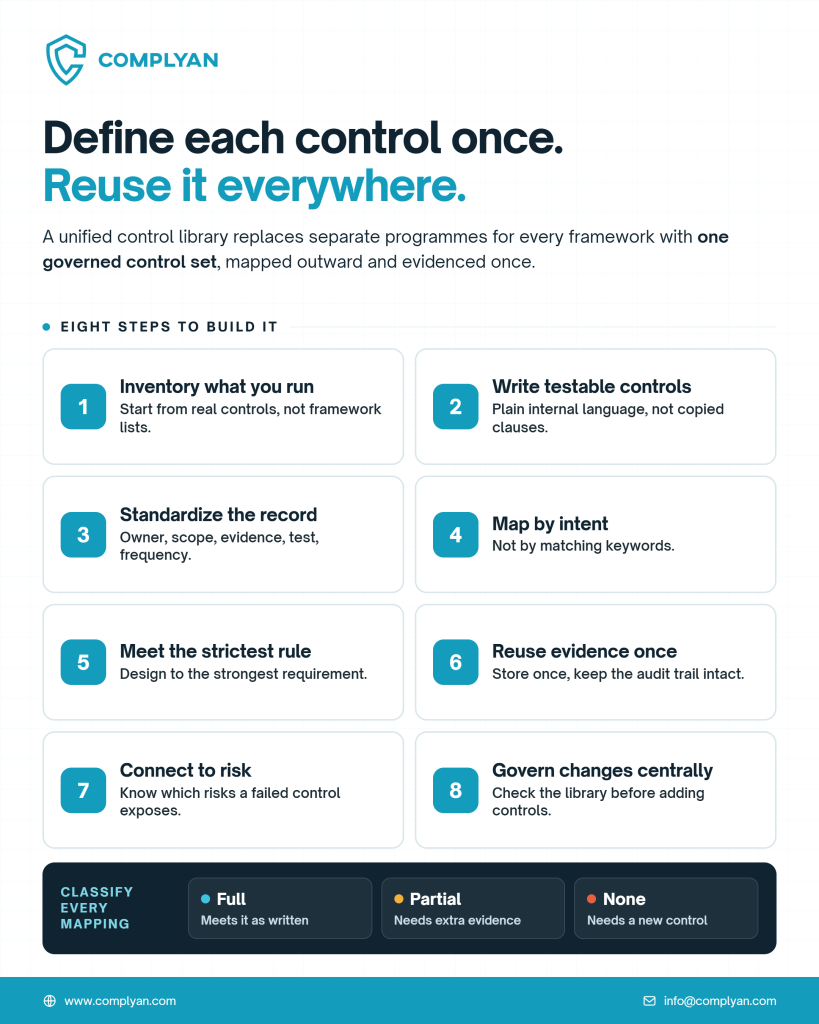
Eight Steps to Build It
Step 1: Inventory What You Already Operate
Do not begin by copying every requirement from every framework into a spreadsheet. Start with the controls the organisation already operates. Gather policies, procedures, technical safeguards, monitoring activities, supplier checks, privacy controls, resilience processes and audit routines.
Remove obvious duplicates and assign each control a unique ID. If three departments use different wording for quarterly access reviews, determine whether they are one control with different scopes or three genuinely different controls.
Step 2: Write Controls in Clear, Testable Language
A control description should say what must happen and, where useful, who or what is in scope. Avoid copying framework wording as the internal control description because external requirements change and different standards express the same intent differently.
Example: “Privileged access to production systems is reviewed at least quarterly by the system owner, and inappropriate access is removed within the defined remediation period.”
That control can be tested. It can also support more than one framework without being rewritten each time.
Step 3: Give Every Control a Standard Record
Each control should contain enough metadata to make ownership, evidence and testing consistent. Useful fields include:
Control ID and control title
Control objective and description
Control owner and supporting teams
Business and technology scope
Control type: preventive, detective, corrective or recovery
Frequency or trigger
Evidence source and retention requirement
Test procedure and success criteria
Linked risks
Linked framework requirements
Exceptions, compensating controls and remediation status
Step 4: Map by Intent, Not by Keywords
Framework mapping fails when teams match similar words and assume the requirements are equivalent. Two standards may both mention access review while differing on frequency, scope, approval or evidence expectations.
Classify mappings instead. A practical model uses three states:
Full coverage: the internal control satisfies the requirement as written.
Partial coverage: the control addresses part of the requirement but needs an additional activity or evidence item.
No coverage: the requirement needs a new control or material redesign.
This prevents over-mapping, which creates a dangerous impression of compliance when important framework-specific details remain unmet.
Step 5: Design for the Strongest Applicable Requirement
Where several frameworks govern the same activity, it can be efficient to design the internal control to meet the strongest applicable requirement across the organisation. For example, if one framework requires privileged access review quarterly while another permits a longer period, the common control can adopt the stricter review frequency where the scope supports it.
This should be a deliberate governance choice. Some frameworks apply only to specific systems, business units or jurisdictions, so the control scope must remain precise.
Step 6: Reuse Evidence Without Losing Traceability
Evidence reuse is one of the biggest gains from a unified library. The same approved incident-response plan, access-review record or vulnerability scan may support several mapped requirements. Store the evidence once and link it to every relevant requirement through the control.
The evidence record should still show source, date, owner, coverage period and validation status. Reuse should reduce duplication, not weaken the audit trail.
Step 7: Connect Controls to Risk
A mature control library does more than support audits. Each control should show which risks it reduces. When a control fails, the organisation can identify the risk scenarios affected and decide whether treatment or escalation is required.
This is where control mapping becomes part of risk management rather than a compliance-only exercise.
Step 8: Govern Changes Centrally
Controls change when technology, regulation, business processes or threats change. Maintain version history and review mappings whenever a control or framework requirement is updated. New frameworks should be assessed against the existing library before teams create new controls.
That single rule prevents the library from returning to the fragmented state it was designed to replace.
Complyan’s Common Control Framework guide explains how one governed control set can reduce duplicate GRC work across multiple standards.
The cybersecurity framework cross-mapping guide also shows why full and partial mappings must be distinguished when controls are reused.
Complyan’s framework library brings GCC and international requirements into one structure and supports evidence reuse wherever mapped controls share the same requirement intent.
What a Control Record Contains
This is practical guidance. Each control needs an ID, the normalized statement, an owner and an evidence owner, a frequency, test steps, the evidence type and where it lives, the mapped requirements with their strength, the linked risks, and the date of the last review. Granularity matters: write at the level of a practice someone performs and can evidence, such as a quarterly access review, rather than copying one framework’s clause wording.
Define done in advance. Every in-scope requirement should map to at least one control, or be recorded as an explicit gap with an owner and a date.
Where to Start
This is practical guidance. Start with the controls that touch the most requirements: access management, logging and monitoring, vulnerability management, backup and recovery, incident response, supplier management, and change control. Normalize and map those first, then test the library with a real request, such as one auditor asking for evidence of a single control. If the answer takes a search instead of a lookup, fix the tagging before widening the library.
Conclusion
A unified control library works when each control is written once in operational terms, mapped to every framework it meets with a stated strength, owned by one person, and backed by evidence collected once. Organizations that separate controls from deliverables, resolve conflicts with the stricter requirement, and review the library when frameworks change can add a new framework by filling gaps instead of starting again.
Frequently Asked Questions About Vendor Risk Scoring
What is a unified control library?
It is a central inventory of internal controls that the organisation governs once and maps to multiple external frameworks, regulations and contractual requirements.
Is a unified control library the same as a Common Control Framework?
The terms are closely related. A Common Control Framework is the structured control set used to satisfy multiple frameworks, while the control library is the governed system of record containing those controls, ownership, evidence, tests and mappings.
Can one control satisfy several frameworks?
Yes, when the control fully meets the intent and scope of each mapped requirement. Where requirements differ, the mapping should be marked partial and the remaining gap should be addressed separately.
How should evidence be reused across frameworks?
Store evidence once against the internal control, then reference that validated evidence from each mapped requirement. Keep dates, scope, ownership and verification status visible for audit traceability.
How often should control mappings be reviewed?
Review mappings when a framework changes, a control changes, the business scope changes or testing shows that the control no longer operates as designed. A periodic governance review should also confirm the library remains current.