


 Governance and Policy Management
Ransomware Resilience Playbook for GCC Organizations

A ransomware programme can look strong right up until the organization has to restore a critical service.
MFA may be deployed. Endpoint protection may be current. Backups may run every night. None of those controls answers the question leadership will face during an attack: how long can the business operate without the affected service, and can it be restored safely within that period?
That is the difference between ransomware prevention and ransomware resilience.
For GCC organizations, resilience also connects directly with existing regulatory expectations. SAMA, for example, requires defined business continuity and disaster recovery plans alongside protected backups and restoration testing.
A ransomware playbook should therefore start with business survival rather than malware.
Ransomware moved from a side risk to a main one for Gulf organizations in a short time. Complyan’s ransomware readiness guide covers the pillars of a prepared program. This playbook covers the order of operations for a GCC organization: what to prepare, what to do in the first 24 hours, and what to prove afterward.
Start With the Services the Business Cannot Lose
Ransomware response becomes chaotic when technical teams know which servers are encrypted but leadership does not know which business service must return first.
The resilience programme should begin by identifying critical operations and mapping the systems that support them.
A payment service may depend on identity infrastructure and a database. It may also require a third-party gateway. Restoring only the application server does not restore the service.
This dependency view should feed directly into cyber risk management.
Complyan Cyber Risk Management provides a centralized risk register where critical assets can be connected to risks, accountable owners and treatment activity.
That makes ransomware risk more useful than a generic entry marked “high.” Teams can see which service is exposed and what recovery weakness is driving the risk.
Why the Gulf Needs Its Own Playbook
Concentrated exposure: SOCRadar’s Gulf Region report for 2026 puts the UAE at 56.36 percent of ransomware attacks in the region and Saudi Arabia at 17.80 percent. Check Point data covered by Dark Reading shows UAE and Saudi organizations facing nearly 2,700 attacks a week, against about 2,300 for a typical organization worldwide.
A fragmented attacker pool: SOCRadar counts RansomHub at 20.9 percent, LockBit at 15.4 percent, and CoinbaseCartel at 13.2 percent, with other groups making up 50.5 percent. A playbook built around one group’s habits will miss half the field.
Edge devices as the front door: CloudSEK researcher Anirudh Batra told The National that unpatched firewalls and VPN gateways remain common entry points, and that the Gulf was not a primary ransomware target until it changed in 2025.
Regulators who ask for recovery proof: per Computer Weekly, Saudi Arabia’s Essential Cybersecurity Controls require organizations to show they can recover quickly and to test backup recovery periodically. The CBK describes CORF as a resilience-first, maturity-oriented model.
Phase 1: Before an Attack, Make Recovery Provable
Test restores, not backups: Veeam research cited by Computer Weekly found only 10 percent of ransomware victims recovered more than 90 percent of their data, even among organizations with backup programs. Run a timed restore of one critical system each quarter and record the result.
Keep one copy out of reach: an offline or immutable copy that attackers cannot reach with stolen admin credentials.
Patch the edge first: inventory every firewall, VPN gateway, and remote-access service, and set a fixed timeline for critical fixes.
Harden identity: Microsoft’s Digital Defence Report 2025, as cited in Chambers’ UAE chapter, found 97 percent of identity attacks worldwide are password-based. Enforce multi-factor authentication and limit privileged accounts.
Decide who decides: name the incident commander, the person who can isolate systems without waiting for approval, and the executive who owns payment and disclosure decisions. Complyan’s governance and policy management tools hold that playbook, its owners, and review dates.
Know your baseline: Complyan’s cyber maturity assessment shows where recovery, identity, and detection stand before an incident forces the question.
Phase 2: The First 24 Hours
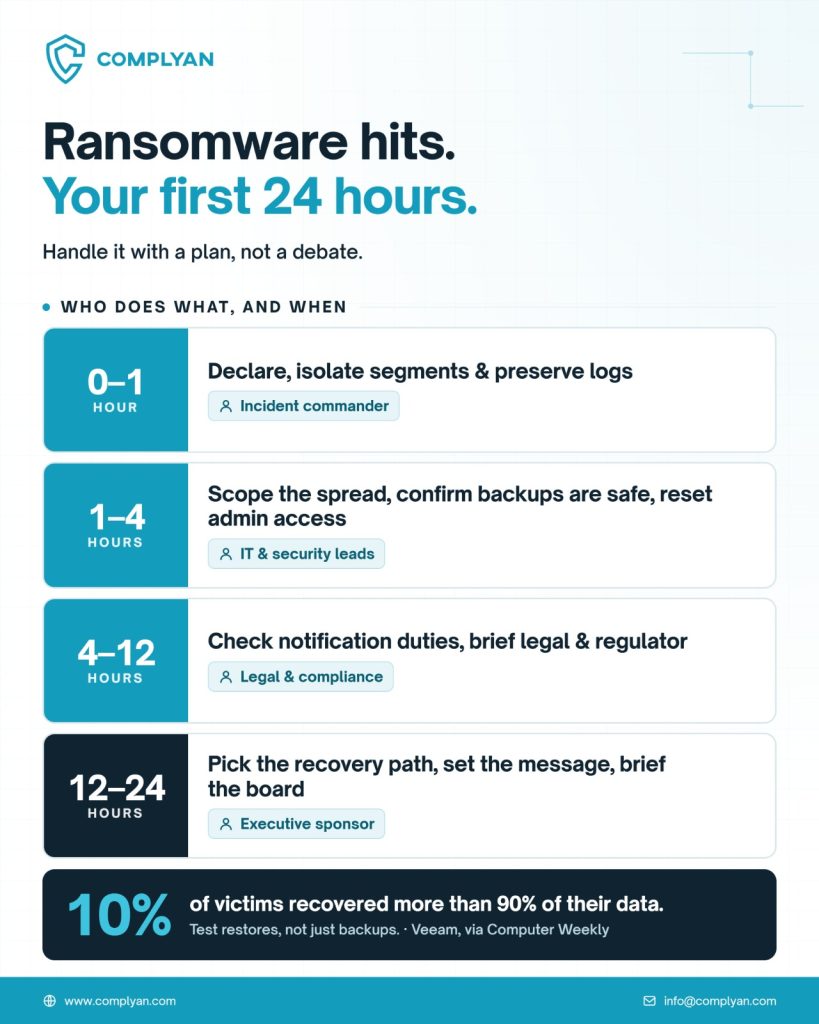
The table below is practical guidance, not regulatory text. Adjust roles to your structure.
Window | Action | Owner | Record to keep |
0 to 1 hour | Declare the incident, isolate affected segments, preserve logs and memory | Incident commander | Time of detection and declaration |
1 to 4 hours | Scope the spread, confirm backups are intact and unreachable, reset privileged credentials | IT and security leads | Affected systems list, backup status |
4 to 12 hours | Check notification duties and brief legal, the regulator contact, and the insurer | Legal and compliance | Clock start times, regulator contact log |
12 to 24 hours | Choose the recovery path, set the customer message, brief the board | Executive sponsor | Decision log with reasons |
Notification clocks vary by sector. Under CITRA’s privacy regulation, licensees must report personal data breaches within 24 hours, per DLA Piper, so the legal check belongs in the first hours, not the second day.
Three Decisions to Settle Before an Incident
The payment stance: whether to pay is a board decision that needs legal input. Agree the criteria and the approval chain in advance, because the day of an attack is the wrong time to debate it.
The disclosure chain: decide who contacts the sector regulator, the national response team, customers, and staff, in what order, and who approves each message.
The insurer’s conditions: read the policy for notice deadlines and approved response vendors, since late notice or an unapproved vendor can complicate a claim.
Test all three in a tabletop. This scenario is illustrative: a compromised VPN gateway leads to encrypted file servers at 2 a.m. on a Friday, the primary backup server is also affected, and the incident commander is traveling. Ask who isolates the network, who confirms the offline copy is intact, and who calls the regulator, then time each answer.
Phase 3: Recovery and Proof
Restore in business-impact order: rebuild identity services first, then the systems that carry revenue or safety, and verify each restored system is clean before reconnecting it.
Watch for re-entry: attackers often keep a second foothold, so monitor restored systems closely for several weeks.
Hold the evidence pack: restore test results, the incident timeline, the decision log, notification records, and a remediation tracker. Complyan’s audit and compliance management platform keeps these mapped to controls, and Complyan’s executive and board reporting gives leadership a current view.
Review suppliers: many incidents begin through a vendor connection. Complyan’s third-party risk management tracks who has access to what, and Complyan’s cyber risk management platform puts the residual exposure in the risk register.
A Rhythm That Keeps the Playbook Alive
This cadence is practical guidance, and it turns a document into a habit.
Monthly: review the inventory of edge devices and the status of critical patches.
Quarterly: run a timed restore of one critical system, and record the result and the time taken.
Twice a year: run a tabletop with the incident commander, legal, communications, and an executive sponsor, using a different scenario each time.
Yearly: brief the board on restore results, open gaps, and the payment and disclosure criteria, and refresh the playbook’s owners and contact list.
Where GCC Programs Stall
Backups that were never restored: the first full restore happens during the incident.
Edge devices outside the patch cycle: firewalls and VPN gateways get patched after servers, if at all.
No decision rights: hours pass while leaders debate who can isolate a system.
Evidence rebuilt after the fact: logs and approvals reconstructed from memory weaken both regulatory and insurer conversations.
Stale contacts: the phone tree lists people who left, and nobody notices until the night it is needed.
A playbook nobody has rehearsed: a document in a shared folder is not a capability until a team has run it under time pressure.
Conclusion: Ransomware Resilience Is Measured After Prevention Fails
A ransomware-resilient organization knows what must recover first and which dependencies are required to restore it.
It has backups that have been tested. Recovery identities are protected. Critical vendors are included in the plan. Findings from exercises become owned remediation actions.
Complyan Ransomware Readiness brings ransomware preparation into the wider GRC programme by connecting controls, risks and recovery requirements.
The objective is not to promise that ransomware will never succeed.
It is to know what happens when it does.
Frequently Asked Questions About Vendor Risk Scoring
What is the difference between ransomware readiness and ransomware resilience?
Readiness covers the preparation needed to prevent and respond to ransomware. Resilience focuses on whether critical operations can continue or recover when an attack succeeds.
Are immutable or offline backups enough?
They are important, but they still need restoration testing. Organizations should prove that the protected copy can restore the complete service within the required recovery period.
How should GCC organizations measure ransomware resilience?
Useful measures include tested recovery times, backup restoration success, critical-service coverage and closure of findings from exercises.
How does Complyan support ransomware readiness?
Complyan connects ransomware risks with control implementation, audit evidence and remediation so readiness can be monitored continuously rather than reviewed only during an incident.