


 Governance and Policy Management
Vendor Risk Scoring Models and Automation: Beyond the Questionnaire

A vendor score only matters if it changes a decision. Too many programs produce a number at onboarding, file it, and never look again, even as third parties show up in more breaches.
Verizon’s 2026 Data Breach Investigations Report, as cited by Dark Reading, found third parties involved in 48 percent of breaches, a 60 percent increase year over year.
Complyan’s third-party risk management platform is built around turning scores into actions. This piece compares scoring models, explains how to calibrate one, and separates what to automate from what to keep with people.
Inherent Risk Comes First
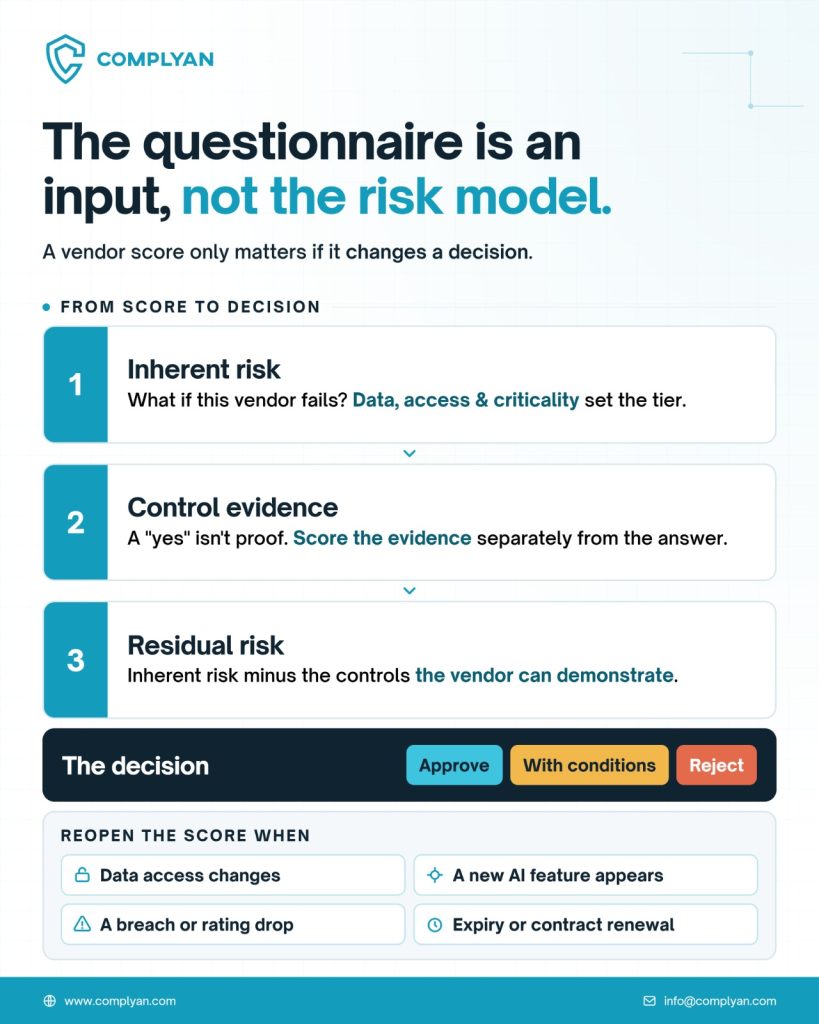
Inherent risk represents the exposure created by the vendor before its security controls are considered.
The scoring model needs to ask what would happen if that supplier failed or was compromised.
A vendor with administrative access to production systems may receive a high inherent-risk score even when it has excellent security controls. A supplier with no sensitive data and no operational dependency may start much lower.
The exact weighting will differ between organizations, but the model should account for factors such as data sensitivity and system access. Business criticality also matters. The organization should consider whether the service can be replaced quickly and whether disruption would affect regulated activity.
Complyan Third-Party Risk Management provides a centralized vendor repository with automated assessments and ongoing risk monitoring.
That gives organizations a way to tier suppliers before deciding what level of assurance they require.
Why a Questionnaire Score Falls Short
It is a snapshot: the answers describe one day, and the vendor’s environment changes after it.
It is self-reported: the vendor writes the answers, and a reviewer rarely has time to test them.
It depends on the reviewer: Atlas Systems notes that when scoring relies on whoever reviewed the vendor that quarter, results become inconsistent across the portfolio, and incomplete vendor records mean tiering happens on partial information.
Five Scoring Models, and When Each Fits
Model | How it works | Strength | Watch out for |
Tier only | Classify by inherent factors such as data access, criticality, and connectivity, then fix the review depth per tier | Fast and simple | Says nothing about control quality |
Weighted scorecard | Score each risk domain, apply weights, and sum | Transparent | False precision, and weights that drift over time |
Inherent minus controls | Start with inherent risk, subtract demonstrated control effectiveness, and use the residual to decide | Ties scrutiny to risk and judges acceptability | Only as good as the evidence behind it |
Outside-in ratings | Score external signals continuously, the approach BestDefense associates with security-ratings platforms | Continuous and objective | Sees internet-facing posture only, not business criticality |
Quantified loss | Express exposure in currency, as in FAIR-style analysis | Board-ready | Needs credible inputs |
Most programs combine models. vCSO.ai describes a two-dimensional approach: inherent risk sets the tier and the depth of review, and residual risk, inherent risk adjusted for the vendor’s controls, decides whether the relationship is acceptable. VISO Trust and LearnTPRM define residual risk the same way, and LearnTPRM maps the residual score to three outcomes: approve, approve with conditions, or reject.
A “Yes” Answer Is Not Control Evidence
Questionnaires remain useful because they create a structured way to ask vendors about their security programmes.
Their weakness is self-attestation.
A supplier can state that it performs annual penetration testing. That answer is stronger when supported by evidence. The same applies to incident-response exercises or certifications.
Control evidence should therefore influence the score separately from the questionnaire response.
A vendor may answer positively to a control while providing weak or expired documentation. The control-effectiveness score should reflect that difference.
Complyan AI can help review vendor documents and security questionnaires, reducing the manual work required to locate relevant information across large assurance packages.
Automation is useful here because the administrative work can be substantial.
The final risk decision should still remain transparent.
Calibrate Before You Automate
ProcessUnity’s guide to tiering gives a sound sequence. Define the risk domains that matter, build an inherent risk questionnaire around them, create clearly defined tiers from the scores, map each tier to a due diligence scope, and validate the model against a representative set of vendors before launch.
The validation step is where programs save themselves. This is practical guidance: take a sample of existing vendors, ask an experienced analyst to rank them without seeing the scores, and compare. Where the model and the analyst disagree, adjust the weights or the questions, not the analyst.
Make every score trigger an action: a score that does not change a review depth, a contract term, or a decision is decoration.
What to Automate, and What to Keep Human
Atlas Systems describes automation as handling repetitive tasks such as data collection, questionnaire routing, and evidence review, and describes its own approach as rules-first and AI-assisted, with every high-risk decision keeping a human sign-off. ProcessUnity describes orchestration that routes each vendor to the right assessment path by tier and reuses shared risk data instead of starting from a blank questionnaire.
Automate:
- Intake and prefill from existing records
- Tier assignment and routing
- Reminders and escalations for late responses
- Draft evidence review and findings
- Score recalculation when something changes
- Renewal and reassessment scheduling
Keep human:
- Approval of high-risk vendors
- Exceptions and risk acceptance
- Judgment on ambiguous evidence
- Remediation negotiations
Complyan’s cyber risk management platform holds the scored risks and approvals, and Complyan’s audit and compliance management platform keeps the supporting evidence attached to each vendor.
Events That Should Reopen a Score
Continuous monitoring is only useful if signals reopen a score. These triggers are practical guidance:
A change in data access: a vendor that gains a new integration or a broader permission has a new inherent risk.
A new AI feature or fourth party: Compyl notes that a vendor’s AI features can process your data and that a model provider you never contracted with may sit within the product.
A breach or a rating drop: external signals should prompt a targeted review, not wait for the annual cycle.
An expiring certificate or contract renewal: both are natural points to retest assumptions.
Pitfalls That Undermine a Good Model
False precision: a score of 73.4 implies accuracy the inputs cannot support, so report bands with the reasons behind them.
Ratings without context: an external rating cannot see which vendors hold your sensitive data, so combine it with inherent risk.
One-time calibration: weights set at launch drift as the vendor base changes, so revisit them on a schedule.
No feedback loop: record every time an analyst overrides a score and why, because frequent overrides show the model needs adjusting.
To measure whether the model works, track onboarding time by tier, the share of reassessments completed on schedule, and the override rate. These measures are practical guidance, and they show leadership what the scoring program delivers.
The GCC Context
Regional frameworks treat suppliers as a core control area. Baker Tilly’s summary of CBK CORF lists a Third-Party Risk Management baseline alongside the Cyber Resilience and Operational Resilience baselines. Complyan’s NCA ECC guide covers the third-party and cloud domain in Saudi Arabia’s controls. Complyan’s cybersecurity compliance tools map one supplier assessment across those frameworks, so a single evidence set serves each regulator.
Conclusion: The Questionnaire Is an Input, Not the Risk Model
A strong vendor risk programme starts by measuring the exposure created by the relationship.
The questionnaire then helps evaluate whether the supplier’s controls reduce that exposure. Evidence validates the answers. Continuous monitoring keeps the result current.
Complyan Third-Party Risk Management brings vendor inventory, assessments and ongoing monitoring into one platform while connecting third-party findings with the wider GRC programme.
The useful outcome is not a completed questionnaire.
It is a defensible decision about whether the organization can accept the remaining risk.
Frequently Asked Questions About Vendor Risk Scoring
What should a vendor risk score include?
The model should consider inherent exposure, the effectiveness of vendor controls and the residual risk remaining after mitigation.
What is vendor criticality?
Vendor criticality measures how important the supplier is to operations and the impact its failure or compromise could have on the organization.
Can vendor risk scoring be fully automated?
Data collection and reassessment can be heavily automated. Risk acceptance and other consequential decisions should remain governed by defined organizational authority.
How often should vendor risk be reassessed?
Frequency should follow supplier criticality. High-risk relationships should also be reassessed when significant changes occur rather than waiting for the next scheduled review.