


 Governance and Policy Management
Cloud Compliance in the Middle East: Managing Data Sovereignty, Residency, and PDPL Across AWS, Azure, and GCP

Cloud adoption across the Middle East has accelerated quickly over the last few years. Organizations across government, healthcare, finance, telecom, and critical infrastructure sectors are moving workloads into AWS, Microsoft Azure, and Google Cloud environments to improve scalability and operational efficiency.
At the same time, regulators across the region are tightening expectations around where data is stored, how it moves across borders, and who maintains control over it.
This has made cloud compliance one of the biggest operational challenges facing organizations in the region today.
The issue is no longer whether cloud platforms are secure enough. The challenge is maintaining regulatory alignment while operating across environments that often span multiple regions, providers, and legal jurisdictions simultaneously.
Why Cloud Compliance Has Become More Complex in the Middle East
Data sovereignty requirements across the Middle East have become significantly stricter.
Countries across the region now place stronger emphasis on:
- Local data residency
- Cross-border transfer restrictions
- Privacy governance
- Sector-specific cloud controls
- Contractual accountability with cloud providers
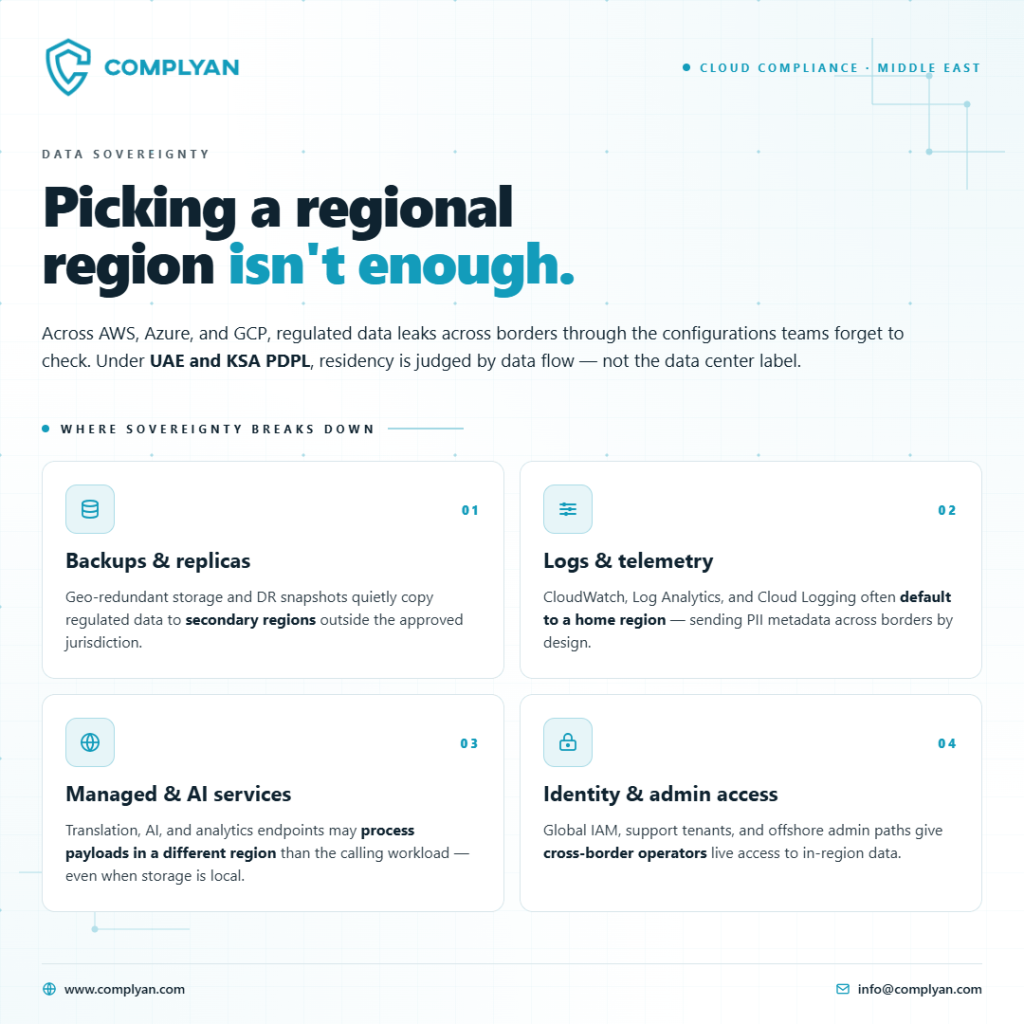
This becomes difficult for organizations operating across AWS, Azure, and GCP because cloud infrastructure does not naturally align with regulatory boundaries.
A workload deployed in one region may still replicate logs, backups, metadata, or processing activities into another jurisdiction depending on how services are configured.
Many organizations assume selecting a regional data center solves the problem. In reality, compliance depends on how data flows operationally across the environment, not just where the primary workload resides.
The Growing Importance of Data Sovereignty
Data sovereignty has become one of the defining cloud compliance issues in the Middle East.
Governments and regulators increasingly expect sensitive information to remain under local legal and operational control. This applies heavily to sectors such as healthcare, finance, telecommunications, and government services.
The challenge is that cloud platforms are built around distributed architectures.
Data may move between regions for redundancy, analytics, failover operations, or service optimization. Without proper governance, organizations can lose visibility into where regulated data is being processed or replicated.
This creates compliance exposure very quickly.
A company may believe customer data remains within the UAE or Saudi Arabia while connected services, logging pipelines, or third-party integrations transfer portions of that data elsewhere automatically.
This is why cloud compliance in the region now depends heavily on visibility and governance rather than infrastructure selection alone.
PDPL Is Changing Cloud Governance Requirements
Privacy regulations across the region are becoming more operationally demanding.
Saudi Arabia’s PDPL, along with broader privacy expectations emerging across the GCC, requires organizations to maintain tighter control over personal data processing, retention, access governance, and cross-border transfers.
This affects cloud architecture directly.
Organizations operating in AWS, Azure, or GCP environments must now consider:
- Where personal data is stored
- Which services process the data
- Whether backups remain within approved jurisdictions
- How third-party integrations interact with regulated information
- Who can access sensitive workloads remotely
The challenge becomes even more complicated in multi-cloud environments where governance standards may differ across providers.
A control implemented properly in Azure may not align operationally with how workloads are deployed in AWS or GCP.
Without centralized oversight, these inconsistencies become difficult to detect.
Multi-Cloud Is Expanding the Compliance Problem
Most organizations in the Middle East are no longer operating within a single cloud environment.
AWS may support production workloads while Azure manages collaboration systems and GCP handles analytics or AI services. This creates operational flexibility but also expands compliance complexity significantly.
Each cloud provider operates differently.
Logging structures vary. Identity management differs. Data replication settings are configured separately. Compliance teams are left trying to maintain governance visibility across platforms that were never designed to function as a single operational environment.
This fragmentation creates risk.
An organization may maintain strong governance in one cloud environment while weaker configurations remain exposed elsewhere.
That is one of the main reasons cloud compliance maturity remains inconsistent across many regional organizations despite growing security investments.
Why Cloud Misconfigurations Continue to Cause Problems
One of the largest cloud compliance risks in the Middle East remains misconfiguration.
Improper storage permissions, exposed APIs, weak identity controls, and unmanaged access paths continue to create exposure across cloud environments.
The problem is not a lack of security features within AWS, Azure, or GCP. The issue is operational complexity.
As environments expand, configurations drift over time. New workloads are deployed quickly, vendor access increases, and permissions accumulate across systems without continuous review.
Without centralized governance, organizations lose visibility into where compliance gaps are forming.
This becomes especially dangerous when regulated data is involved.
The Shift Toward Continuous Cloud Compliance
Traditional compliance models relied heavily on periodic assessments and audit cycles.
That approach is becoming increasingly difficult to maintain in cloud environments where workloads change constantly.
Organizations are now shifting toward continuous compliance models where controls are monitored continuously rather than reviewed only during assessments.
This allows compliance teams to identify issues as they emerge instead of discovering them during audits months later.
Platforms like Complyan Cybersecurity Compliance support this by centralizing compliance visibility across cloud environments, automating evidence collection, and maintaining operational oversight across multiple frameworks simultaneously.
This becomes particularly valuable in multi-cloud environments where governance consistency is difficult to maintain manually.
Why Cloud Compliance Is Becoming a Business Risk Issue
Cloud compliance in the Middle East is no longer limited to regulatory reporting.
Data residency violations, unmanaged cross-border transfers, or weak governance controls now create operational, contractual, and reputational risks simultaneously.
For regulated industries, these issues can affect customer trust, licensing obligations, and operational continuity.
This is why cloud governance discussions are increasingly moving beyond IT teams and into executive-level risk conversations.
Organizations now need visibility into how cloud infrastructure, privacy requirements, vendor access, and operational risk intersect across the business.
Building a Sustainable Cloud Compliance Model
Organizations managing cloud compliance effectively in 2026 are focusing on governance consistency rather than isolated controls.
They are centralizing visibility across AWS, Azure, and GCP environments while maintaining stronger oversight around identity governance, data residency, vendor access, and cross-border processing activities.
Solutions like Complyan Privacy and Compliance help organizations align cloud operations with regional privacy and compliance requirements while reducing the operational strain created by fragmented compliance workflows.
The goal is no longer simply passing audits.
It is maintaining continuous visibility into where regulated data exists, how it moves, and whether governance controls remain aligned as cloud environments evolve.
Conclusion
Cloud adoption across the Middle East will continue expanding across every major sector.
At the same time, regulators will continue placing stronger emphasis on data sovereignty, residency, privacy governance, and operational accountability.
Organizations that rely on fragmented compliance models and periodic reviews will struggle to maintain visibility across increasingly complex cloud environments.
The organizations performing best today are the ones treating cloud compliance as a continuous operational process rather than a yearly assessment requirement.
That shift is becoming essential for maintaining both regulatory alignment and long-term operational resilience.