

 Governance and Policy Management
Fourth-Party Risk: The Vendors Your Vendors Use

You may never sign a contract with the cloud host behind your payroll provider, but if that host fails, your payroll still stops. Verizon’s 2026 Data Breach Investigations Report found third parties involved in 48 percent of breaches, up 60 percent year over year, as Atlas Systems reports, and the exposure goes deeper than the vendors you list. Complyan’s third-party risk management platform tracks vendor relationships. This piece covers the tier beneath them: what fourth-party risk is, what regulators expect, and a method to get visibility without mapping the whole internet.
What Fourth-Party Risk Is, and What It Is Not
Fourth-party risk is the exposure from the subcontractors, suppliers, and service providers your own third parties rely on, per SmartSuite. Nth-party risk extends the idea to every tier below. Rescana draws a useful line between fourth-party risk and concentration risk. Fourth-party risk asks what a specific vendor depends on. Concentration risk asks how many of your vendors depend on the same thing. A shared cloud provider belongs in both views.
What the Numbers Say
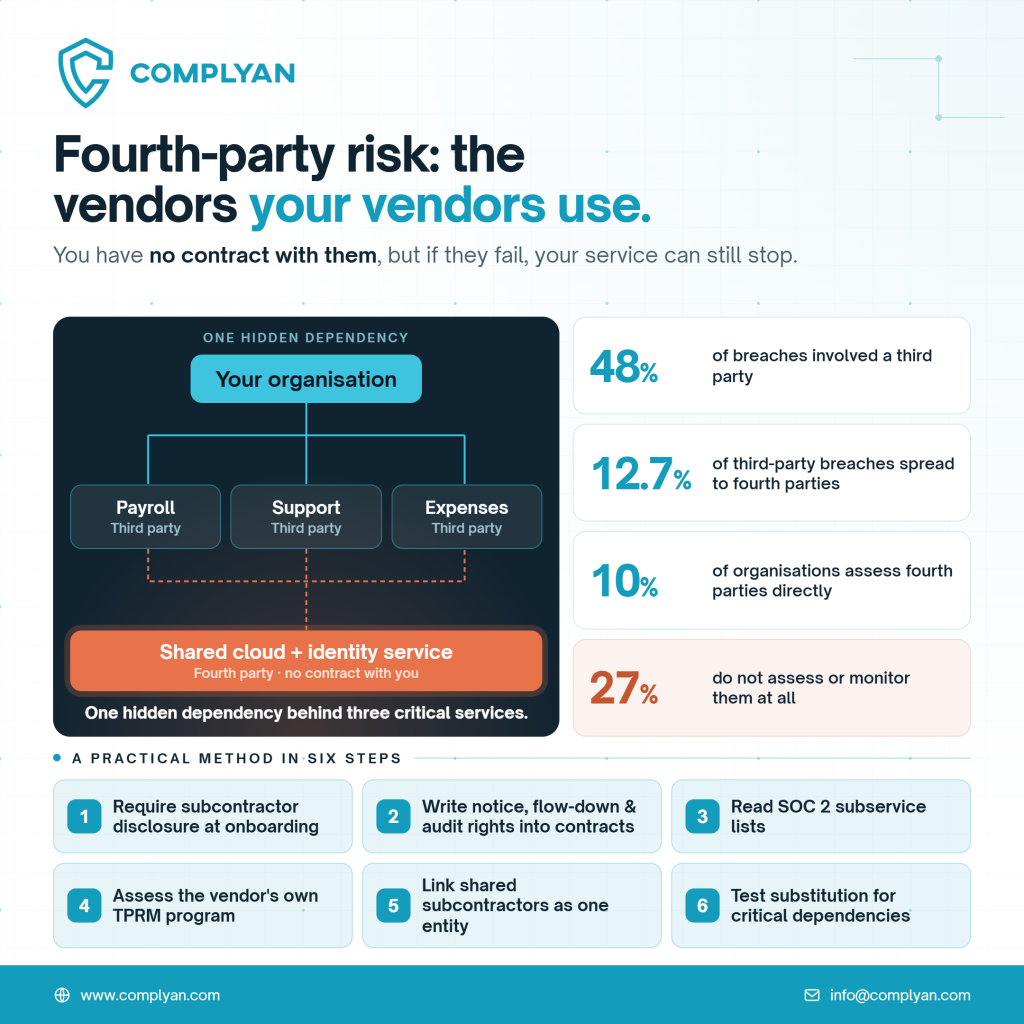
Mitratech’s 2026 predictions report cites SecurityScorecard’s Global Third-Party Breach Report, which found fourth-party breaches account for 4.5 percent of all breaches and that 12.7 percent of third-party breaches extend into fourth-party incidents. Mitratech also cites Venminder’s research: only 10 percent of organizations directly assess fourth parties, and 27 percent do not assess or monitor them at all. Most rely on an indirect check of their vendors’ own practices instead.
Why You Cannot Assess Them Directly
Rescana notes visibility comes from your contract with the direct vendor, not from any relationship with the subcontractor. Patrick Lefler’s analysis points out a further limit: a typical clause obliges a vendor to disclose its direct subcontractors and stops there, and a vendor acting in good faith often has no visibility into what its subcontractors have subcontracted. He adds that the quality of a vendor’s answer tends to track its own third-party maturity more than the real chain.
What Regulators Expect
Source | What it asks about subcontractors |
|---|---|
DORA | The register of information under Article 28(3) includes subcontracting chains, per Mitratech. Article 29 addresses concentration and subcontracting risk, and Article 30 contract terms cover permitted subcontracting and service locations, per Bitsight. Technical standards require assessing and monitoring the chain, per SmartSuite |
US interagency guidance, June 2023 | Evaluate how the third party selects and oversees subcontractors, consider notice and consent terms, and monitor reliance and locations, per Digital X Force |
EBA/GL/2026/09, published 18 September 2026 | Final guidelines on third-party risk for non-ICT services, whose definition of subcontracting covers chains and nth-party providers, per Digital X Force |
CBUAE Operational Risk Regulation | Critical Operations mapping covers third-party service providers, including intragroup entities, and their interdependencies, per the Rulebook |
CBK CORF | A Third-Party Risk Management baseline sits beside the cyber and operational resilience baselines, per Baker Tilly |
Complyan’s DORA implementation guide covers the EU regime in depth.
A Practical Method
This method combines the sources above and is practical guidance.
Require disclosure at onboarding: Mitratech’s checklist advises asking primary vendors to disclose their critical subcontractors before signing.
Write the rights into the contract: SmartSuite lists consent or notification rights for subcontracting of critical services, flow-down of security and resilience obligations, and audit rights that reach material subcontractors. Rescana adds the right to be told of material subcontractor changes.
Read the vendor’s assurance reports: Risk Publishing notes SOC 2 subservice lists give partial fourth-party visibility, and Complyan’s SOC 2 guide explains what those reports contain.
Assess the vendor’s own program: SmartSuite advises evaluating the vendor’s third-party risk program, since you rely on it to manage the fourth party.
Record subcontractors as linked entities: a fourth party behind several vendors then appears once, which is how concentration becomes visible. Lefler describes the same idea as a graph that answers which subcontractors, at any depth, support a critical function.
Test substitution: Bitsight notes NIST’s supply-chain mapping guidance asks which alternative can perform the same activity and how long it would take to start.
Questions to Put to a Critical Vendor
This list is practical guidance. Which subcontractors support the service you deliver to us, and in which countries do they operate? What data do they touch? How do you assess and monitor them? How and when will you tell us about changes and incidents? Which of them would be hard to replace? Gaps in the answers show how mature the vendor’s own program is.
Events That Should Trigger a Fresh Look
This list is practical guidance. Revisit the dependency record when a vendor announces a new subprocessor, when a known fourth party suffers a significant incident, when a vendor is acquired, when a service moves to a new hosting region, and at every contract renewal. Each can change the picture without any change to your own systems.
An Illustrative Example
This scenario is illustrative. A company’s payroll provider, support desk, and expense platform each run on the same cloud region and use the same identity service. No single vendor assessment shows it, because each lists the provider as a subcontractor. Once the three records link to one fourth-party entity, the company sees one dependency behind three critical services, asks how long each could operate without it, and decides whether to diversify or accept the risk with a review date.
Where Programs Go Wrong
Mapping everything: Rescana advises getting visibility without trying to map every vendor’s entire supply chain. Focus on critical services.
Treating every fourth party alike: weight them by the service they support and how hard they are to replace.
Relying on a one-time list: subcontractors change, so ask for updates and tie reviews to contract renewals and incidents.
Separate registers: Rescana warns a fourth-party finding can also be a concentration finding, so track them together.
No owner: each critical dependency needs a named person who decides what to do about it.
Build the Method in Complyan
This is practical guidance. Link subcontractors to each supplier in Complyan’s third-party risk management, and record concentration scenarios as scored risks in Complyan’s cyber risk management platform. Keep contract clauses, reports, and reviews attached through Complyan’s audit and compliance management platform. Complyan’s cybersecurity compliance tools map one supplier record across the frameworks that ask for it, and Complyan’s executive and board reporting shows leadership where dependencies concentrate.
Conclusion
Fourth-party risk is hidden by design: no contract, little disclosure, and failures that still reach your service. Organizations that require disclosure, write subcontractor rights into contracts, link shared dependencies, and test what happens if a critical one fails can manage the tier beneath their vendors.