


 Governance and Policy Management
CMMI AI Maturity Model 2026: What Organizations Need to Know About CMMI AIM

For years, CMMI has given organizations a structured way to answer a basic operational question: how consistently can we execute a process, measure its performance and improve it?
In 2026, that question has moved directly into AI.
Organizations are deploying copilots, machine learning systems and autonomous workflows faster than many governance programmes can keep pace. AI tools may already be producing measurable results while ownership remains unclear, approvals differ between departments and nobody can show whether performance is being measured consistently.
That gap is one reason the CMMI Institute launched CMMI Artificial Intelligence Maturity (CMMI AIM) in July 2026. The model extends the established CMMI approach into enterprise AI governance, helping organizations assess whether AI has developed into a controlled organizational capability rather than a collection of disconnected projects.
CMMI Has Moved Beyond Traditional Process Maturity
Our earlier beginner’s guide to CMMI covered the traditional progression from reactive processes at lower maturity levels to measured and continuously improved capabilities at the higher levels.
That foundation still matters. CMMI remains focused on repeatability, accountability, performance measurement and improvement.
AI adds another problem.
A company may have mature software development or service-management processes while its AI adoption remains highly inconsistent. One department may use approved enterprise AI platforms while another uploads sensitive information to public tools. A development team may measure model performance carefully while business users deploy AI-assisted workflows without defined acceptance criteria.
CMMI AIM is designed to expose those differences.
The CMMI Institute says AI-related content now extends across all 31 CMMI Practice Areas, with AI-specific additions appearing in nearly half of the practices. Its AI maturity view covers eight domains: Data, Development, People, Safety, Security, Services, Suppliers and Virtual collaboration. CMMI Institute
That makes AI maturity an organizational issue rather than something owned only by the data science team.
AI Maturity Starts With Knowing Where AI Is Being Used
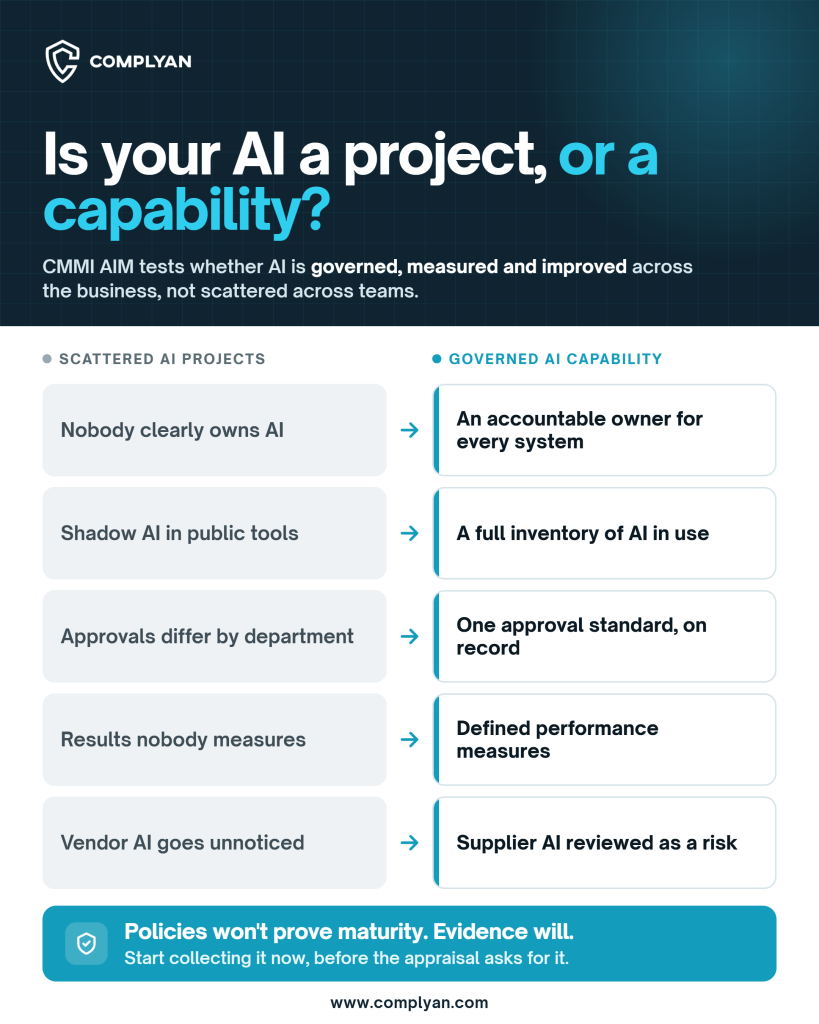
One of the harder governance problems is identifying AI use before trying to control it.
An enterprise may have sanctioned AI systems in production while employees use generative AI for research, code generation or document analysis outside formal workflows. Suppliers may also embed AI into products without the customer initially treating that service as an AI dependency.
The GTSC case study published by ISACA in August 2026 illustrates the problem clearly. GTSC found that AI use was already delivering value across the organization, but the practices around governance, ownership and measurement were not yet standardized at the enterprise level. Following its CMMI AIM pilot assessment, the company appointed a Chief AI Officer, integrated AI governance into its security and risk processes, introduced role-based training and began incorporating AI into internal quality audits.
The important lesson is not that every organization needs the same structure. It is that AI maturity cannot be measured properly when the organization does not have visibility over who is using AI, for what purpose and under which controls.
Why This Matters More Than a New Certification Line Item
Most organizations adopted AI tools faster than they built any governance around them. A team spins up a model for one workflow, another team licenses a different vendor’s assistant for something unrelated, and within a year the organization has a scattered collection of AI capabilities with no shared standard for risk, oversight, or performance measurement. This is precisely the gap CMMI AIM was built to close.
A real case study makes the mechanism concrete: GTSC applied CMMI AIM to convert a fragmented set of AI initiatives into a governed, scalable, value-driven enterprise program, giving leadership a single maturity baseline to measure AI capability against rather than a patchwork of disconnected pilots. This is the same discipline traditional CMMI has always applied to software delivery, now pointed at AI specifically: assess where capability genuinely stands, identify the gaps, and appraise progress against a recognized standard rather than an internal, self-graded claim.
AI Risk Should Be Measured as a Capability Problem
Many organizations assess AI risk system by system. CMMI AIM introduces a broader view.
A technically strong model may still operate within an immature organization. Data governance might be weak. Supplier controls may be inconsistent. Staff may have limited training. There may be no repeatable method for evaluating whether the AI system continues to deliver its intended business outcome.
CMMI AIM therefore incorporates AI across areas such as security, data management, workforce capability and supplier governance rather than treating AI risk as a single technical category. CMMI Institute
This also gives organizations a more useful way to prioritize improvement.
A maturity assessment can identify whether the major weakness is model security, unclear accountability, poor data quality or an absence of performance metrics. Improvement can then be directed toward the capability creating the risk.
The same assessment-driven approach sits behind Complyan’s Cybersecurity Maturity capability, which evaluates current processes against maturity criteria and provides a structured path for improvement. Complyan
AI Can Also Change How CMMI Work Is Performed
The relationship works in both directions. CMMI can help govern AI, while AI can reduce some of the manual effort involved in maintaining mature processes.
AI can assist with evidence review, identify gaps in documentation, summarize findings and help teams locate inconsistencies across large control sets. It can also support measurement by bringing together information that would otherwise require manual review.
The key is keeping automation tied to controlled workflows.
Complyan AI applies AI to compliance activities such as evidence review, assignments, control mapping and status tracking. That can reduce administrative effort while the underlying governance structure continues to define what must be done, who owns it and what evidence is required. Complyan
AI therefore becomes more useful when it operates within a mature process rather than replacing one.
AI Can Also Change How CMMI Work Is Performed
The connection to cybersecurity compliance is direct rather than incidental. CMMI’s traditional five levels already map cleanly onto cybersecurity maturity work: Complyan’s own cyber maturity assessment tools apply the same progression logic, moving organizations from reactive, undocumented security practices toward measured, continuously improving ones. CMMI AIM extends that logic to AI systems, which is precisely where security and compliance teams are now being asked to demonstrate oversight: model governance, data handling, explainability, and accountability for automated decisions.
An organization already running a CMMI-aligned cybersecurity program has a real head start here, since the appraisal discipline, evidence culture, and maturity mindset transfer directly. Complyan’s cross-framework mapping reflects this same principle: a control or practice validated once should count toward every framework it genuinely satisfies, rather than requiring separate proof for each new model an organization adopts
Building Toward Both Tracks Now
Establish the traditional CMMI foundation first if it does not already exist: AI maturity assessment assumes a baseline capacity for process discipline that a five-level appraisal already measures directly.
Inventory every AI system in active use before appraising anything: CMMI AIM cannot assess governance over capability nobody has mapped, and most organizations discover more shadow AI usage than expected the moment they look.
Treat AI maturity as a genuine risk and compliance function, not an IT side project: The governance, data handling, and accountability questions CMMI AIM raises are the same ones a security and compliance program already needs answered.
Map maturity work across frameworks rather than running it in isolation: Evidence proving AI governance maturity should feed the same control library supporting broader cybersecurity and privacy compliance, not sit in a separate binder nobody else references.
What 2027 Could Look Like
The next stage will likely be less about whether organizations use AI and more about whether they can prove that AI produces controlled, measurable results.
CMMI AIM already introduces independent appraisal, training and benchmarking specifically for AI maturity. GTSC, one of the pilot participants, has stated that it plans AIM and CMMI maturity appraisals in 2027.
That points toward a broader shift: AI governance may increasingly be assessed through evidence of repeatable capability rather than policy statements alone.
Organizations preparing for 2027 should therefore start collecting the evidence now: AI inventories, accountable owners, approval records, risk assessments, supplier reviews, training data, performance measures and documented improvement actions.
CMMI in 2026 Is About Proving AI Maturity
CMMI has always been concerned with whether an organization can move from inconsistent execution toward predictable and measurable performance.
CMMI AIM applies that discipline to AI.
The question for governance teams is no longer simply whether AI has been adopted. It is whether the organization can prove that AI use is governed, measured and improved with the same discipline expected from other critical business capabilities.
Complyan helps bring that evidence together through maturity assessments, governance workflows, risk management and multi-framework control mapping, giving teams a structured way to turn maturity goals into accountable work rather than another static assessment.